When you come to my office for a consultation, after we have covered what the structures look like, patients usually ask the same thing: "What is my gallbladder actually doing?"
Your Liver Never Stops Working
Your liver makes bile all day, every day. It does not wait for a meal to start working. On average, the liver produces about 600 milliliters of bile a day — a little over two cups.¹ That bile travels through the hepatic ducts and the common hepatic duct. The gallbladder branches off this system through the cystic duct, and between meals, it stores bile and concentrates it so it works more efficiently when you need it.²
The Trigger: A Hormone Called CCK
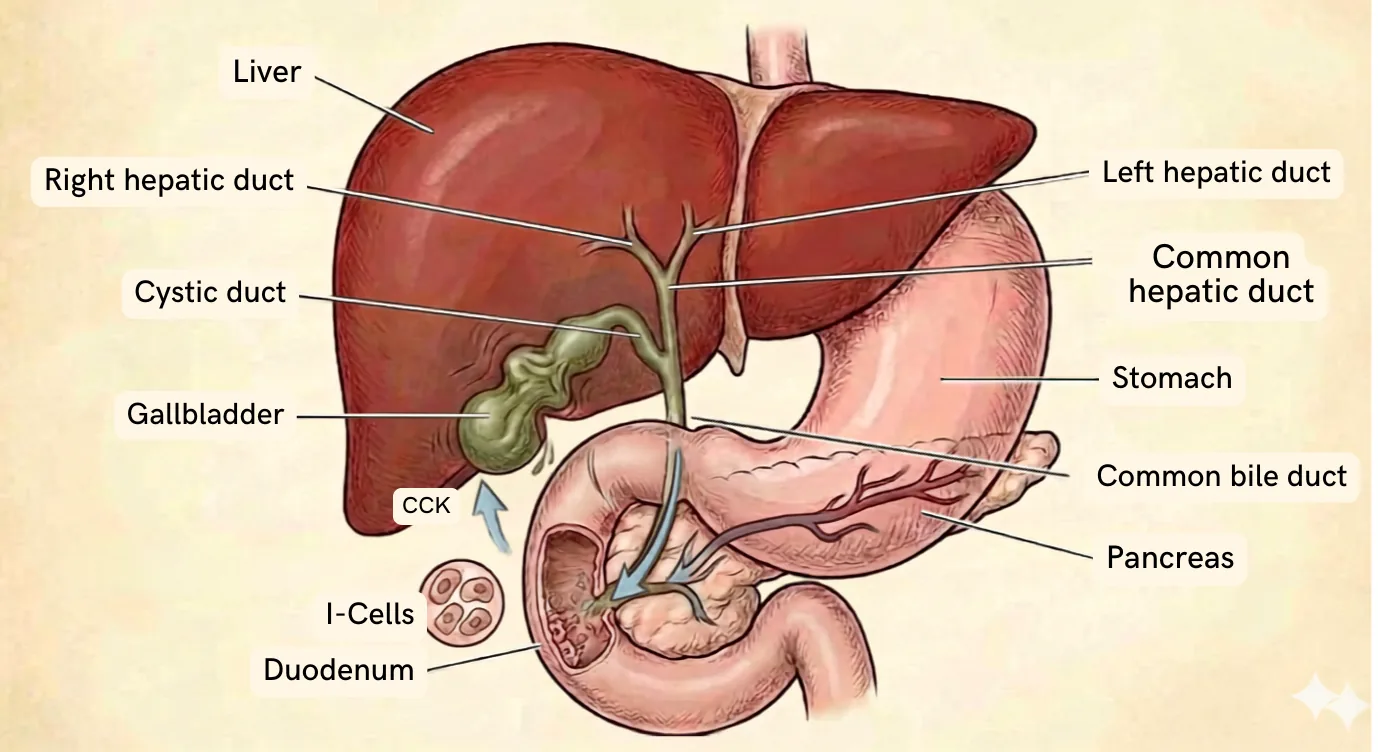
I-cells in the duodenum sense fat and release CCK, causing your gallbladder to squeeze.
The trigger for release is a hormone called cholecystokinin, or CCK. When fatty food reaches your small intestine, specialized cells there release CCK into your bloodstream. CCK does two things at once: it tells the gallbladder to contract and squeeze stored bile out through the cystic duct, and it relaxes the sphincter of Oddi, the small muscular valve guarding the end of the bile duct, so bile can pass through into the intestine.²
Where Bile and Pancreatic Juice Meet
Bile travels down the common bile duct and joins the pancreatic duct at the ampulla of Vater. Bile and pancreatic juice enter your small intestine together at that single point.³
How Fat Actually Gets Digested
Once bile arrives, it goes to work. Fat does not dissolve in water on its own, so bile breaks large fat globules into smaller droplets — a process called emulsification. Smaller droplets give pancreatic lipase, a digestive enzyme from the pancreas, far more surface area to act on. That is how fat actually gets digested and absorbed into your body.³
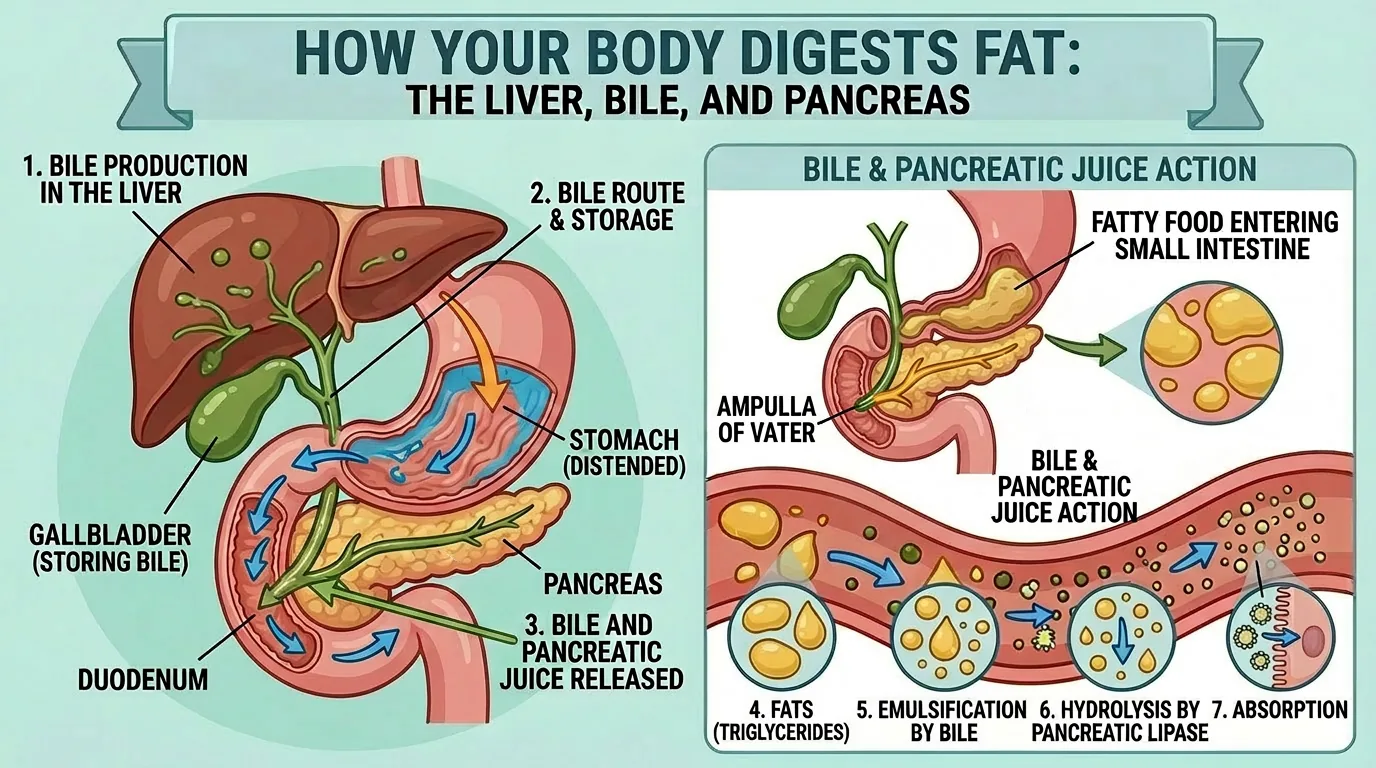
The complete pathway, from gallbladder squeeze to fat digestion in the small intestine.
This entire pathway — from liver to gallbladder to small intestine — has to work in sequence every single time you eat.
Resident Pearl
Gallbladder emptying can be measured directly with a CCK-stimulated hepatobiliary scintigraphy scan (HIDA with sincalide), reported as a gallbladder ejection fraction. A GBEF below roughly 35–38% at 60 minutes after CCK infusion is the diagnostic threshold used for biliary dyskinesia — a condition covered later in this series.⁴ It is the same CCK pathway described above, just tested pharmacologically rather than physiologically.
Up next: Part 3, Pathology — how gallstones form.
References
1. Almajid AN, Sugumar K. Physiology, Bile. StatPearls [Internet]. Treasure Island, FL: StatPearls Publishing; updated September 12, 2022. https://www.ncbi.nlm.nih.gov/books/NBK542254/
2. Hundt M, Basit H, John S. Physiology, Bile Secretion. StatPearls [Internet]. Treasure Island, FL: StatPearls Publishing; updated September 26, 2022. https://www.ncbi.nlm.nih.gov/books/NBK470209/
3. Behar J. Physiology and Pathophysiology of the Biliary Tract: The Gallbladder and Sphincter of Oddi — A Review. International Scholarly Research Notices. 2013. https://onlinelibrary.wiley.com/doi/10.1155/2013/837630
4. DiBaise JK, Oleynikov D. Does gallbladder ejection fraction predict outcome after cholecystectomy for suspected chronic acalculous gallbladder dysfunction? A systematic review. Am J Gastroenterol. 2003;98(12):2605–2611. https://doi.org/10.1111/j.1572-0241.2003.08772.x