The short version
- Inguinal hernias in women are less common and more often missed. The pain gets blamed on other causes first.
- Femoral hernias are more common in women and riskier if left untreated; the robotic view lets both areas be checked in the same operation.
- The (not the spermatic cord) runs through the canal in women, and that changes how the repair is planned.
- If pain near the crease at the top of your thigh has no clear explanation, ask to be evaluated specifically for a hernia.
A quick summary. The full details are below, and none of it replaces an exam.
What is a female inguinal hernia?
A female hernia is a weak spot in a woman's lower abdominal wall, just above the crease at the top of the thigh, where fat or part of the intestine pushes through. This creates a bulge, and often discomfort or pain, especially with lifting, coughing, or prolonged standing. Inguinal hernias are less common in women than in men, but they still happen, and they're sometimes overlooked because pain in this area in women gets attributed to other causes first.
Female inguinal hernia anatomy: the inguinal canal in women
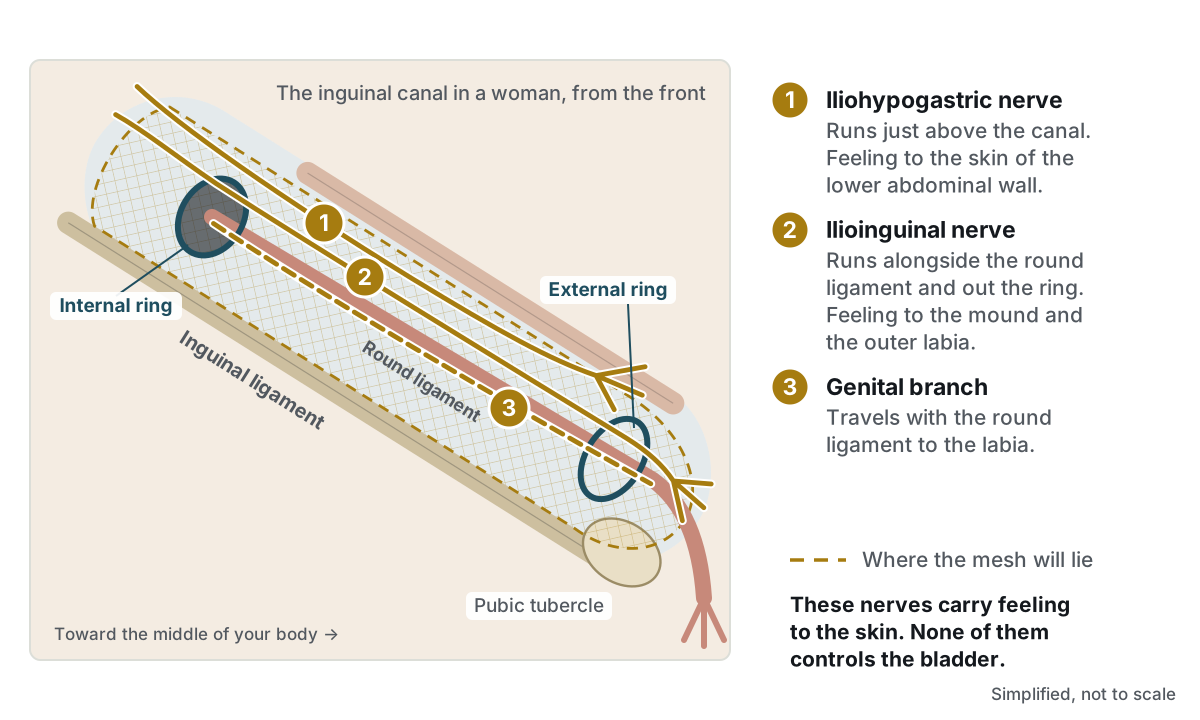
In a woman, the inguinal canal is a short tunnel through the muscles of the lower belly wall, just above the crease at the top of the thigh, and the round ligament runs through it instead of the spermatic cord. It runs from an opening on the inside, called the internal ring, to an opening under the skin, called the external ring. The round ligament is a thin cord of tissue that goes from the top of the uterus to the skin of the labia.
Three small skin nerves run through or beside the canal: the iliohypogastric nerve, the ilioinguinal nerve, and the genital branch of the genitofemoral nerve. They carry feeling to the skin of the lower belly, the mound above the labia, and the outer labia. Just below the canal, under the inguinal ligament, is the femoral space, where the large blood vessels to the leg pass. A femoral hernia comes through there.
Watch the video below to see what happens in a girl before birth, and where each of the three hernias comes from.
Why inguinal hernias look different in women
Inguinal hernias in women are less common than in men, the bulge is often smaller, and femoral hernias are more common. In men, the inguinal canal carries the spermatic cord. In women, it carries the round ligament, a thin cord of tissue that runs from the uterus down to the crease at the top of the thigh. That difference changes both how a hernia tends to form and what has to be protected during repair.
- Femoral hernias are more common in women. These sit just below the main inguinal canal, near the blood vessels that run into the thigh, and carry a higher risk of the trapped tissue losing its blood supply if left untreated.
- The can occasionally involve the ovary or fallopian tube. This is uncommon, but it's one reason imaging and a careful exam matter before surgery.
- The bulge itself is often smaller and harder to feel than in men, since there's no scrotum for it to extend into.
Why the diagnosis is sometimes missed
In women, pain near the crease at the top of the thigh is commonly attributed first to ovarian cysts, round ligament pain in pregnancy, endometriosis, or hip problems. Because the hernia itself can be subtle on exam, it sometimes takes longer to reach the right diagnosis than it would in a man with the same problem. If that pain doesn't have a clear explanation, it should be evaluated specifically for a hernia.
Three types of hernia in this area
- Indirect inguinal hernia: comes through the internal ring, the opening the round ligament passes through, and follows the round ligament down the canal.
- Direct inguinal hernia: develops later in life from general wear and weakening of the floor of the canal.
- Femoral hernia: sits just below the inguinal canal, near the blood vessels that travel into the thigh. It is more common in women than in men, and more likely to become stuck.
What happens to the round ligament during repair?
The round ligament is a thin cord of tissue that runs from the top of the uterus, through the inguinal canal, to the skin of the labia. During a robotic repair, I usually divide it so the mesh can lie flat. I divide it at the lining of the abdomen, away from the small nerve that travels beside it. Most women notice no change afterward.
What is the round ligament, and what is the matching part in men?
In adult women the round ligament does very little. The uterus is held in place mainly by stronger ligaments deep in the pelvis and by the muscles of the pelvic floor.
In men, the structure that runs through this same opening is the spermatic cord. It carries the tube that moves sperm from the testicle and the blood vessels that keep the testicle alive. Men need both, so the spermatic cord is never cut. When I repair a hernia in a man, I peel the lining of the abdomen off the cord and lay the mesh flat over it.
Why do you divide it?
To repair any inguinal hernia, I peel the lining of the abdomen back and lay one flat piece of mesh over the whole weak area, including the space where femoral hernias form. The round ligament runs right through the middle of that area. I can free the hernia sac from the ligament, so the question is what to do with the ligament itself.
Keeping it means one of two extra steps: cutting a slit in the mesh so it fits around the ligament, or opening the lining along the ligament and freeing it along its whole length.¹,² Unlike the spermatic cord in men, the round ligament does very little in an adult woman. Dividing it lets one whole piece of mesh lie flat, with no slit, and makes the mesh easier to place. Studies of more than 1,000 women found that dividing the ligament made the operation shorter, with no difference in pain, numbness, prolapse (the uterus dropping), or the hernia coming back.¹,³
Will I notice anything afterward?
Most women notice nothing. A small nerve called the genital branch of the genitofemoral nerve runs with the round ligament to the skin of the labia and the mound just above it. I divide the ligament at the lining of the abdomen, before the ligament and that nerve come together, so the nerve is left alone. If the nerve is cut, you may have a numb spot there, and that numbness may not come back.
Does it affect a future pregnancy?
There is no known reason that dividing the round ligament on one side would affect a future pregnancy. One study followed about 400 women for three and a half years and found no effect on later pregnancy or childbirth.⁴ That is not enough women to be certain.³ If you plan to become pregnant in the future, tell me before surgery. In that case I keep the round ligament.
How I repair an inguinal hernia in a woman
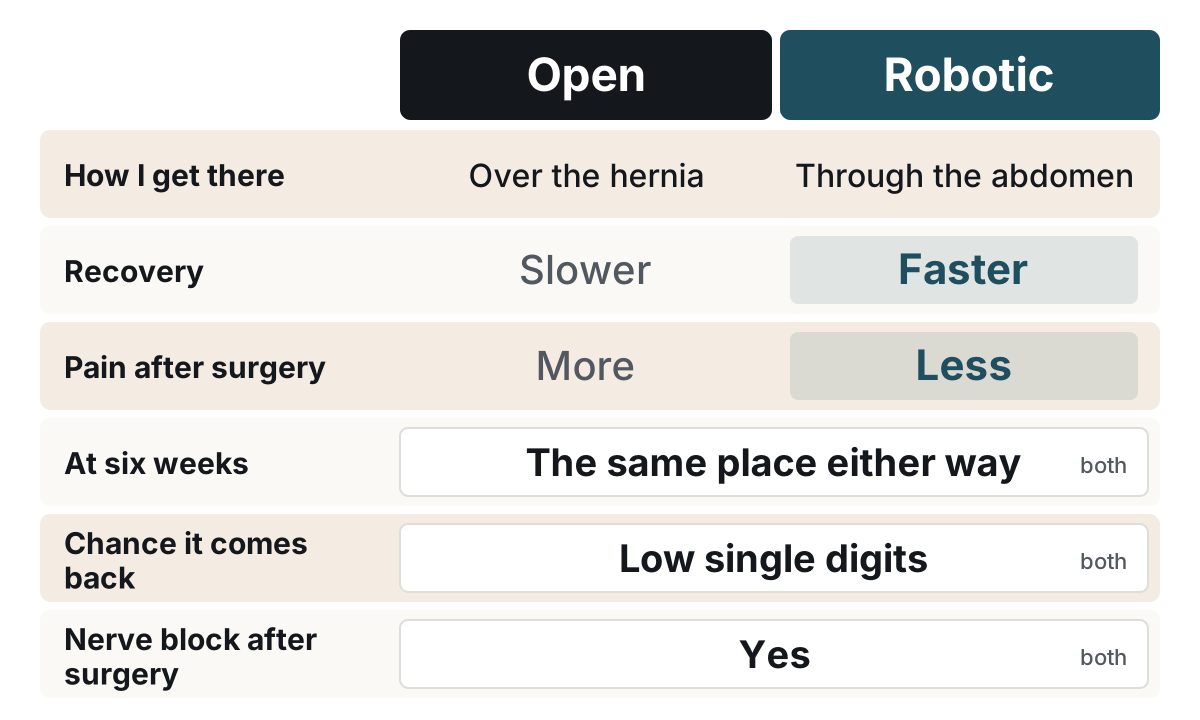
For most women I recommend a robotic repair, because from inside the abdomen I can check the inguinal and femoral spaces in the same operation. I can also repair it through an open incision, depending on your anatomy, hernia size, prior surgical history, and your own preference. Both approaches use mesh to reinforce the repair. Choose a guide below for the full details on each.
Robotic vs. open repair, side by side
| Robotic-Assisted Repair | Open Repair | |
|---|---|---|
| Incisions | Three incisions, about 1cm each | One incision, about 10cm, just above the crease at the top of the thigh |
| Anesthesia | General anesthesia | Local, regional, or general anesthesia. Without general anesthesia, you must be able to lie still during the repair. |
| Hospital stay | Most patients go home the same day | Most patients go home the same day |
| Bladder catheter | Sometimes used during surgery to keep the bladder empty | Not used |
| Return to work and normal activity | Generally shorter than open repair | Generally takes a bit longer than minimally invasive repair |
| Lifting limit after surgery | Nothing over 10 to 15 pounds until your 2 week visit, when we reassess | Nothing over 10 to 15 pounds until your 2 week visit, when we reassess |
| Closure | Absorbable stitches under the skin and waterproof skin glue, no staples or visible stitches | Absorbable stitches under the skin and waterproof skin glue, no staples or visible stitches |
| Water on incisions | Shower the day of surgery, pat dry. No soaking in a tub or pool for 4 weeks | Shower the day of surgery, pat dry. No soaking in a tub or pool for 4 weeks |
| Nerve block for pain | Often given near the nerves in this area | Often given to numb the nerves in this area |
Source for return-to-work comparison: SAGES patient education materials.
Robotic-Assisted Repair
Three small incisions in the upper abdomen, a view of the femoral space at the same time, and a same-day recovery for most patients.
Read more →Open Repair
A single incision directly over the hernia, done under local, regional, or general anesthesia. Without general anesthesia, you must be able to lie still during the repair. Also typically a same-day procedure.
Read more →Common questions about inguinal hernia in women
How common is an inguinal hernia in females?
Inguinal hernias are much less common in women than in men, but they do happen. In women, the most common kind is an indirect inguinal hernia, which follows the round ligament into the inguinal canal.
Why is an inguinal hernia in a woman often missed?
The bulge is often small and hard to feel. Groin pain in a woman is often blamed first on an ovarian cyst, endometriosis, or a hip problem. If your pain has no clear cause, ask to be examined for a hernia.
Are femoral hernias more common in women?
Yes. A femoral hernia forms just below the inguinal canal, next to the large vein of the leg. It is more common in women than in men and more likely to trap intestine, so it should be repaired.
Which repair do you recommend for women?
I usually recommend a robotic repair. Through three small incisions, I can check the inguinal and femoral spaces in the same operation and cover them with one flat piece of mesh.
What happens to the round ligament during my repair?
I usually divide it at the lining of the abdomen, before it meets the small nerve that runs to the labia, so the mesh can lie flat and the nerve is left alone. If you plan to become pregnant in the future, tell me before surgery, and I keep the round ligament.
How much can I lift after surgery?
Nothing over 10 to 15 pounds for 2 weeks. A gallon of milk is a rough idea of 10 pounds. I see you in clinic at 2 weeks, and we reassess then.
References
1. Silveira CAB, de Figueiredo SMP, Rasador ACD, et al. Round ligament management during minimally invasive groin hernia repair in women: a systematic review and meta-analysis. Surg Endosc. 2024;38(4):1731-1739. https://doi.org/10.1007/s00464-024-10721-1
2. Lin R, Lin X, Yang Y, et al. Laparoscopic transabdominal preperitoneal repair for female patients with groin hernias. BMC Womens Health. 2023;23(1):422. https://doi.org/10.1186/s12905-023-02527-5
3. Zhong W, Zhang L, Zhong JQ, et al. Comparison of outcomes between preservation or division of the uterine round ligament in laparoscopic groin hernia repair in females: a meta-analysis and trial sequential analysis. Hernia. 2024;28(2):343-354. https://doi.org/10.1007/s10029-023-02917-6
4. Liu Y, Liu J, Xu Q, et al. Objective follow-up after transection of uterine round ligament during laparoscopic repair of inguinal hernias in women: assessment of safety and long-term outcomes. Surg Endosc. 2022;36(6):3798-3804. https://doi.org/10.1007/s00464-021-08696-4