The short version
- An hernia is a bulge at or near the navel; in adults it does not close on its own.
- Whether is used depends mainly on the size of the muscle defect: larger than 2 cm, recurrent hernias, and higher BMI generally favor mesh.
- Dr. Rodriguez repairs umbilical hernias either through a small open incision or robotically. The comparison below puts them side by side, and rebuilding a natural, inward-appearing navel is part of the plan either way.
- A bulge that is suddenly stuck out, firm, and painful is an emergency. Go to the ER.
A quick summary. The full details are below, and none of it replaces an exam.
What is an umbilical hernia?
An hernia happens when tissue from inside your abdomen pushes through a weak spot in the abdominal wall at or near your navel. That tissue might be fat, the lining around your intestines (omentum), or in some cases a loop of intestine itself, creating a visible or feelable bulge.
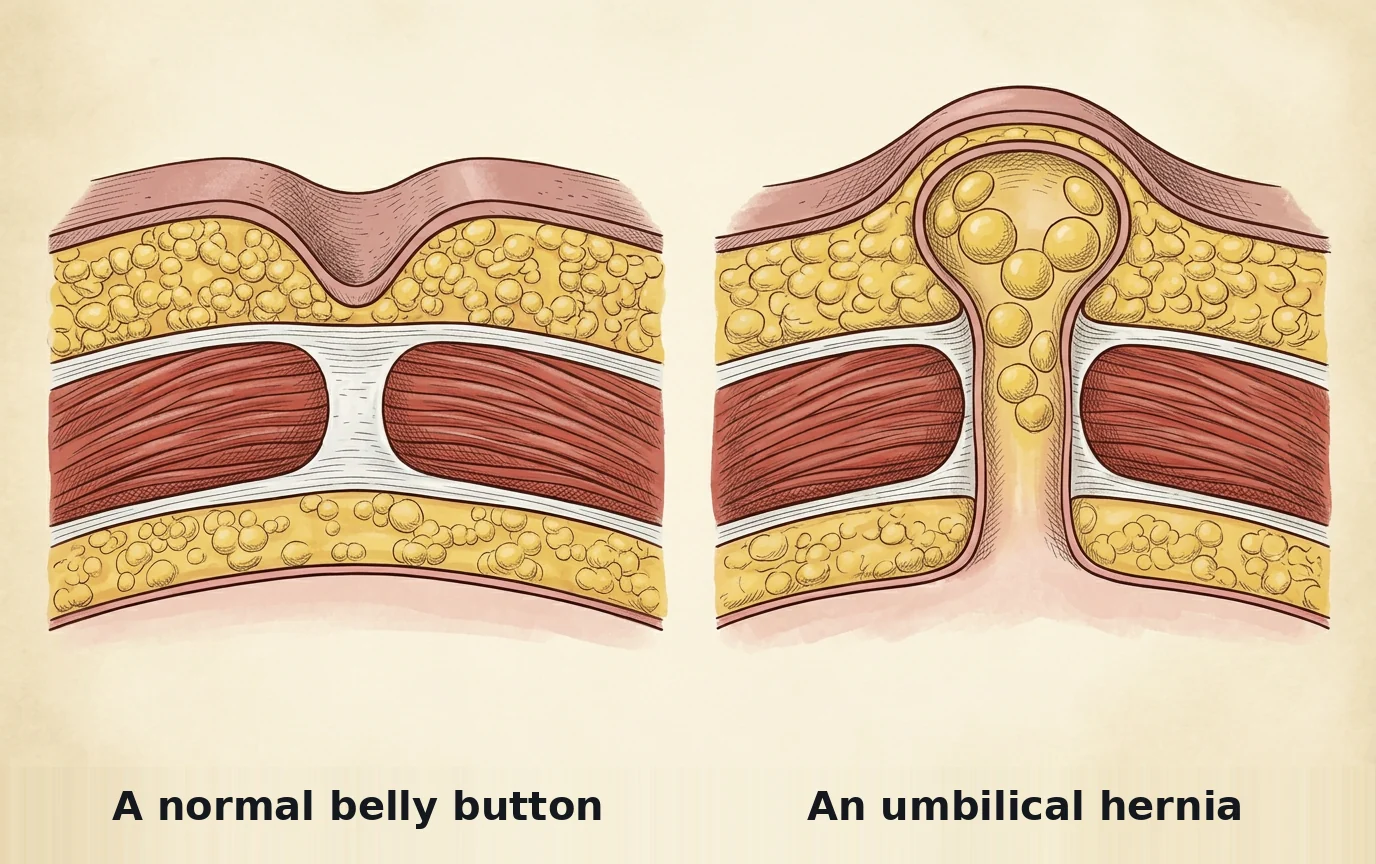
Types of umbilical hernia
- Reducible: the bulge goes back in when gently pushed.
- : the bulge stays out, even with pressure.
- : the blood supply to the trapped tissue is cut off. This is a surgical emergency, and if this is suspected, you'll be sent straight to the Emergency Department.
- Recurrent: a hernia that has been repaired before and has come back.
When is surgery recommended?
Surgery is usually recommended once a hernia causes symptoms, keeps growing, or gets in the way of daily life. The decision about whether mesh is needed depends mainly on the size of the actual defect in your abdominal wall muscle (not how big the bulge looks from outside), your BMI, and whether this is a repeat hernia.
- Defect 2 cm or smaller: a suture-only repair (no mesh) may be appropriate for some patients.
- Defect larger than 2 cm, a recurrent hernia, or a higher BMI: mesh is generally recommended to lower the chance it comes back.
- Profession and activity level also factor in: patients whose work or lifestyle involves heavy lifting or other vigorous activity may be offered mesh even for a smaller defect, since that activity puts more ongoing strain on the repair.
Can I wait to fix my hernia?
If your hernia does not bother you, waiting is a safe choice. This is called watchful waiting. When a hernia causes no symptoms, the medical risk of waiting is low.
A hernia will never heal on its own. Surgery is the only way to fix it.
If your hernia is getting bigger, I recommend fixing it sooner. A smaller hernia is easier to repair, and the recovery is easier too. Waiting adds little medical risk, but a larger hernia can change the operation you need and how long it takes to recover.
Two ways this is repaired
Dr. Rodriguez repairs umbilical hernias either through a traditional open incision or robotically, depending on the size of the defect, your BMI, whether the hernia has come back before, and your own preference. Both approaches close the weak spot and, when needed, reinforce it with mesh, and both aim to restore a natural, inward-appearing navel. Choose a guide below for the full details on each.
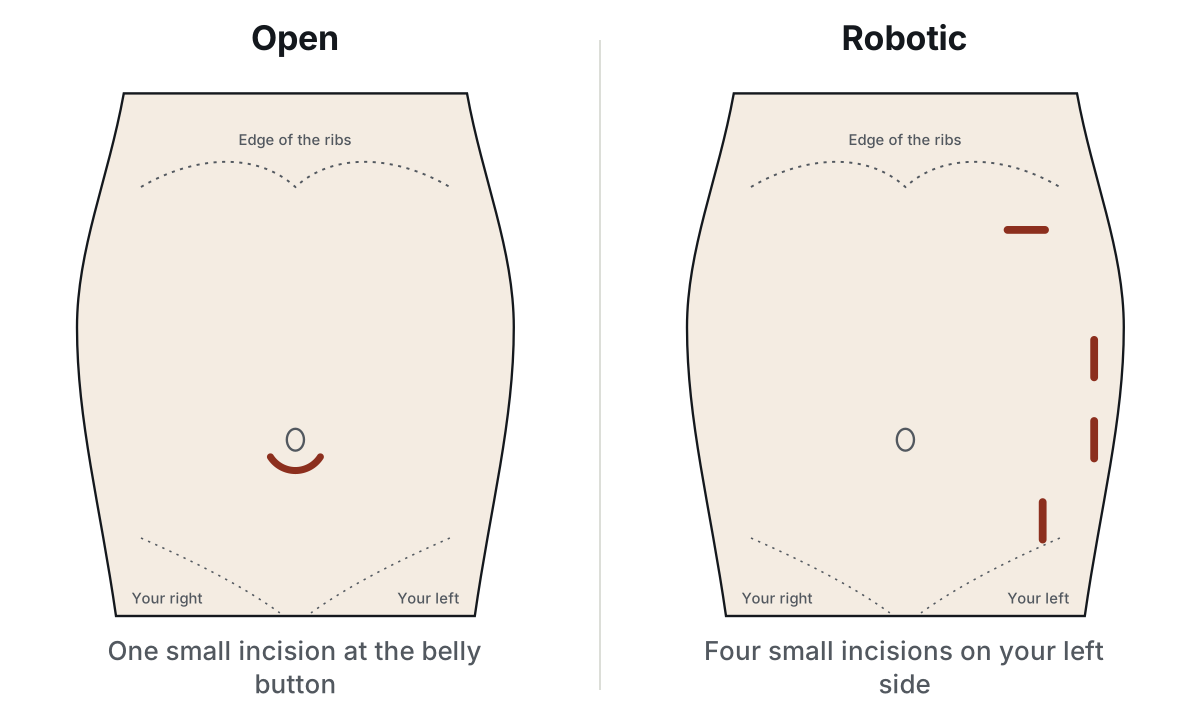
Open vs. robotic repair, side by side
| Robotic-Assisted Repair | Open Repair | |
|---|---|---|
| Incisions | Four small incisions, about 1cm each, placed off to the side of the navel | One small incision at or just beneath the navel |
| Anesthesia | General anesthesia | General anesthesia |
| Mesh | Allows wide mesh overlap around the defect, which can improve durability | Suture-only suits many smaller hernias; mesh is added for larger or recurrent hernias |
| Navel reconstruction | Rebuilding a natural, inward-appearing navel is part of the plan | Rebuilding a natural, inward-appearing navel is part of the plan |
| Hospital stay | Most patients go home the same day | Most patients go home the same day |
| Lifting limit after surgery | Nothing over 10 pounds until your 2 week visit, when we reassess | Nothing over 10 pounds until your 2 week visit, when we reassess |
| Closure | Absorbable stitches under the skin and waterproof skin glue, no staples or visible stitches | Absorbable stitches under the skin and waterproof skin glue, no staples or visible stitches |
| Water on incisions | Shower the day of surgery, pat dry. No soaking in a tub or pool for 4 weeks | Shower the day of surgery, pat dry. No soaking in a tub or pool for 4 weeks |
Guidance on when mesh is used reflects the EHS/AHS umbilical & epigastric hernia guidelines and Dr. Rodriguez's practice.
Robotic-Assisted Repair
Four small incisions off to the side of the navel, a 3D console-guided view, wide mesh overlap, and a same-day recovery for most patients.
Read more →Open Repair
A single small incision at the navel, suture-only for many smaller hernias, with mesh added for larger or recurrent ones. Also typically a same-day procedure.
Read more →