The short version
- An hernia is a groin bulge from tissue pushing through a natural weak spot, often with discomfort when lifting, coughing, or straining.
- It will not heal on its own; both open and robotic repair reinforce the weak spot with .
- Which approach fits you depends on your anatomy, hernia size, surgical history, and preference. The comparison table below puts them side by side.
- Most patients go home the same day with either approach.
A quick summary. The full details are below, and none of it replaces an exam.
What is an inguinal hernia?
An inguinal hernia happens when tissue, often part of the intestine or surrounding fat, pushes through a weak spot in your lower abdominal wall, in the groin area. This creates a bulge, and often discomfort or pain, especially when lifting, coughing, or straining. Not every ache in that area means you have a hernia, which is why an exam matters.
Why does this happen?
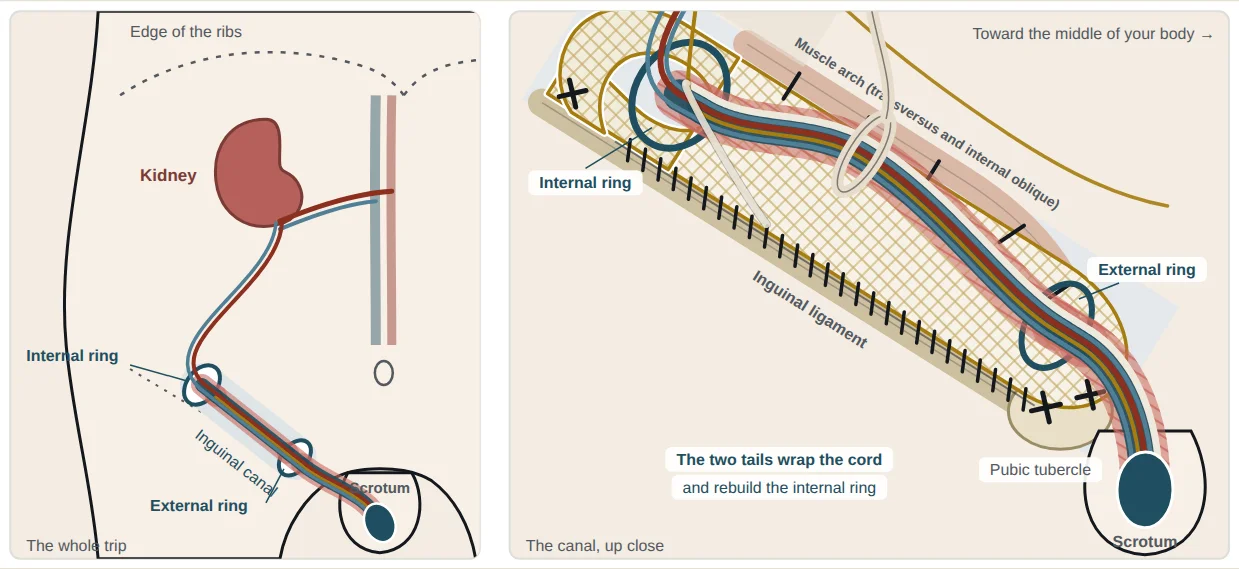
The groin area naturally has a passage called the inguinal canal. While a baby is developing, this canal is where the testicles travel down into the scrotum (in males). That process leaves a natural weak spot in the abdominal wall for everyone, which can widen over time or under strain.
Three types of hernia in this area
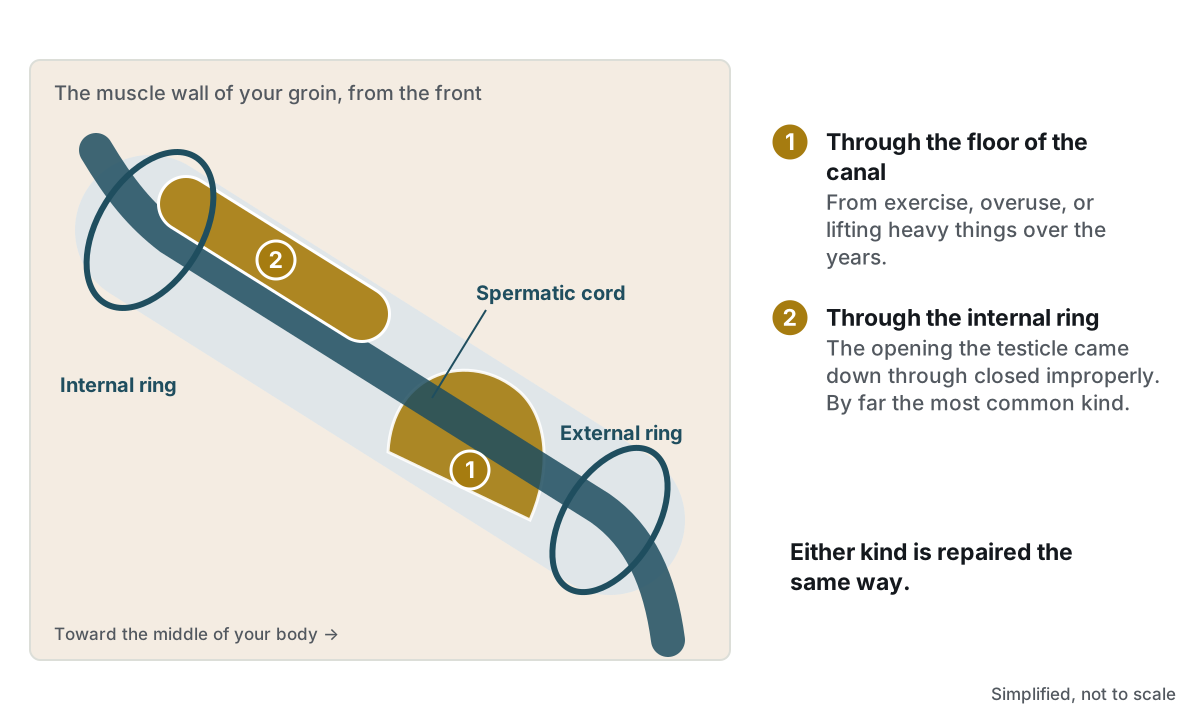
- Indirect inguinal hernia: the most common type. Often present from birth, it follows the same path the testicles took during development.
- Direct inguinal hernia: develops later in life from general wear and weakening of the abdominal wall muscles.
- : less common, and located just below the main inguinal area, near the blood vessels that travel into the thigh. This type is more common in women.
See it happen: the testicle's trip and the two kinds of hernia, step by step ↓
Can I wait to fix my hernia?
If your hernia does not bother you, waiting is a safe choice. This is called watchful waiting. When a hernia causes no symptoms, the medical risk of waiting is low.
A hernia will never heal on its own. Surgery is the only way to fix it.
If your hernia is getting bigger, I recommend fixing it sooner. A smaller hernia is easier to repair, and the recovery is easier too. Waiting adds little medical risk, but a larger hernia can change the operation you need and how long it takes to recover.
Two ways this is repaired
Dr. Rodriguez repairs inguinal hernias either robotically or through a traditional open incision, depending on your anatomy, hernia size, prior surgical history, and your own preference. Both approaches use mesh to reinforce the repair. Choose a guide below for the full details on each.
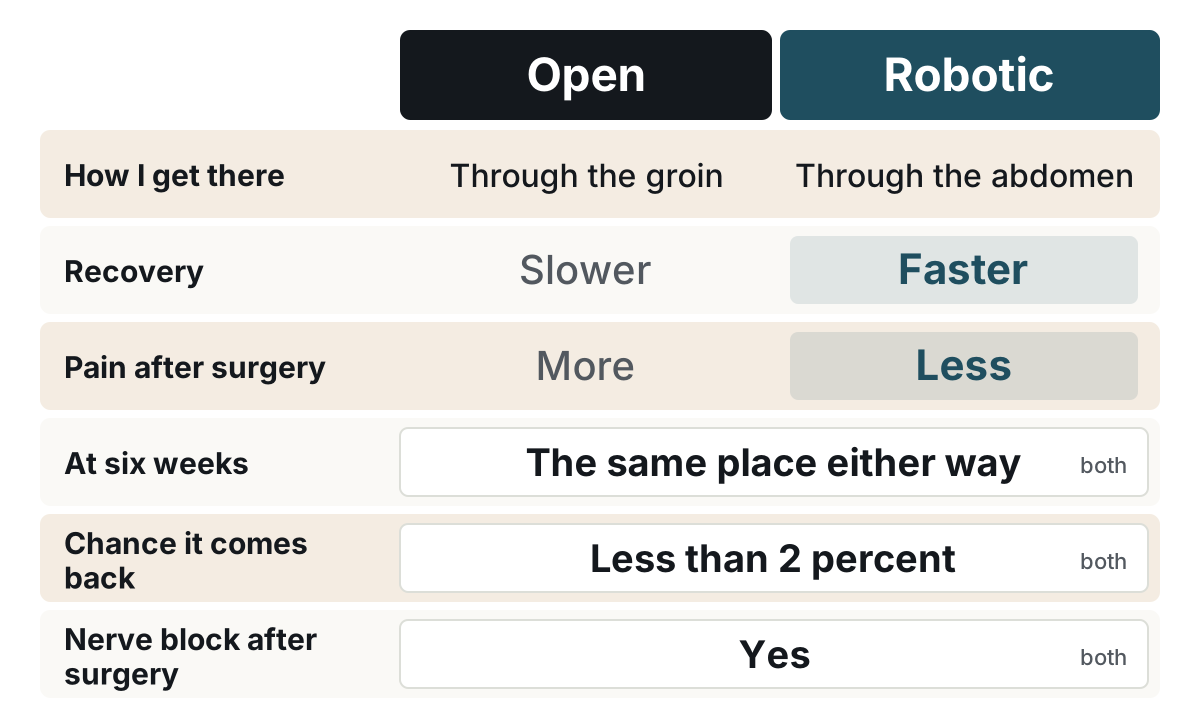
Robotic vs. open repair, side by side
| Robotic-Assisted Repair | Open Repair | |
|---|---|---|
| Incisions | Three incisions, about 1cm each | One incision, about 10cm, just above the groin crease |
| Anesthesia | General anesthesia | Typically general anesthesia |
| Hospital stay | Most patients go home the same day | Most patients go home the same day |
| Bladder catheter | Sometimes used during surgery to keep the bladder empty | Not used |
| Return to work and normal activity | Generally shorter than open repair | Generally takes a bit longer than minimally invasive repair |
| Lifting limit after surgery | Nothing over 10 pounds until your 2 week visit, when we reassess | Nothing over 10 pounds until your 2 week visit, when we reassess |
| Closure | Absorbable stitches under the skin and waterproof skin glue, no staples or visible stitches | Absorbable stitches under the skin and waterproof skin glue, no staples or visible stitches |
| Water on incisions | Shower the day of surgery, pat dry. No soaking in a tub or pool for 4 weeks | Shower the day of surgery, pat dry. No soaking in a tub or pool for 4 weeks |
| Nerve block for pain | Often given near the groin nerves | Often given to numb the groin nerves |
Source for return-to-work comparison: SAGES patient education materials.
Robotic-Assisted Repair
Three small incisions in the upper abdomen, a 3D console-guided view, and a same-day recovery for most patients.
Read more →Open Repair
A single incision directly over the hernia, done under local, regional, or general anesthesia. Also typically a same-day procedure.
Read more →