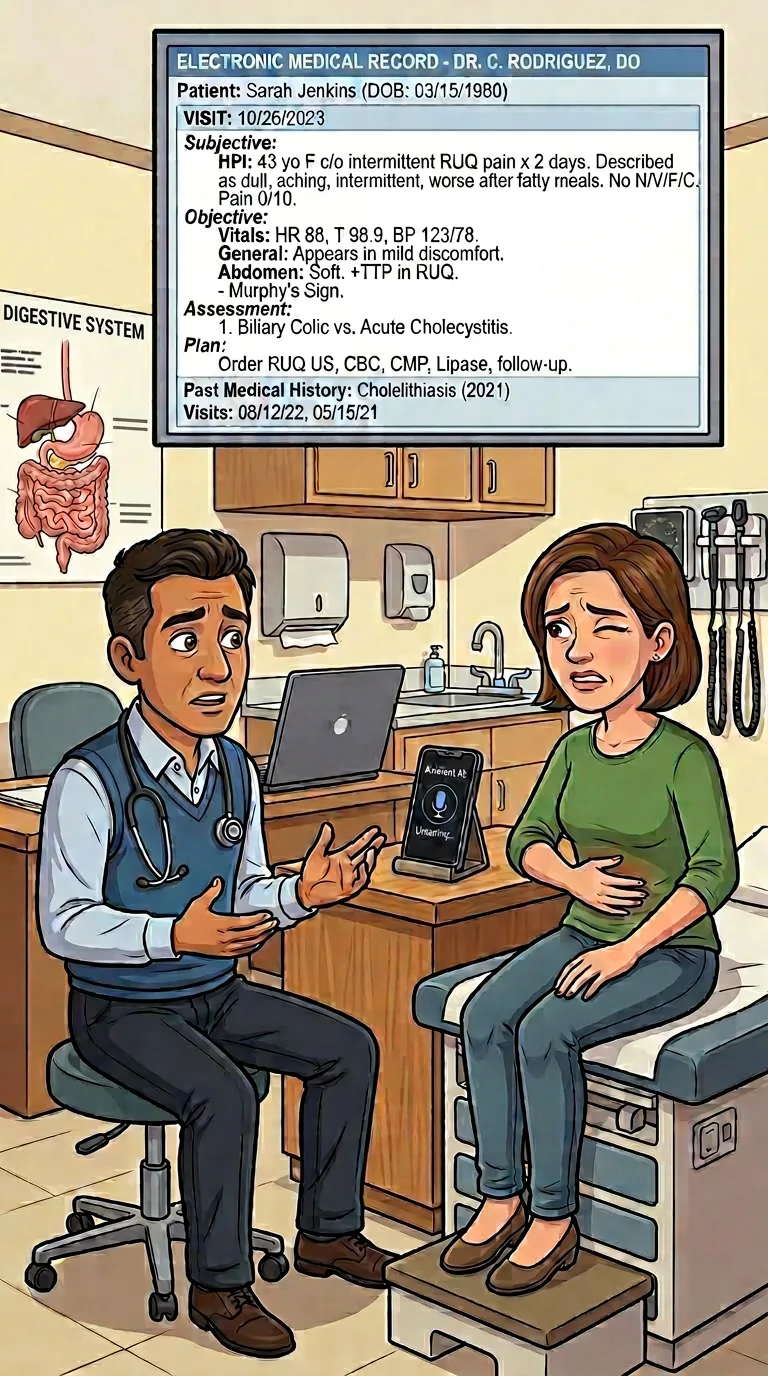
Since the beginning of medicine, the post-visit note has been a persistent inefficiency. How do you use technology to make clinic notes faster -- ambient AI? Talk-to-text? "Dot phrases"? My answer: I use all three.
Ambient AI
In my practice, we use Epic. I recently started using DAX Copilot, and I've found it to be an invaluable tool -- it doesn't forget a single detail of the clinical encounter. Using it day to day, I've noticed a few real benefits:
- I have more eye contact with patients
- I spend less time at a keyboard after hours
- I review patients' medication lists and the reason each medication is being taken, and that shows up in the assessment and plan section of my notes -- which helps a lot on the day of surgery
- It creates detailed notes that actually reflect the conversation, not a summary of it
To help it capture an accurate, specific exam, I have to say my physical exam findings out loud -- for example, "there is tenderness to palpation in the right upper quadrant." I also have to restate things in clinical terms when a patient describes them in their own words, like saying "you have right upper quadrant pain" after a patient tells me "I have pain here."
Talk-to-Text
I take a "trust but verify" approach with ambient AI. I read through what it puts together and use Dragon to make corrections or add detail. I took touch typing in high school, but I'm faster with talk-to-text.
"Dot Phrases"
Most of my elective practice is robotic-assisted surgery: gallbladder removal and abdominal hernia repairs of all kinds. For roughly 70-80% of the procedures I perform, I have a "dot phrase" that covers my standard consent discussion in clinic: the surgical approach, common risks, the steps we take to reduce those risks, and what to expect after surgery. For gallbladder surgery, a simple ".crodchole" pulls in the basics. Anatomy, physiology, the "critical view of safety," and more.
I couldn't tell you exactly how much time each of these tools saves on a given note. But last Monday, I saw 15 patients by 3:00pm. All notes were done, orders were in, and charges were submitted by 3:15pm. I call that a win. It took time, practice, trial and error, and a willingness to keep adjusting -- but it's been well worth the effort.