More than 750,000 cholecystectomies are performed in the United States every year.¹ It's one of the most common operations in the country. Patients ask plenty of questions about how it will go, but almost nobody asks which tool performs it. Surgeons themselves don't agree on the answer. Ask five and you'll get five different takes: always use the robot, only for complex cases, only to train residents, never because it's too expensive, or never because "if laparoscopy isn't broken, don't fix it." That range of opinion, among people who all trained the same way, is itself worth taking seriously.
I've spent the last several weeks digging through the research to sort through that disagreement, for my patients and for myself. This is the first of a three-part series. Today we're looking only at elective cholecystectomy: a scheduled surgery on a gallbladder that is usually not inflamed, where the anatomy is closest to normal appearing. Part 2 will cover EGS (Emergency General Surgery) cases: the on-call gallbladders, which are typically inflamed and where the anatomy can be more difficult to discern. Part 3 is where I tell you what I actually do in my own practice, and why.
I'm structuring it this way because it's how we're trained to think in medicine. You learn normal anatomy before you learn to recognize pathology. This series follows that same order: the near-normal anatomy first, the distorted anatomy second.
A word on the evidence before we start
Almost every study below is retrospective, meaning researchers looked back at outcomes after the fact rather than randomly assigning patients to one approach or the other. Surgeons and patients chose their own path, which means the two groups may differ in ways the statistics can't fully correct for. That doesn't make this evidence worthless. It means I'll tell you, study by study, how it was built, and I'll be careful to separate what's statistically significant from what's actually significant to you as a patient. A finding can clear a p-value threshold in a study of 100,000 patients and still amount to a difference measured in hours, not days.
The case for robotic: elective
The largest piece of evidence here is ROBOCOP, from Abou Assali, et al.: a retrospective analysis of 116,771 elective patients treated between 2020 and 2022, drawn from the Intuitive Custom Hospital Analytics Database.² Patients weren't randomized; group demographics were balanced statistically after the fact using propensity weighting, and more than 20% of the cases were robotic. With that caveat in mind, the study found lower conversion to open surgery (OR 0.51, 95% CI 0.42-0.61, p<.001), lower readmission (OR 0.89, p=.008), and fewer hospital-acquired complications (OR 0.71, p<.001) with robotic.
The same study found zero bile duct injuries in 23,581 robotic cases, compared with 15 injuries in 93,122 laparoscopic cases (p=.009).² That's a striking number, and it's worth discussing. But a study that finds zero events in one group doesn't prove the true risk is zero; it means the risk is low enough that this particular sample size didn't catch an event. Zero-event statistics deserve real caution before they become a headline.
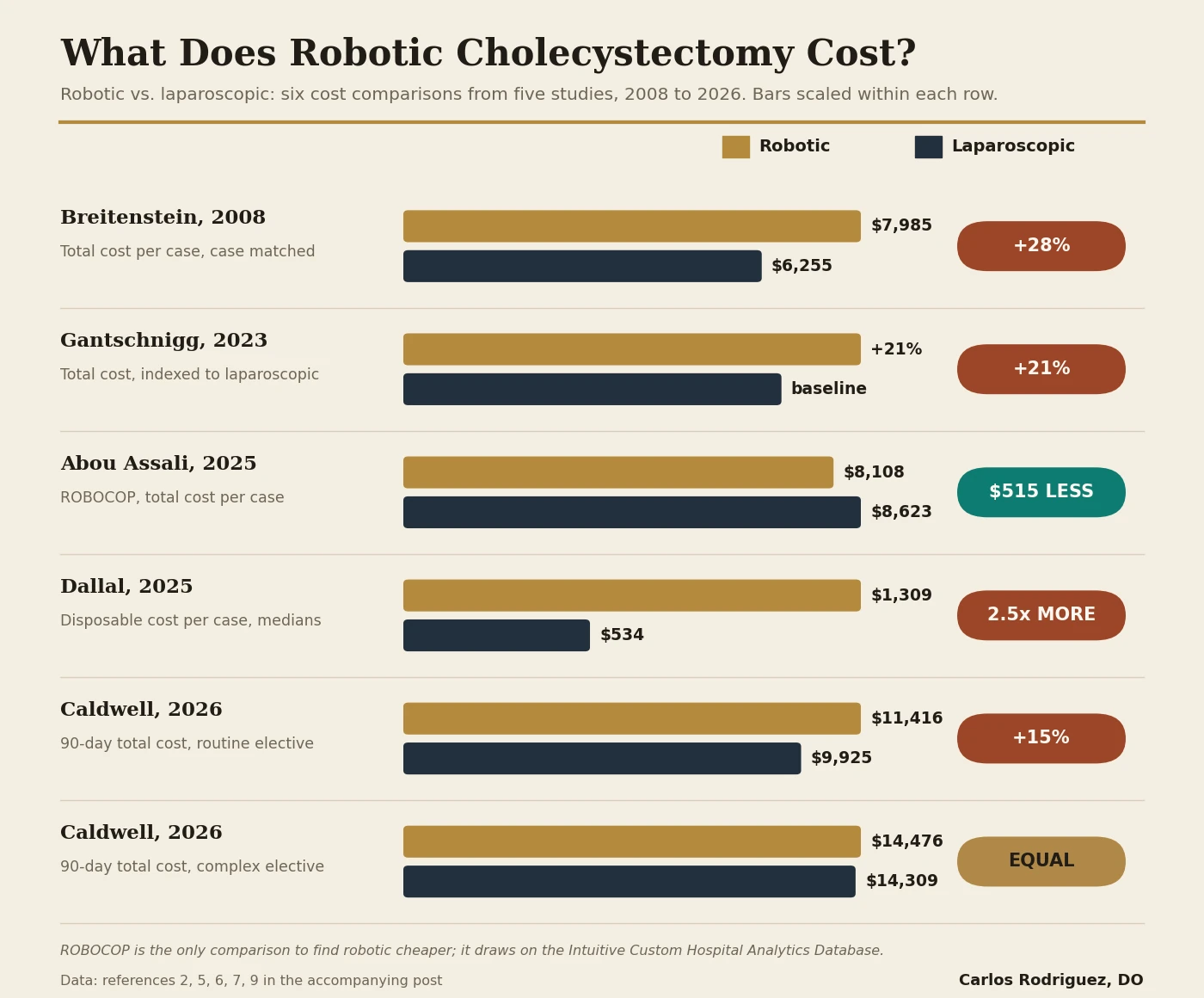
Abou Assali, et al., also reported on cost, and it's worth flagging here because it stands alone in this post: robotic came out slightly cheaper than laparoscopic ($8,108 vs. $8,623 per case, a $515 difference, p<.001).² Cost isn't reported as an odds ratio; it's a direct dollar comparison. Hold onto that number, because every other cost study below points the opposite direction.
A separate systematic review from Tang, et al., pooling data from 17 published studies totaling 75,866 patients, found a significantly lower rate of conversion to open surgery with robotic (relative risk 0.58).³ In a multicenter study from Mehrotra, et al., where patients selected their own surgical approach rather than being assigned one, robotic patients reported less pain and a faster return to work.⁴
Complex elective cases
Published July 15, 2026, in JAMA Surgery, a new study from Caldwell, et al., asks a sharper question than "robotic vs. laparoscopic, elective vs. not." It asks: what happens when the elective gallbladder isn't a simple one?⁵ This is a retrospective, single-center cohort study out of an academic hepatobiliary referral center, covering cases from August 2018 to August 2024. It was not randomized, and the authors are candid that surgeons preferentially chose the robotic platform for their more difficult cases, a real source of selection bias worth keeping in mind.
Caldwell, et al., defined "complex elective" cholecystectomy by specific preoperative criteria: a prior operation in which a surgeon was unable to safely remove the entire gallbladder due to inflammation or distorted anatomy, a gallbladder drainage tube already in place, or a documented history of gallbladder perforation or fistula.⁵ All were still elective and non-emergent.
Of 230 such complex cases (168 laparoscopic, 62 robotic), robotic was associated with a significantly reduced need for unplanned postoperative endoscopic or interventional-radiology procedures (4.8% vs. 17.9%, p=.01) and fewer overall complications (14.5% vs. 28.6%, p=.04).⁵ Conversion to open surgery was zero percent with robotic, versus 13.7% with laparoscopic (p<.001). Operating room costs were still higher for robotic ($8,936 vs. $7,720), but total cost of care over the 90-day period came out statistically no different between the two groups ($14,476 robotic vs. $14,309 laparoscopic): the authors attribute this to avoided complications and reinterventions offsetting the robot's higher upfront cost.
The authors' conclusion, and mine after reading the full text: complexity may be the variable that determines whether robotic's price tag is worth paying. I'd add one caution the authors themselves raise. This is one single-center study from a high-volume referral practice, and it may not generalize to lower-volume settings or surgeons less experienced with complex biliary anatomy.
The case against robotic: elective
For the routine, non-complex elective cases in that same cohort, Caldwell, et al., found none of the above advantages held: total cost of care was significantly higher for robotic ($11,416 vs. $9,925), with no measurable outcome benefit.⁵
Dallal, et al., in a 2025 analysis in Surgery, looked at the question from a different angle: disposable equipment costs, across many surgeons at a single health system.⁶ The median disposable cost was $1,309 per robotic case versus $534 per laparoscopic case, with no significant difference in complications or readmissions. Conversions to open were more frequent with laparoscopic, but the conversion rate was low, and the cost of those conversions did not meaningfully close the gap. The authors concluded the robotic platform didn't offer benefits sufficient to offset its added disposable cost in routine cholecystectomy.
Gantschnigg, et al., in a 2023 Austrian study, found nearly identical operative time between the two approaches but 21% higher total cost with robotic.⁷ Han, et al., in a meta-analysis pooling 26 studies, found no meaningful outcome advantage in either direction and concluded that laparoscopic remained the better value overall, specifically because it costs less without giving up outcomes.⁸
The oldest comparison in this discussion comes from Breitenstein, et al.: a 2008 case-matched study that found $7,985 per robotic case versus $6,255 laparoscopic, 28% more.⁹ Important context: that data is now almost 20 years old, from a much earlier generation of the platform. It still directly contradicts the cheaper-with-robotic finding from Abou Assali, et al. That study, which draws on an Intuitive-maintained database and includes Intuitive employees among its authors, remains the only one in this post to find robotic cheaper. Industry-affiliated authors can and do produce rigorous research, but the pattern is worth weighing: on cost, every other comparison here, from 2008 to 2026, points the same direction.
Where the evidence stands today
Here is the elective picture in one paragraph. Conversion rates and complex-case outcomes may favor robotic approaches. On cost, most comparisons favor laparoscopic for routine elective cases, though the data are not unanimous. The strongest elective data, from Abou Assali, et al., and from Caldwell, et al., come with real caveats: an industry database and a single referral center. That doesn't make them wrong; it means I'm not ready to call the elective case closed.
Resident Pearls
- Elective cholecystectomy is exactly the setting where you'd expect a new technology to show its cleanest advantages, since anatomy is close to normal and the operative field is calm. Even here, the evidence is mixed once you separate cost from outcome and statistical significance from clinical significance.
- Zero-event findings (like the zero bile duct injuries reported by Abou Assali, et al.) are seductive but require the same statistical caution as any other rare-event data: a large denominator with zero events tells you the upper bound of risk is low, not that the risk is zero.
- Complexity, not just "elective vs. emergency," may be the more useful axis for deciding when the added cost of robotic technology is justified. Caldwell, et al., is the first study I've seen that stratifies this directly, though it's one single-center series and the authors flag their own selection bias.
- A subtotal or fenestrating cholecystectomy is a deliberate, safe decision made when a surgeon judges that continuing to dissect carries more risk than stopping. Worth knowing that distinction when you read "prior aborted cholecystectomy" in a paper.
- Always check how a study was funded and who's on the author list, especially for industry-adjacent technology. It doesn't automatically invalidate the findings, but it belongs in how you weigh them, and cost data in particular deserves a source check.
Coming up
Part 2 turns to EGS: the inflamed, on-call gallbladder, where anatomy can be distorted and the calculus changes. Part 3 is my own answer: where I land, and why, after weighing all of this.
In the meantime, see my patient guide on gallbladder disease and more on how I decide between a robotic and an open approach.
References
1. SAGES Safe Cholecystectomy Program. Society of American Gastrointestinal and Endoscopic Surgeons. https://www.sages.org/safe-cholecystectomy-program/
2. Abou Assali M, Li Y, Bossie H, Neighorn C, Wu E, Mukherjee K. Robotic Care Outcomes Project (ROBOCOP) for elective cholecystectomy. Surg Endosc. 2025;39:7262-7271. https://pubmed.ncbi.nlm.nih.gov/
3. Tang K, et al. Robotic versus laparoscopic cholecystectomy: a systematic review and meta-analysis. Medicine (Baltimore). 2025. https://pubmed.ncbi.nlm.nih.gov/
4. Mehrotra M, et al. Patient-selected robotic vs. laparoscopic cholecystectomy: pain and return-to-work outcomes. Surg Endosc. 2026. https://pubmed.ncbi.nlm.nih.gov/
5. Caldwell KE, Threlkeld E, Litrel J, Brocke T, Fields RC, Panni RZ, Nguyen T, Leigh N, Sanford DE. Outcomes and Costs After Robotic vs Laparoscopic Complex Elective Cholecystectomy. JAMA Surg. Published online July 15, 2026. https://pubmed.ncbi.nlm.nih.gov/
6. Dallal RM, Araya S, Sadeh JI, Marchuk TP, Yeo CJ. Impact of the robotic platform and surgeon variation on cholecystectomy disposable costs-More is not better. Surgery. 2025 Jul;183:109332. doi:10.1016/j.surg.2025.109332. https://pubmed.ncbi.nlm.nih.gov/40113517/
7. Gantschnigg A, et al. Short-term outcomes and costs analysis of robotic-assisted versus laparoscopic cholecystectomy: a retrospective single-center analysis. Langenbecks Arch Surg. 2023. https://pmc.ncbi.nlm.nih.gov/articles/PMC10409838/
8. Han C, Shan X, Yao L, et al. Robotic-assisted versus laparoscopic cholecystectomy for benign gallbladder diseases: a systematic review and meta-analysis. Surg Endosc. 2018;32(11):4377-4392. https://pubmed.ncbi.nlm.nih.gov/
9. Breitenstein S, Nocito A, Puhan M, Held U, Weber M, Clavien PA. Robotic-assisted versus laparoscopic cholecystectomy: outcome and cost analyses of a case-matched control study. Ann Surg. 2008;247(6):987-993. https://pubmed.ncbi.nlm.nih.gov/