In Part 1 we looked at the elective gallbladder: scheduled, usually not inflamed, anatomy closest to normal appearing. Today we turn to the other kind. EGS stands for Emergency General Surgery, and the EGS gallbladder is the one that comes in through the emergency department: it is usually inflamed, swollen, and possesses distorted biliary tree anatomy that can be difficult to identify.
This is the harder case. Inflammation distorts the anatomy. The tissue planes that are crisp in an elective case can be swollen, scarred, or bleeding, and the structures a surgeon must positively identify before dividing anything can be far harder to discern. Whatever platform you choose, this is the operation where judgment matters most.
A word on the evidence before we start
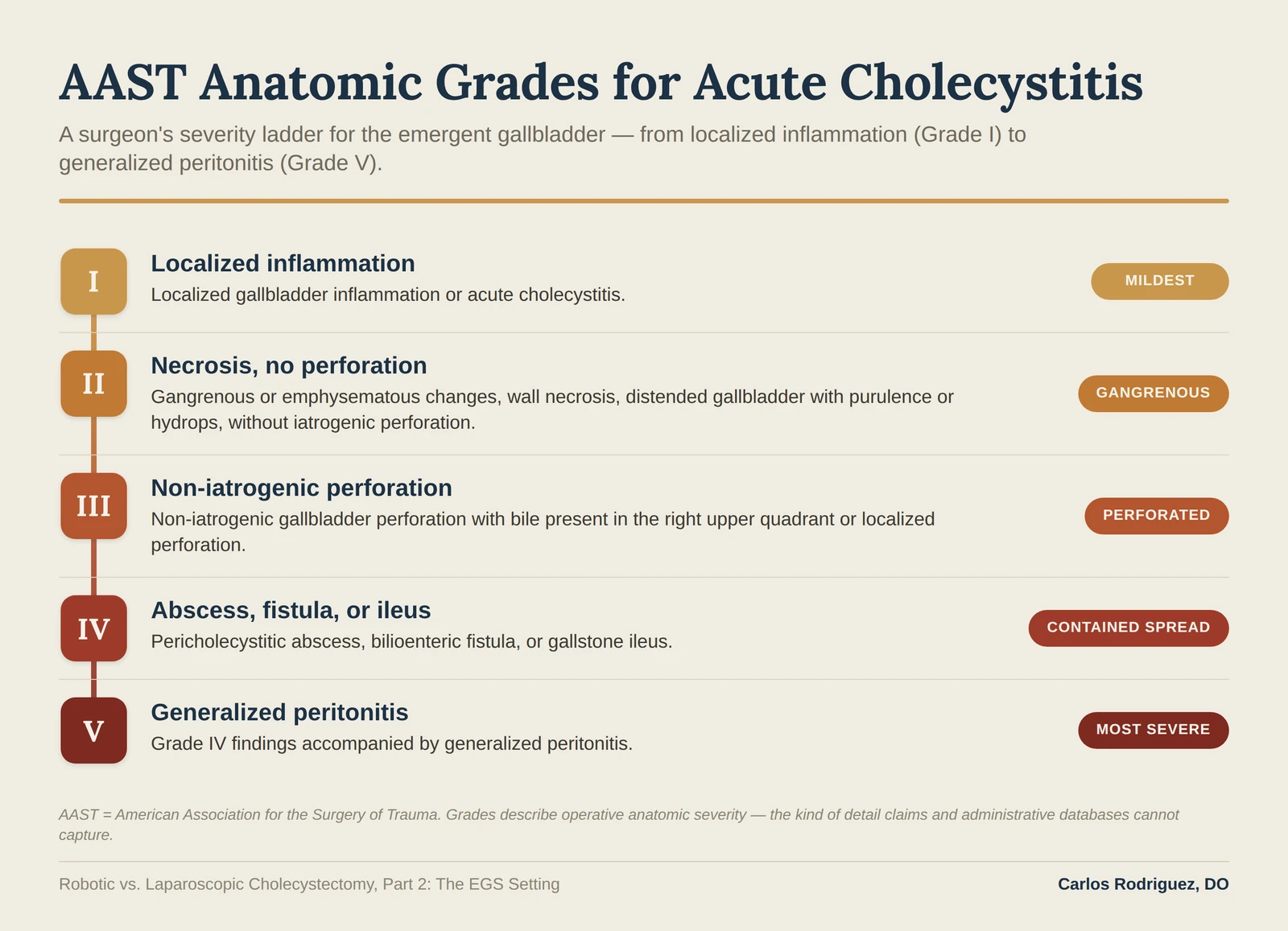
Everything below is observational. No randomized trial comparing robotic and laparoscopic cholecystectomy in the emergency setting has reported results. One is underway (STaRLING, a single center non-inferiority trial planning 276 patients), but it is still recruiting. Much of the data comes from claims and administrative databases, which do not show grade of inflammation. There are 5 different operative grades (1-5, with 5 being the most inflamed), and claims data show none of them, so heterogeneity is baked into every comparison below. These databases also cannot fully account for why a surgeon chose one platform over the other. To help you interpret the data presented, I will tell you how each study was built as we go. As in Part 1, I will also separate what is statistically significant from what is significant to you.
The case for robotic: EGS
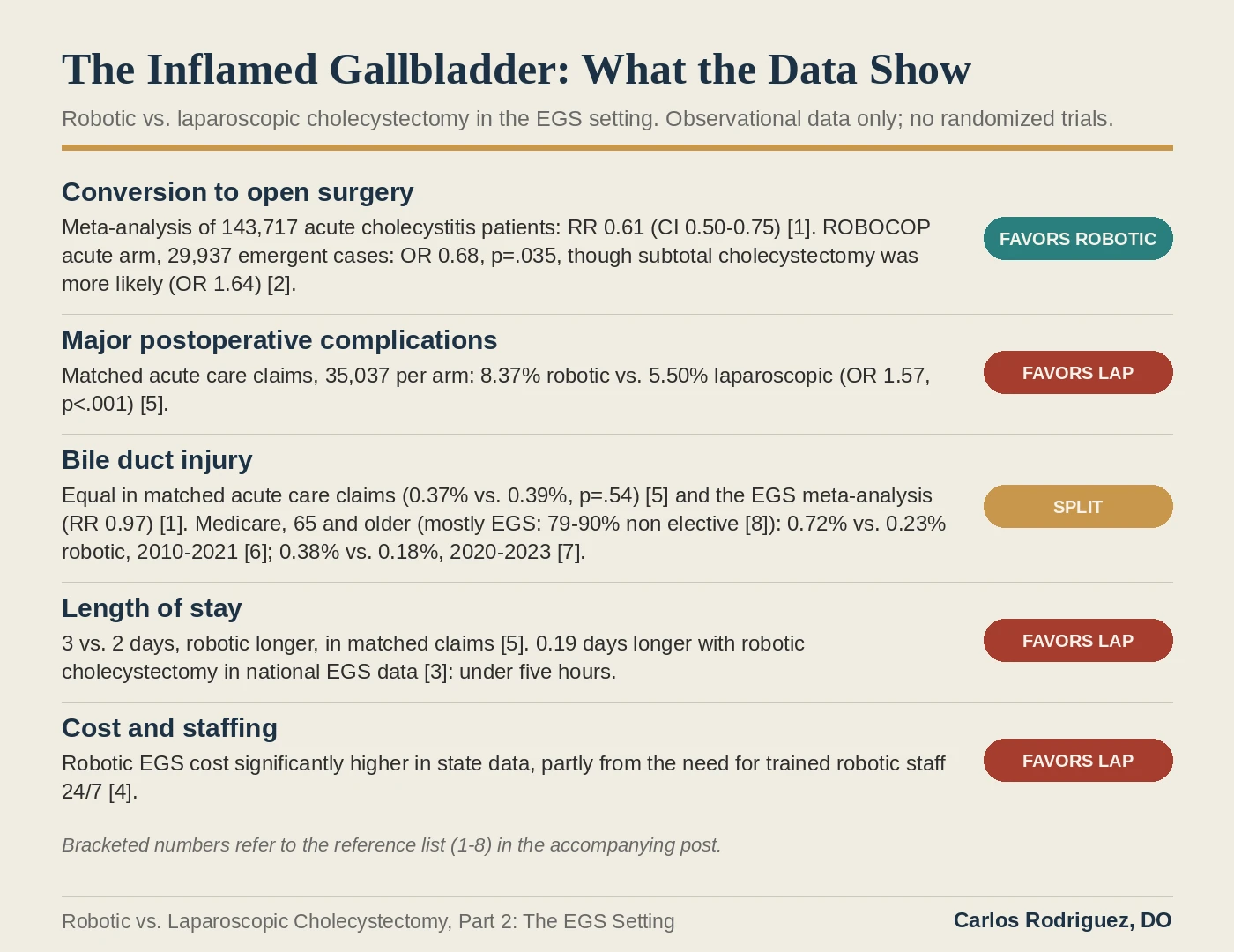
The most current summary comes from Zaidi, et al., a 2026 systematic review and meta-analysis of robotic versus laparoscopic cholecystectomy specifically in acute cholecystitis: seven observational studies, 143,717 patients, searched through 2025.¹ The headline finding was a significantly lower risk of conversion to open surgery with robotic (RR 0.61, 95% CI 0.50-0.75). Bile duct injury was comparable between platforms (RR 0.97, 95% CI 0.77-1.21), as were intraoperative complications, readmission, and mortality. The authors are direct about the limitations: six of the seven studies carried moderate to serious risk of bias, and none were randomized.
The ROBOCOP program covered in Part 1 has an acute arm (published separately). Greenberg, et al., in a 2024 Journal of Trauma and Acute Care Surgery study drawn from the same Intuitive database, compared 26,786 laparoscopic with 3,151 robotic emergent cholecystectomies from 2020 to 2022.² After weighting, robotic was associated with lower conversion to open surgery (OR 0.68, 95% CI 0.49-0.93, p=.035) and comparable complications, but higher odds of subtotal cholecystectomy (OR 1.64, 95% CI 1.03-2.60, p=.037). Read those two findings together: robotic converted to open less often but performed subtotal cholecystectomy more often. A subtotal cholecystectomy removes part of the gallbladder rather than all of it. It's a deliberate choice when removing the whole gallbladder would carry more risk than removing most of it (~90-95%) and all stones. Whether that difference reflects judgment, platform limitations, or case selection is exactly the kind of question observational data cannot answer.
Lunardi, et al., in a 2024 JAMA Surgery analysis of an all-payer database of 829 US facilities covering 1,067,263 urgent and emergent operations, including 793,800 cholecystectomies (plus colectomy and inguinal and ventral hernia repair), found that robotic use in EGS is rising steadily and, after propensity matching, was associated with lower conversion to open surgery across all procedures studied.³ Length of stay went the other way for the gallbladder: total stay was 0.19 days longer with robotic cholecystectomy (95% CI 0.14-0.23, p<.001). Here is where statistical and clinical significance part ways: 0.19 days is less than five hours. It clears the statistical bar and means almost nothing to an actual patient, in either direction. One more disclosure that matters: the author list includes an Intuitive Surgical employee, and other authors report ties to the company.
Grimsley, et al., in a 2023 state level analysis of 60,733 emergency cases, found that after robotic cholecystectomy patients had fewer ICU admissions and higher rates of discharge directly home.⁴
The case against robotic: EGS
The largest EGS specific comparison points the other way. Woldehana, et al., in a 2025 JAMA Surgery study, analyzed a commercial claims database of acute care cholecystectomies from 2016 to 2021 and propensity matched 35,037 robotic to 35,037 laparoscopic patients (mean age 46; commercially insured patients only, so Medicare and uninsured patients are not represented).⁵ Bile duct injury, the primary outcome, was statistically equal: 0.37% robotic vs. 0.39% laparoscopic (p=.54). But robotic was associated with more major postoperative complications (8.37% vs. 5.50%; OR 1.57, p<.001), more postoperative drain use (OR 1.66, p<.001), and a longer median stay (3 vs. 2 days, p<.001). The authors concluded that under current practice conditions, robotic cholecystectomy may not offer clear benefits over laparoscopy in the acute setting. Claims data cannot tell us how sick each gallbladder was, and the authors acknowledge that case selection may confound these results. Even so, this is the largest matched EGS comparison we have.
Cost also does not improve in the emergency setting. In the Grimsley analysis, hospital cost for robotic EGS procedures was significantly higher than laparoscopic, driven in part by the need for trained robotic staff around the clock.⁴ An emergency robotic program requires a trained team available at all hours.
The bile duct injury question
Bile duct injury deserves its own section, because it is the one complication every gallbladder surgeon organizes their operation around, and the data here truly conflict.
Mullens, et al., in a 2025 JAMA Network Open study of 737,908 Medicare patients (age 65 and older, mean age 75) from 2010 to 2021, found that bile duct injury requiring operative repair was approximately 3 times higher with robotic cholecystectomy: 0.72% vs. 0.23% (RR 3.12, 95% CI 2.34-3.91).⁶ The authors stratified patients by complexity, meaning predicted risk of 90 day adverse outcomes, modeled from claims factors (age, diagnoses, comorbidities, admission type) and split into thirds. Note what that is and is not: a patient risk score, not an inflammation grade. Claims data still cannot grade the gallbladder itself. The gap held in every tercile (RR 3.14, 3.13, and 3.11), and injury after robotic surgery in the lowest risk group (0.47%) was more common than after laparoscopic surgery in the highest risk group (0.33%). Overall complications and readmissions were similar; reoperations were more frequent in the robotic group.
Some surgeons argue that findings from the technology's first decade in broad use should not define it today. Mullens, et al. tested exactly that in a follow up JAMA Surgery analysis (Comparative Safety of Robotic-Assisted vs Laparoscopic Cholecystectomy in Contemporary Practice) of 379,970 Medicare patients, again age 65 and older, limited to contemporary practice, 2020 to 2023.⁷ Robotic use kept growing, from 9.2% of cases in 2020 to 22.4% in 2023, and the risk adjusted bile duct injury gap persisted: 0.38% robotic vs. 0.18% laparoscopic (RR 2.09, 95% CI 1.69-2.49). Differences in serious complication rates were small (RR 1.09, 95% CI 1.06-1.13).
One more point matters for this series: these Medicare cohorts are mostly EGS. The share of Medicare cholecystectomies performed during unplanned, non-elective admissions (the EGS presentations) rose from 78.8% in 2011 to 90.1% in 2021, so this data speaks directly to the emergency setting, in an older population.⁸
Now hold that against the EGS specific data: Woldehana found bile duct injury statistically equal in 70,074 matched acute care patients (0.37% vs. 0.39%, p=.54),⁵ and the Zaidi meta-analysis of 143,717 patients found RR 0.97 in acute cholecystitis.¹ How can both be true? Different populations (older Medicare patients vs. younger commercial claims patients), rare events (a few injuries in every thousand cases, so estimates are fragile), and zero randomization anywhere. When the direction of an effect flips depending on which database you open, the correct conclusion is not that one study is lying. It is that the question is not answered.
Where the evidence stands today
Here is the EGS picture in one paragraph. Conversion to open surgery consistently favors robotic approaches in the inflamed gallbladder, across the meta-analysis, the national EGS data, and the industry database acute arm, though that last study also found more subtotal cholecystectomies with robotic. The largest matched acute care comparison found more complications and longer stays with robotic, and the Medicare data show a persistent bile duct injury signal against it, while EGS specific analyses find injury rates equal. Cost favors laparoscopic, in part because emergency robotics requires around the clock staffing. Nothing in this setting is randomized. Anyone who tells you the EGS question is answered, in either direction, is ahead of the data.
Resident Pearls
- Conversion to open surgery is the most consistent robotic advantage in the inflamed gallbladder. Remember, though, that conversion is a surgeon decision, not a fixed biological outcome. Lower conversion is only a win if safety outcomes hold up alongside it.
- The 0.19 day length of stay difference in Lunardi (longer with robotic cholecystectomy) is the cleanest teaching example in this series of statistically significant vs. clinically meaningful. Always convert the units: 0.19 days is under five hours.
- Check the denominator population before you generalize. A commercial claims cohort (mean age 46) and a Medicare cohort (65 and older) are answering different questions, and mixing them is how arguments start.
- Claims and administrative data cannot grade inflammation severity. No Tokyo grade, no operative findings, no AAST grading.
- Bile duct injury is rare enough (roughly 2 to 4 per 1,000 in these datasets) that single estimates are fragile. Watch for the direction of effect flipping between databases; that is a sign the truth is close to the noise floor.
- Whatever the platform, the safety valves are the same: the critical view of safety, and a subtotal or fenestrating cholecystectomy when continuing to dissect carries more risk than stopping.
Coming up
Part 3 is where I stop presenting both sides and tell you where I land: what I actually do in my own practice, elective and emergent, and why.
In the meantime, see my patient guide on gallbladder disease and more on how I decide between a robotic and an open approach. Missed Part 1 on the elective case? Start there.
References
1. Zaidi H, et al. Is robotic surgery ready for emergency cholecystectomy? A systematic review and meta-analysis of robotic versus laparoscopic approach in acute cholecystitis. J Robot Surg. 2026;20(1). doi:10.1007/s11701-026-03145-7. https://link.springer.com/article/10.1007/s11701-026-03145-7
2. Greenberg S, Abou Assali M, Li Y, et al. ROBOtic Care Outcomes Project (ROBOCOP) for acute gallbladder pathology. J Trauma Acute Care Surg. 2024;96(6):971-979. https://pubmed.ncbi.nlm.nih.gov/38189678/
3. Lunardi N, Abou-Zamzam A, Florecki K, et al. Robotic Technology in Emergency General Surgery Cases in the Era of Minimally Invasive Surgery. JAMA Surg. 2024;159(5):493-499. https://pubmed.ncbi.nlm.nih.gov/38446451/
4. Grimsley EA, Janjua HM, Herron T, et al. Patient outcomes and cost in robotic emergency general surgery. J Robot Surg. 2023;17(6):2937-2944. https://pubmed.ncbi.nlm.nih.gov/37856059/
5. Woldehana NA, Jung A, Parker BC, Coker AM, Haut ER, Adrales GL. Clinical Outcomes of Laparoscopic vs Robotic-Assisted Cholecystectomy in Acute Care Surgery. JAMA Surg. 2025;160(7):755-762. doi:10.1001/jamasurg.2025.1291. https://jamanetwork.com/journals/jamasurgery/article-abstract/2834477
6. Mullens CL, Sheskey S, Thumma JR, et al. Patient Complexity and Bile Duct Injury after Robotic-Assisted vs Laparoscopic Cholecystectomy. JAMA Netw Open. 2025;8(3):e251705. https://jamanetwork.com/journals/jamanetworkopen/fullarticle/2831890
7. Mullens CL, Lee EY, Thumma JR, Dimick JB, Sheetz KH. Comparative Safety of Robotic-Assisted vs Laparoscopic Cholecystectomy in Contemporary Practice. JAMA Surg. 2026. doi:10.1001/jamasurg.2026.1585. https://jamanetwork.com/journals/jamasurgery/article-abstract/2849504
8. Mullens CL, Sinamo JK, Hallway A, Sheetz KH, Ehlers AP, Telem DA. Contemporary Outcomes of Cholecystectomy. JAMA Surg. 2026;161(4). doi:10.1001/jamasurg.2025.6865. https://jamanetwork.com/journals/jamasurgery/article-abstract/2845364