When you come to my office for a consultation, this is usually the first question patients want answered. "Why did I get a gallstone?" In Part 1 we covered the anatomy of the biliary tree, and in Part 2 we covered how the gallbladder works. Now we are ready to talk about what goes wrong.
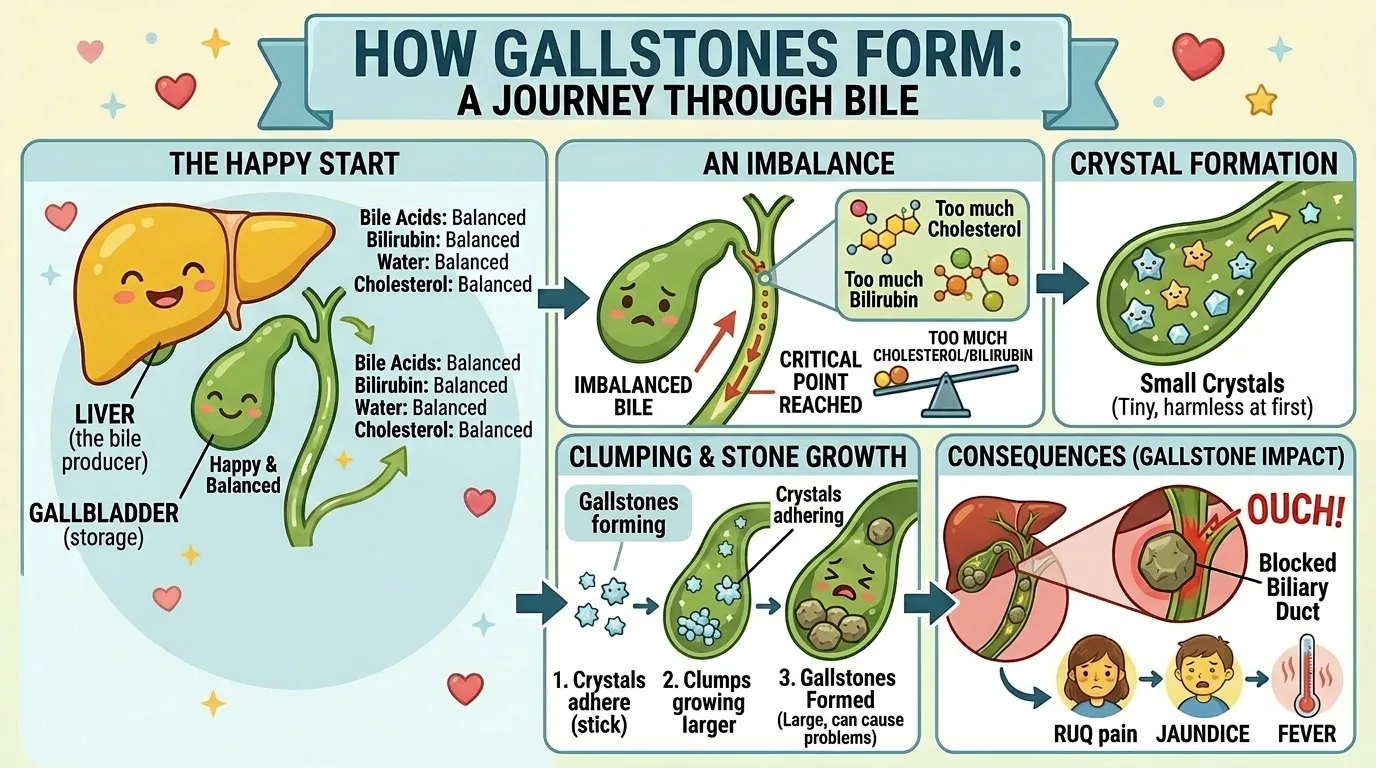
Bile Out of Balance
Bile is a careful mix of three things: cholesterol, bile salts, and a pigment called bilirubin.¹ A gallstone starts to form when that mix tips out of balance. Most gallstones are cholesterol stones. They form when there is too much cholesterol in the bile for the salts to keep it dissolved.¹ When too much bilirubin builds up instead, a different type called a pigment stone can form. This post focuses on the more common cholesterol stone.
From Crystals to Sludge to Stone
When bile holds too much cholesterol, tiny crystals begin to form, much like sugar collecting at the bottom of a glass of sweet tea. Those crystals get caught in a layer of mucus inside the gallbladder and form what we call sludge.
Whether that sludge turns into a real stone often comes down to a second factor: how well the gallbladder empties. A gallbladder that squeezes poorly or empties slowly gives the crystals more time to sit still, stick together, and clump. Doctors call this slow emptying bile stasis. It works hand in hand with the cholesterol imbalance to grow stones over weeks and months.¹
Who Is More Likely to Form Stones
A few things raise the odds. Estrogen raises the amount of cholesterol in bile, while progesterone slows the gallbladder down so it empties less completely.³ That is why higher-hormone states like pregnancy and hormone therapy raise the risk of stones.¹
Age also matters. As we get older, the liver puts more cholesterol into bile and makes fewer of the bile salts that keep it dissolved, and the gallbladder empties less well. All three changes push bile toward stone formation, which is part of why gallstones become far more common after 40.¹
Obesity, rapid weight loss, diabetes, and a diet high in sugar and low in fiber all push the balance further toward stone formation as well.¹
GLP-1 medications, including semaglutide (Ozempic, Wegovy) and tirzepatide (Mounjaro, Zepbound), carry an FDA warning for gallbladder disease. A large review of clinical trials found that patients taking these medications had a higher rate of gallstones and gallbladder inflammation than patients on placebo.⁴ Part of the reason ties back to Part 2. These drugs lower CCK, the hormone that tells the gallbladder to squeeze, which slows emptying and adds to the same problem described above.
Why Most People Never Know They Have Them
Here is what surprises most patients. Of everyone who has gallstones, only about 1 in 10 develop symptoms within 5 years, and about 1 in 5 within 20 years.¹ The rest carry stones quietly for life. We usually find these silent stones by accident, on an ultrasound or CT scan ordered for an unrelated reason.
Why Some Stones Stay Silent and Others Do Not
This comes down to two things: size and location. A stone resting quietly in the body of the gallbladder rarely causes problems. A stone that drifts toward the cystic duct, the narrow tube we covered in Part 1, can begin to block how the gallbladder empties. Larger stones are more likely to get stuck there, while smaller stones often pass through without ever being noticed.¹ That blockage is where real symptoms begin.
For more on gallbladder disease and when removal is recommended, see my gallbladder patient guide. Missed the earlier posts in this series? You can find them all on the blog.
Up next: the pathology continues, with when stones start causing problems, and when they do not.
References
1. Jones MW, Weir CB, Marietta M. Gallstones (Cholelithiasis). StatPearls [Internet]. Treasure Island, FL: StatPearls Publishing; updated June 2, 2025. https://www.ncbi.nlm.nih.gov/books/NBK459370/
2. Admirand WH, Small DM. The physicochemical basis of cholesterol gallstone formation in man. J Clin Invest. 1968;47(5):1043-1052. https://doi.org/10.1172/JCI105794
3. Tierney S, Nakeeb A, Wong O, Lipsett PA, Sostre S, Pitt HA, Lillemoe KD. Progesterone alters biliary flow dynamics. Ann Surg. 1999;229(2):205-209. https://pmc.ncbi.nlm.nih.gov/articles/PMC1191632/
4. He L, Wang J, Ping F, Yang N, Huang J, Li Y. Association of Glucagon-Like Peptide-1 Receptor Agonist Use With Risk of Gallbladder and Biliary Diseases: A Systematic Review and Meta-analysis of Randomized Clinical Trials. JAMA Internal Medicine. 2022;182(5):513-519. https://jamanetwork.com/journals/jamainternalmedicine/fullarticle/2790392