Parts 1 and 2 laid out the evidence for the scheduled gallbladder and then the emergency one, respectively. Neither post could conclusively state one approach is better than the other. This post asks a harder question: with the outcomes roughly a wash, is there a real case for making robotic cholecystectomy a standard approach rather than a niche one? I will lay out that case as fairly as I can, including the strongest evidence against it, and tell you what I do and why.
The case that lied: every general surgeon has been here
The ultrasound was reassuring. Thin gallbladder wall. No surrounding fluid. Nothing on that scan said the operation would be difficult.
Then I got inside. I could not grasp the gallbladder to retract it; the tissue was too inflamed to hold. I had injected indocyanine green before the operation, a dye that makes bile ducts glow under a special light, and it would not shine through the swollen tissue at the base of the liver. I could not see the anatomy I needed to see. So I removed the part of the gallbladder I could safely visualize, took out all the stones, and left a small, markedly inflamed portion behind. I performed a subtotal cholecystectomy in a case I had thought would be straightforward.
Nothing told me that was coming.
The numbers say I might not have known
A 2024 study built a score to predict the severity of cholecystitis using preoperative data. Across 575 patients, the best purpose-built score, the Severe Acute Cholecystitis Score, correctly identified 76.2% of cases with a C statistic of 0.76, but still missed most severe cases, with a sensitivity of 40.7%.¹ In EGS circles, the well-known AAST score, which combines the clinical picture with the imaging, predicted a severely inflamed gallbladder with a C statistic of 0.53.¹ A coin flip is 0.50.
Several other studies have tried to grade cholecystectomy difficulty before the operation, with mixed success. My read is that these preoperative scores can flag many of the cases that will be easy, but they cannot reliably tell us which ones will turn out difficult.²⁻⁴
My position
Any routine gallbladder can become the case above. When a cholecystectomy is unexpectedly difficult, the operation is safer in the hands of a surgeon who is fluent on the platform in front of them, for that exact operation, that day. I am most fluent on the robot because I use it for every gallbladder.
Where the evidence sits
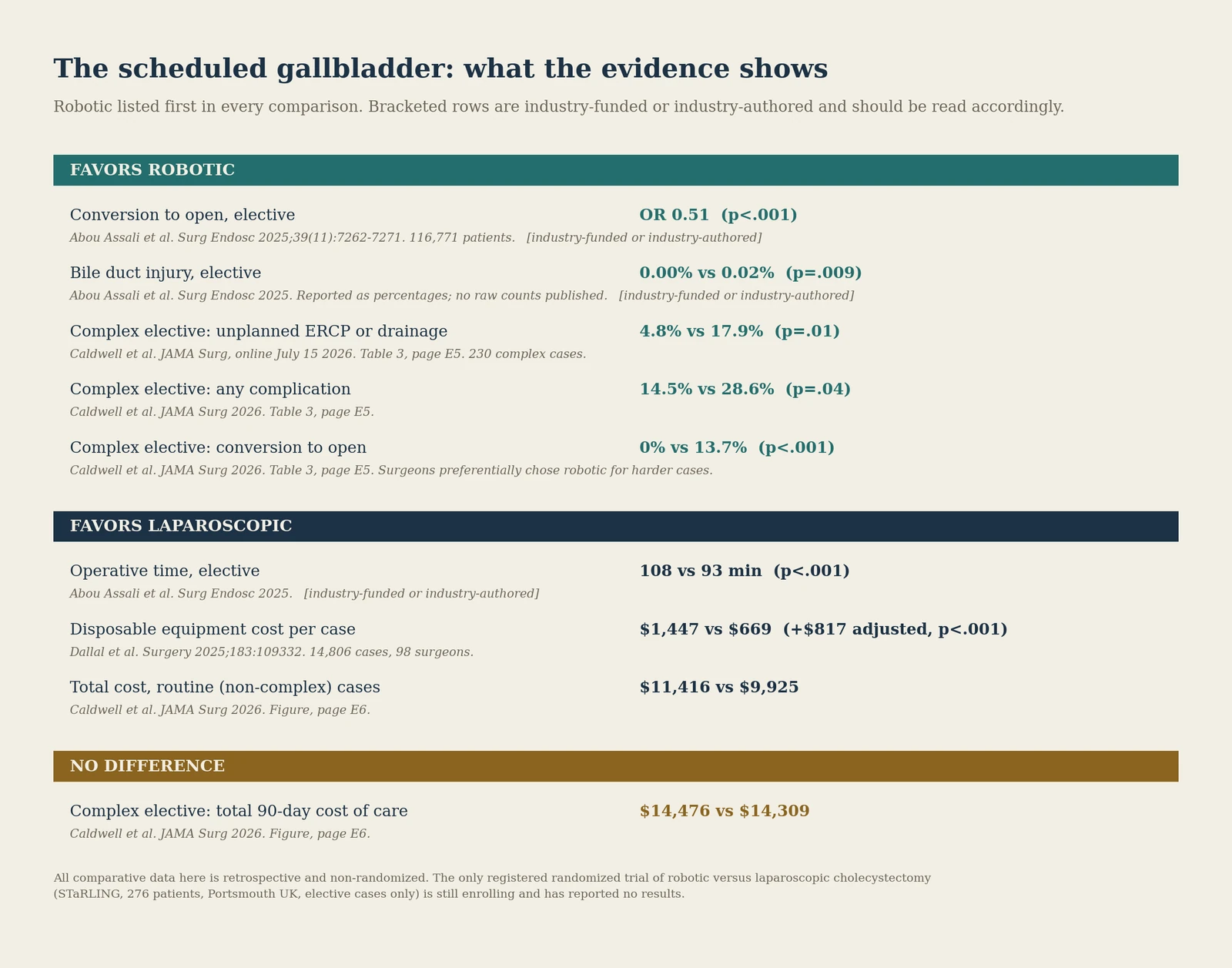
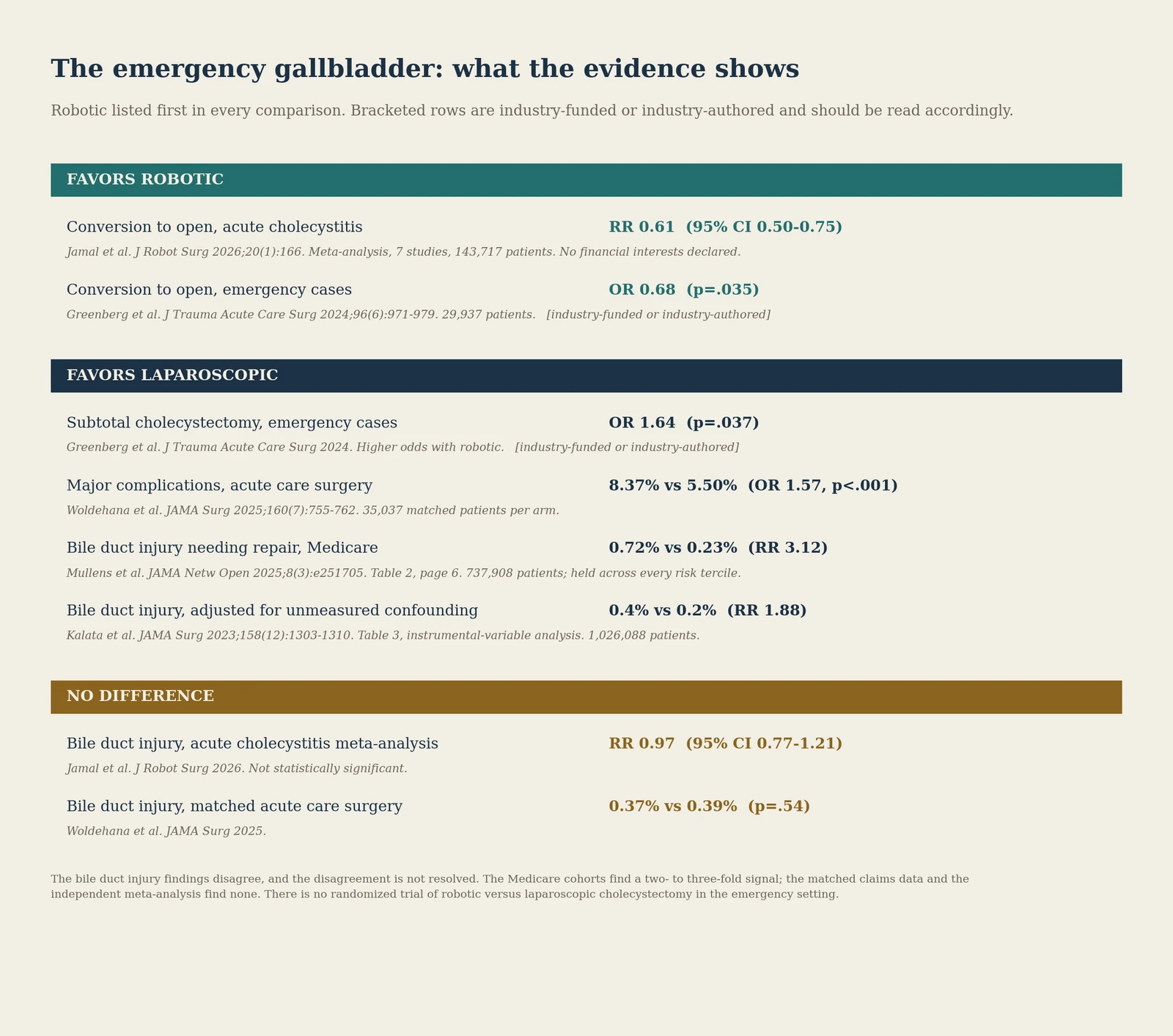
Scheduled surgery
In scheduled operations, the largest study, utilizing an industry database, found lower odds of converting to open with robotic (OR 0.51) and a lower bile duct injury rate (0.00% versus 0.02%, p=0.009).⁵ In a different study evaluating the “hardest scheduled cases”, a single academic center found robotic patients needed fewer unplanned procedures afterward (4.8% versus 17.9%, p=.01), had fewer complications (14.5% versus 28.6%, p=.04), and had no conversions to open against 13.7%, at the same total 90-day cost. Those authors disclose that surgeons preferentially chose the robot for the harder cases.⁶
Emergency general surgery
In emergency operations, the only industry-independent meta-analysis, 143,717 patients, found lower conversion with robotic (RR 0.61) and no difference in bile duct injury (RR 0.97).⁷
A manufacturer-database study of 29,937 emergency cases found lower conversion to open (OR 0.68) and higher odds of subtotal cholecystectomy (OR 1.64).⁸
An independent study of 70,074 matched patients found robotic did worse on major complications, 8.37% versus 5.50% (OR 1.57, p<.001), with equivalent bile duct injury rates.⁹
Medicare data
Medicare data covering 737,908 patients found bile duct injury requiring surgical repair in 0.72% of robotic cases versus 0.23% of laparoscopic, a relative risk of 3.12, holding across every risk group from the healthiest patients to the sickest.¹⁰ In absolute terms, roughly 7 patients per thousand against 2 per thousand. Both numbers are small, but arguably different.
An earlier study of more than a million Medicare beneficiaries comparing robotic to laparoscopic cholecystectomy found a higher rate of bile duct injury, 0.7% versus 0.2%, RR 3.16, in the robotic group. It also found a higher rate of postoperative biliary interventions, defined as ERCP or common bile duct exploration, 7.4% versus 6.0%, RR 1.25.¹¹
These large Medicare claims studies do point to real differences in outcomes, but they carry author-acknowledged limitations: they cannot account for procedural factors "such as the severity and chronicity of gallbladder inflammation."¹¹ My read is that it is difficult to generalize these findings to my own surgical practice.
My take so far
The outcome data is mixed. Robotic leads on conversion to open; laparoscopic leads on the Medicare bile duct injuries; the independent emergency data is split. No approach has cleanly won.
Learning curve?
A note on learning curves. In robotic cholecystectomy, surgeons take new technology and apply it to a procedure they already know well, then teach it to tomorrow's surgeons much the way laparoscopic cholecystectomy was taught to them.
Researchers analyzed cholecystectomy Medicare claims and identified 4,443 surgeons who performed 637,765 cholecystectomies from 2010 through 2019 (15,145 of them, 2.37%, robotic-assisted). "To reach equivalent bile duct injury rates with traditional laparoscopic cholecystectomy, surgeons would need to perform between 300 and 450 robotic-assisted cholecystectomies."¹²
In the same dataset: "Most surgeons (3867 [87.0%]) performed fewer than 10 robotic-assisted cholecystectomies."¹² Not per year. Over the decade.
Question: Are we attributing the national bile duct injury rate for robotic cholecystectomy to surgeons who use the robot only occasionally?
Two 2026 series describe what routine, structured robotic cholecystectomy looks like. In one high-volume teaching program, 441 consecutive robotic cholecystectomies performed by 22 surgeons and trainees produced no intraoperative injuries and no conversions to open or laparoscopic surgery, with complications in 1.4%; operative time leveled off after roughly 30 cases.¹³ A separate multicenter cohort followed the first 50 cases of each of five surgeons and found their operating time leveled off somewhere between 11 and 34 cases, with no bile duct injuries across 250 operations.¹⁴
Both studies measured proficiency by operative time, and both state plainly that they were not powered to prove the bile duct injury rate is equal. So neither answers the 300-to-450 question above, but, they do show in a structured, repeated practice the operation is learned quickly and was performed safely.
My take
I think the question of how many cases it takes to approach laparoscopic bile duct injury rates needs more study. I do not think a retrospective Medicare claims dataset, in which the vast majority of surgeons (87%) performed 10 or fewer robotic cholecystectomies in a decade, is adequate to answer it.
The cost objection
Cost is the argument I hear most, and it is legitimate. In a health system with 14,806 cholecystectomies by 98 surgeons across 14 hospitals, robotic disposable equipment averaged $1,447 per case against $669 for laparoscopic, an adjusted difference of $817 (p<.001).¹⁵ Robotic cases predicted a much lower conversion rate, which the authors priced at $93,000 per conversion prevented, and no other outcome differed.¹⁵
One of the more interesting points in that study was the spread between surgeons. Within laparoscopy alone, the cheapest surgeon averaged $272 per case and the most expensive $1,934, a sevenfold range on one platform, larger than the difference between platforms. If every surgeon operated at the 25th percentile of their own platform's cost, disposable savings would run 35% for laparoscopic and 24% for robotic.¹⁵
A three-arm approach has shown meaningful savings. A 2026 series of 131 three-port robotic cholecystectomies reports its total consumable cost as $1,030 for three ports against $1,483 for four, a 30% reduction from using one fewer arm, with no major intraoperative complications.¹⁶ A separate three-arm technique series reported a 46% consumable cost reduction (two of its three authors are paid proctors for the manufacturer).¹⁷
My take
I dissect with the hook and control the cystic artery and duct with clips and scissors. There are cheaper ways to do it: monopolar curved scissors to dissect and divide the duct and artery, or silk ties on the duct and artery before dividing them with the monopolar device being used for dissection. The point is that cost is very much within the surgeon's control.
What a day at the console does to my body
The case for the robot is not only in the outcome tables. We must consider what surgery is doing to the body.
Minimally invasive surgery is hard on surgeons. In a 2010 survey, 87% of surgeons who regularly perform minimally invasive surgery reported physical symptoms or injuries.¹⁸ A meta-analysis of 5,828 surgeons and interventionalists found 12% had needed a leave of absence, a practice restriction, or early retirement from a work-related musculoskeletal disorder.¹⁹
Modality seems to matter. In a more recent survey of European surgeons, 72% reported pain from their laparoscopic operating over the previous year, against 48% from robot-assisted operating.²⁰ That matches my experience, though for me it is partly nostalgia now: apart from an occasional laparoscopic appendectomy (fewer than 20 since 2020) and laparoscopic VP shunt placement (more than 50, though each involves under 10 minutes of laparoscopy), I no longer do long laparoscopic cases. Even so, 48% of surgeons still reporting work-related pain is a problem worth investigating.
The console does not solve this. Among 292 robotic surgeons, 41% still reported frequent pain after operating, and the authors concluded that "robotic platforms alone are not sufficient."²¹ A systematic review of 16 studies found robotic surgery "relieves some pressures in the arm and shoulder for surgeons," but "it poses a new risk to the lower back, trapezius and finger muscles."²² The load moves rather than disappearing.
Part of what is missing is not the platform but the workstation. Consoles differ, chairs differ, and few give a surgeon a repeatable, well-adjusted seat from one room to the next. If we want reproducible ergonomics, from console to console and case to case, an integrated and properly adjustable seat should be standard equipment, not an afterthought. That is my opinion, not a finding, but it is where the ergonomic gains will actually come from.
What the platform gives me in the operation
Vision. A randomized trial of 3D versus standard laparoscopic cholecystectomy found no overall difference in operative time. In grade 3 and 4 gallbladders, the hard ones, 3D was significantly faster, 18:02 against 30:23 (p<0.001).²³ The advantage appears where the anatomy is hard. This was a study looking at 3D vs standard 2D laparoscopy- I am extrapolating to robotic surgery.
Platform fluency. Robotic hernia repair is the other half of my practice. Doing gallbladders on the same system keeps my team and me fluent in the operating system itself: docking, port geometry, instrument exchange, how my bedside assistant and I talk, what to do when something fails. This is a claim about fluency, not outcomes.
What would change my mind
There is one registered randomized trial in the world comparing robotic to standard laparoscopic gallbladder removal. STaRLING is enrolling 276 patients at a single hospital in Portsmouth, England, in elective cases only, with all 30-day complications as its endpoint. The authors did not power it on bile duct injury because the event is too rare and defined too inconsistently.²⁴
For the emergency gallbladder there is no randomized trial at all. Everything in Part 2 was retrospective or registry-based. That is the state of the evidence a randomized trial does not exist.
If a properly powered randomized trial shows robotic cholecystectomy is worse in experienced hands, I will evaluate my practice and change if I judge it necessary. I also watch my own results continually; if I see any deviation in outcomes, even one, I look at what to change next time to keep my results consistent.
Where this leaves us: the case for adoption
Step back from my own practice and ask the real question: should robotic cholecystectomy be a standard approach, not a niche one? Here is the ledger, kept plain.
- Scheduled cases: outcomes are at least comparable, with lower conversion to open and, in complex elective cases, fewer unplanned procedures and complications.⁶ Bile duct injuries have been reported to be lower.⁵
- Emergency cases: the independent data show lower conversion and no difference in bile duct injury,⁷ while one independent study found more major complications.⁹ Mixed, and no trial answers it.
- No randomized outcome trials exist. Every comparison above is retrospective or registry-based. One elective randomized trial is enrolling;²⁴ for the emergency gallbladder there is none.
- Cost is largely the surgeon's to control. Robotic disposables cost more, but the cost spread is in the surgeons’ hands,¹⁵ and a three-arm technique nearly closes any cost spread.¹⁶
- Less physical strain, but not none. Robotic operating hurts fewer surgeons than laparoscopy, 48% versus 72%,²⁰ yet 41% of robotic surgeons still report frequent pain.²¹ The console helps; it does not cure.
- The workstation needs to catch up. Consoles and chairs vary too much. Reproducible ergonomics, from console to console and case to case, calls for an integrated, adjustable seat as standard, not an add-on. (My opinion, not a finding.)
- The national safety signal deserves scrutiny. The largest Medicare analysis followed 4,443 surgeons, but 87% performed fewer than 10 robotic cholecystectomies in an entire decade.¹² Is that the dataset we should use to conclude the robot is harming patients?
None of this crowns a winner, and I will not pretend it does. This is one of the more contentious questions in general surgery right now, with experienced surgeons firmly on both sides. My take away is in trained, committed hands the outcomes are comparable, the secondary advantages are real, and the loudest safety alarm should really be about occasional use.
That is enough for me to make the robot my standard, and it is a defensible reason for another surgeon to do the same, on two conditions. Commit to the volume that competence requires, and audit your own outcomes, case by case, so your practice answers to your own data and not to a marketing claim or a registry average. Beyond that, the field needs what it does not yet have: adequately powered, ideally randomized, studies in both the elective and emergency settings.
One last thought: train as you fight
A Navy pilot learns to fly in a T-45C Goshawk, the aircraft used for "intermediate and advanced Strike training," a pipeline that "fills fleet seats for the FA-18C/D Hornet and E/F Superhornet."²⁵ The trainer stays behind. In a squadron, the training flights are in the airplane they would actually fight in. There is a reason for that- repetition buys consistent outcomes.
I am not comparing an inflamed gallbladder to combat. But any surgeon who has found a right upper quadrant so hostile that even finding the gallbladder is a fight knows the value of having done the ordinary version a thousand times. Every gallbladder gets a real operation, done to the same standard, with the same critical view of safety and the same willingness to stop and perform a subtotal cholecystectomy. Repetition buys consistent outcomes.
For more on gallbladder disease and when removal is recommended, see my gallbladder patient guide. Missed the earlier posts in this series? You can find them all on the blog.
Up next: back to the main series, with stones that escape the gallbladder and lodge in the bile duct.
References
1. Kuhlenschmidt K, Taveras LR, Schuster KM, et al. A novel preoperative score to predict severe acute cholecystitis. J Trauma Acute Care Surg. 2024;96(6):870-875. SACS and AAST C statistics and the sensitivity figure from the structured abstract, Results. https://pubmed.ncbi.nlm.nih.gov/38523119/
2. Sugrue M, Coccolini F, Bucholc M, Johnston A; WSES Working Group. Intra-operative gallbladder scoring predicts conversion of laparoscopic to open cholecystectomy: a WSES prospective collaborative study. World J Emerg Surg. 2019;14:12. Cited with references 3 and 4 as studies grading cholecystectomy difficulty. https://pmc.ncbi.nlm.nih.gov/articles/PMC6417130/
3. Siada S, Jeffcoach D, Dirks RC, Wolfe MM, Kwok AM, Sue LP, Davis JW. A predictive grading scale for acute cholecystitis. Trauma Surg Acute Care Open. 2019;4(1):e000324. Cited with references 2 and 4 as studies grading cholecystectomy difficulty. https://pmc.ncbi.nlm.nih.gov/articles/PMC6660796/
4. Schuster KM, O'Connor R, Cripps M, et al. Multicenter validation of the American Association for the Surgery of Trauma grading scale for acute cholecystitis. J Trauma Acute Care Surg. 2021;90(1):87-96. Across 861 patients, median AAST imaging subscale 1 versus median Parkland grade 3 (Results narrative), supporting the Resident Pearls point. https://pubmed.ncbi.nlm.nih.gov/33332782/
5. Abou Assali M, Li Y, Bossie H, Neighorn C, Wu E, Mukherjee K. Robotic Care Outcomes Project (ROBOCOP) for elective cholecystectomy. Surg Endosc. 2025;39(11):7262-7271. Bile duct injury rates (0.00% vs 0.02%, p=0.009) in the unadjusted Results and restated in the Discussion. Conflict of interest: three co-authors are employees of Intuitive Surgical Inc. and the senior author consults for the company; the study runs on Intuitive's proprietary Custom Hospital Analytics database. https://pubmed.ncbi.nlm.nih.gov/40858944/
6. Caldwell KE, Threlkeld E, Litrel J, et al. Outcomes and costs after robotic vs laparoscopic complex elective cholecystectomy. JAMA Surg. Published online July 15, 2026. doi:10.1001/jamasurg.2026.2650. Outcomes in Table 3, page E5; multivariable analysis in Table 4, page E5; selection-bias limitation on pages E6 to E7. No conflicts reported. https://jamanetwork.com/journals/jamasurgery/fullarticle/2851634
7. Jamal Z, Talal MA, Saeed J, Siddiqui A, Haider MI, Zafar K, Zaidi H. Is robotic surgery ready for emergency cholecystectomy? A systematic review and meta-analysis of robotic versus laparoscopic approach in acute cholecystitis. J Robot Surg. 2026;20(1):166. Conversion RR 0.61 (95% CI 0.50-0.75); bile duct injury RR 0.97 (95% CI 0.77-1.21). Six of seven included studies carried moderate to serious risk of bias. https://pubmed.ncbi.nlm.nih.gov/41521240/
8. Greenberg S, Abou Assali M, Li Y, Bossie H, Neighorn C, Wu E, Mukherjee K. ROBOtic Care Outcomes Project for acute gallbladder pathology. J Trauma Acute Care Surg. 2024;96(6):971-979. Same Intuitive Custom Hospital Analytics database and three Intuitive-employee co-authors as reference 5; these are not independent studies. https://pubmed.ncbi.nlm.nih.gov/38189678/
9. Woldehana NA, Jung A, Parker BC, Coker AM, Haut ER, Adrales GL. Clinical outcomes of laparoscopic vs robotic-assisted cholecystectomy in acute care surgery. JAMA Surg. 2025;160(7):755-762. Robotic 8.37% (2,934 of 35,037) versus laparoscopic 5.50% (1,926 of 35,037). Bile duct injury 0.37% versus 0.39%, OR 0.93 (95% CI 0.73-1.18), P=.54. https://jamanetwork.com/journals/jamasurgery/fullarticle/2834477
10. Mullens CL, Sheskey S, Thumma JR, Dimick JB, Norton EC, Sheetz KH. Patient complexity and bile duct injury after robotic-assisted vs laparoscopic cholecystectomy. JAMA Netw Open. 2025;8(3):e251705. Bile duct injury rates in Table 2; the injury signal held across all three complexity terciles. Fee-for-service Medicare, ages 66 to 99. https://jamanetwork.com/journals/jamanetworkopen/fullarticle/2831468
11. Kalata S, Thumma JR, Norton EC, Dimick JB, Sheetz KH. Comparative safety of robotic-assisted vs laparoscopic cholecystectomy. JAMA Surg. 2023;158(12):1303-1310. Fee-for-service Medicare, ages 66 to 99 (1,026,088 beneficiaries, 2010 to 2019). Bile duct injury 0.7% vs 0.2% (RR 3.16) and postoperative biliary interventions, defined as ERCP or common bile duct exploration, 7.4% vs 6.0% (RR 1.25), both from the multivariable analysis; the instrumental-variable analysis found no significant difference for biliary interventions. Limitations quote ("such as the severity and chronicity of gallbladder inflammation") from the Discussion. https://pmc.ncbi.nlm.nih.gov/articles/PMC10512167/
12. Sheetz KH, Thumma JR, Kalata S, Norton EC, Dimick JB. Learning curve for robotic-assisted cholecystectomy. JAMA Surg. 2024;159(7):833-836. Both quoted sentences in Results. The robotic share, 2.37%, is 15,145 of 637,765 (the paper reports the counts, not the percentage). Case volumes are estimated total volumes across all payers, scaled from Medicare using hospital payer mix. https://pmc.ncbi.nlm.nih.gov/articles/PMC11112490/
13. Gravante G, Mita MT, Altamura A, et al. Robotic cholecystectomy during surgical training: learning curve and perioperative outcomes of 441 consecutive cases in a high-volume teaching center. J Robot Surg. 2026;20(1):628. No intraoperative injuries and no conversions; complications 1.4%; CUSUM stabilization by roughly 30 cases, in Results. Structured da Vinci training program; the authors declare no competing interests and report no funding. https://pubmed.ncbi.nlm.nih.gov/42324436/
14. Schena CA, Mita MT, De Palma C, et al. Mapping the learning curve of robotic cholecystectomy: a multi-surgeon cohort analysis. Surg Endosc. Published online July 27, 2026. doi:10.1007/s00464-026-13196-4. Operative-time breakpoints of 11 to 34 cases; no bile duct injuries in 250 cases; the authors state the cohort was not powered to demonstrate safety equivalence. No funding; no conflicts of interest declared. https://pubmed.ncbi.nlm.nih.gov/42509501/
15. Dallal RM, Araya S, Sadeh JI, Marchuk TP, Yeo CJ. Impact of the robotic platform and surgeon variation on cholecystectomy disposable costs: more is not better. Surgery. 2025;183:109332. All figures from the structured abstract, Results and Conclusion; the article is closed access and no page or table locators were obtainable. Disposable cost only, excluding capital, operating room time and downstream care. https://pubmed.ncbi.nlm.nih.gov/40113517/
16. Dar R, Bramnick Z, Drobot A, Levit B, Sbeit W, Farraj M. Optimizing robotic cholecystectomy: improving cost-effectiveness with non-inferior safety and efficacy. J Robot Surg. 2026;20(1). doi:10.1007/s11701-026-03393-7. Total consumable cost $1,030 (three-port) versus $1,483 (four-port), a 30% reduction, in the itemized cost table. Single-arm series of 131 cases with no comparator; costs taken from manufacturer price lists. https://pubmed.ncbi.nlm.nih.gov/42474578/
17. van Boxel GI, Carter NC, Fajksova V. Three-arm robotic cholecystectomy: a novel, cost-effective method of delivering and learning robotic surgery in upper GI surgery. J Robot Surg. 2024;18(1):180. Consumable cost figure from the abstract. Competing interests, verbatim: "Both Gijs van Boxel and Nicholas Carter are proctors for Intuitive Surgical." Single-arm descriptive series with no control group. https://pubmed.ncbi.nlm.nih.gov/38653914/
18. Park A, Lee G, Seagull FJ, Meenaghan N, Dexter D. Patients benefit while surgeons suffer: an impending epidemic. J Am Coll Surg. 2010;210(3):306-313. Figure from the structured abstract, Results and Conclusions. https://pubmed.ncbi.nlm.nih.gov/20193893/
19. Epstein S, Sparer EH, Tran BN, et al. Prevalence of work-related musculoskeletal disorders among surgeons and interventionalists: a systematic review and meta-analysis. JAMA Surg. 2018;153(2):e174947. Figure in Results, subsection "Disability Burden": 12% (277 of 2,319 physicians; 95% CI 7%-18%); 5,828 physicians across 21 articles overall. https://pmc.ncbi.nlm.nih.gov/articles/PMC5838584/
20. Wells AC, Kjellman M, Harper SJF, Forsman M, Hallbeck MS. Operating hurts: a study of EAES surgeons. Surg Endosc. 2019;33(3):933-940. Figures in Results, "Surgical modality and pain over the past 12 months," and Figure 2. These are 12-month figures, reported as the share of surgeons performing each modality who reported significant pain. https://pmc.ncbi.nlm.nih.gov/articles/PMC6394677/
21. Zhang IY, Keller D, Chan KS, Hsiao V, Bryant MK, Narula N, Wright AS. Adoption of ergonomic practices among robotic surgeons: a survey from the Society of American Gastrointestinal and Endoscopic Surgeons (SAGES) Ergonomics Task Force. Surg Endosc. 2025;39(10):6897-6902. Figures and quoted conclusion from the abstract. https://pubmed.ncbi.nlm.nih.gov/40858948/
22. Cooper H, Lau HM, Mohan H. A systematic review of ergonomic and muscular strain in surgeons comparing robotic to laparoscopic approaches. J Robot Surg. 2025;19(1):252. Quoted sentence: Discussion. The review reports no pooled estimates; heterogeneity precluded meta-analysis. https://pmc.ncbi.nlm.nih.gov/articles/PMC12126336/
23. Schwab KE, Curtis NJ, Whyte MB, Smith RV, Rockall TA, Ballard K, Jourdan IC. 3D laparoscopy does not reduce operative duration or errors in day-case laparoscopic cholecystectomy: a randomised controlled trial. Surg Endosc. 2020;34(4):1745-1753. Grade 3 and 4 subgroup result in Results, "Operative time"; the paper lists the 3D time first in that sentence. https://pmc.ncbi.nlm.nih.gov/articles/PMC7093411/
24. Straatman J, Kooij CD, Mercer SJ, et al. Surgical techniques: robotic versus conventional laparoscopic cholecystectomy in benign gallbladder disease: a randomized controlled, open, parallel, non-inferiority, single-center trial (STaRLING trial). Trials. 2026;27(1):254. Sample size and single-center Portsmouth setting in the protocol. Funding, verbatim: "This trial is funded by the Intuitive Foundation following a competitive grant application." Competing interests: five named authors "are proctors for Intuitive Surgical." ClinicalTrials.gov NCT07119203. https://pmc.ncbi.nlm.nih.gov/articles/PMC13037317/
25. Chief of Naval Air Training. Student Naval Aviator: Tailhook (Strike) Training. United States Navy. Quoted phrases from the Strike training description. Note: the source page spells it "Superhornet" as one word. https://www.cnatra.navy.mil/training-sna.asp