Most gallbladder problems follow one pattern. A gallstone blocks the outlet of the gallbladder, the gallbladder becomes painful or inflamed, and removing it solves the problem.
This post covers three situations that do not.
An inflamed gallbladder with no stones
About 10 percent of acute cholecystitis happens without any gallstones.¹ Doctors call it acalculous cholecystitis. Acalculous means without stones.
It develops in a different kind of patient. Most people with acalculous cholecystitis are already very sick in the hospital, often in the intensive care unit. The usual settings are recovery from major surgery, a stroke, a heart attack, sepsis, severe burns, or serious injury. Long periods without eating, and nutrition given only through a vein, also raise the risk.¹
Without a stone, the inflammation has a different cause. When a person has not eaten for days, the hormone that tells the gallbladder to empty is not released, so bile sits in the gallbladder.¹ As pressure builds, the gallbladder wall can lose its blood supply.¹ Stagnant bile and poor blood flow are the two proposed causes.² Some surgeons now call the version driven by poor blood flow ischemic cholecystitis and consider it a more dangerous form of the disease.³
It is also harder to recognize. Many of these patients are too sick to take part in an exam, so an unexplained fever may be the only clue.¹ Ultrasound and CT are the first tests. A nuclear medicine scan, the HIDA scan from Post 8, is used when those are unclear.²
It is a serious condition. Reported death rates range from 30 to 75 percent.¹ These patients were already very sick before the gallbladder became involved.
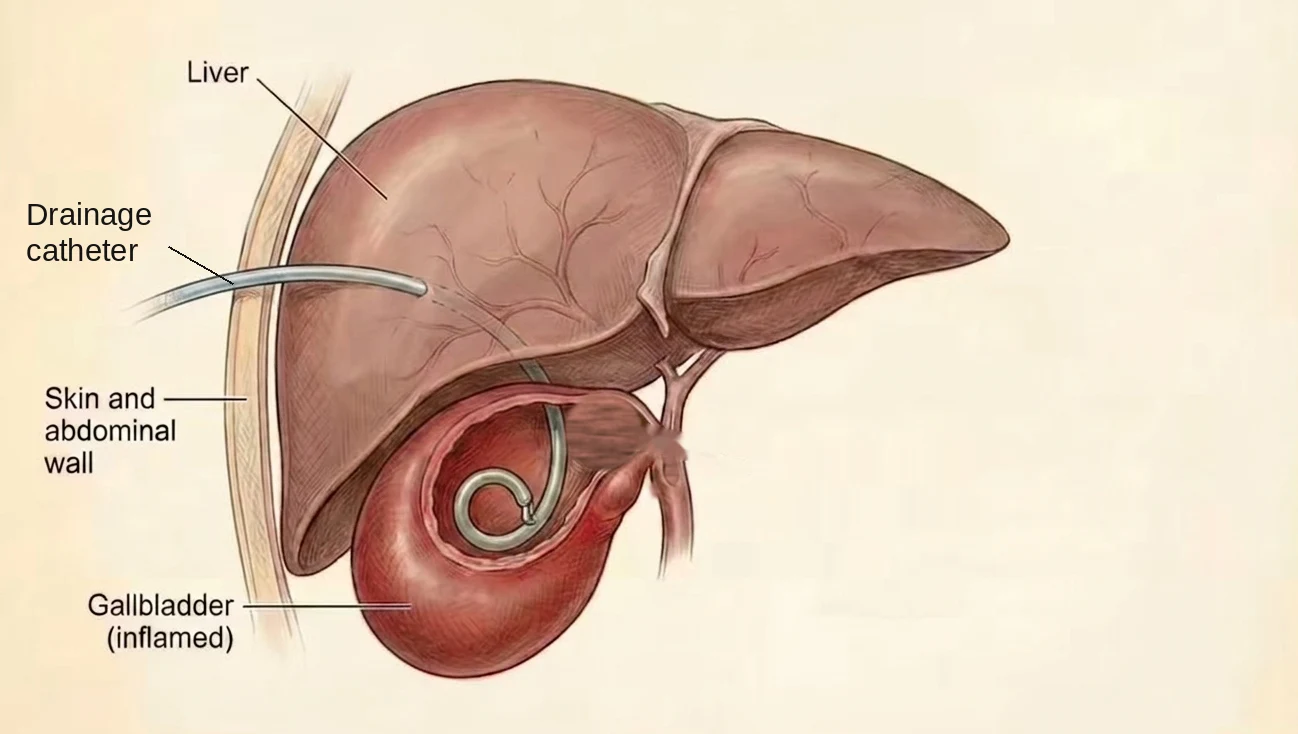
What I do. When the patient can safely undergo anesthesia, I remove the gallbladder. Cholecystectomy is the preferred definitive treatment.¹ For the rare patient in whom anesthesia itself is the greatest danger, a radiologist can place a small drain through the skin into the gallbladder to relieve the pressure and infection until the patient recovers (Figure 2).
Pain that continues after the gallbladder is out
Some people still have pain or stomach symptoms after their gallbladder is removed. Doctors have recognized this as post-cholecystectomy syndrome since 1947, and there is still no agreement on its cause, how to diagnose it, or how to treat it.⁴
That lack of agreement shows up in the numbers. A 2026 analysis that pooled nine studies and 2,948 patients found post-cholecystectomy syndrome in 3.2 percent.⁵ A 2025 review reported rates as high as 47 percent.⁴ StatPearls, a reference used by doctors, gives 5 to 30 percent.⁶ Without an agreed definition, the numbers vary this widely.
The causes fall into two groups.⁶
The first group comes from the bile system. A stone can be left behind in the bile duct. Bile can leak. The bile duct can narrow. The stump of the cystic duct that is left behind can form a stone. The muscle at the lower end of the bile duct, where it enters the intestine, can fail to relax. Symptoms can start soon after surgery or months to years later.⁶
Diarrhea after surgery also belongs to this group. I covered it in Post 12. It is usually temporary and it is treatable.
The second group was never the gallbladder. Acid reflux, a stomach ulcer, irritable bowel syndrome, and pancreatitis can all cause symptoms after surgery, and doctors can overlook them as the cause.⁶ Irritable bowel syndrome is common after gallbladder removal. A 2026 analysis of 17 studies found it in about 21 percent of patients. People who had their gallbladder removed were not significantly more likely to have irritable bowel syndrome than people who had not.⁷
What I tell patients. If you still hurt after surgery, call us. The search starts with blood work to check the liver and pancreas and then imaging of the bile ducts.⁶
The best prevention happens before the first operation. The 2025 review says careful patient selection before cholecystectomy helps prevent operations that were not needed.⁴
Gallbladder surgery through one incision
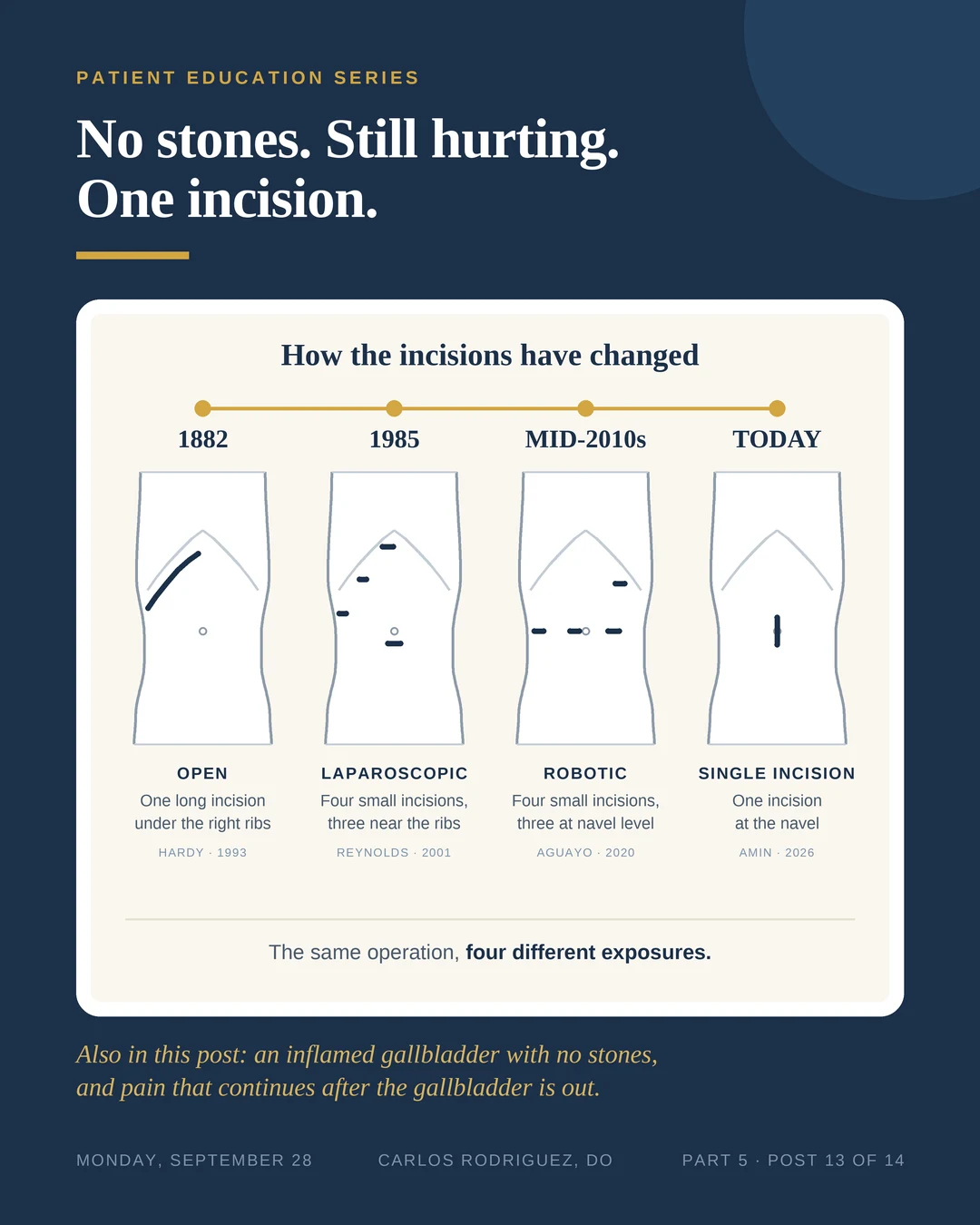
Figure 1 shows how the incisions for this operation have changed.
Open surgery, 1882. Carl Langenbuch performed the first gallbladder removal at the Lazarus Hospital in Berlin in July 1882.⁸ For about a hundred years the operation was done through one long incision.
Laparoscopic surgery, 1985. Erich Mühe of Böblingen, Germany, performed the first laparoscopic gallbladder removal on September 12, 1985.⁹ The German Surgical Society did not accept his work at first. Philippe Mouret of France performed the operation with four small incisions in 1987, and interest among general surgeons grew after that.¹⁰
Robotic surgery, mid-2010s. The first robotic gallbladder removal was reported from Belgium in 1998.¹¹ It stayed rare for years. In a national database of hospital admissions in the United States, robotic surgery accounted for 0.02 percent of inpatient gallbladder removals in 2008 and 3.2 percent in 2017.¹² This is how I perform the operation, through four small incisions.
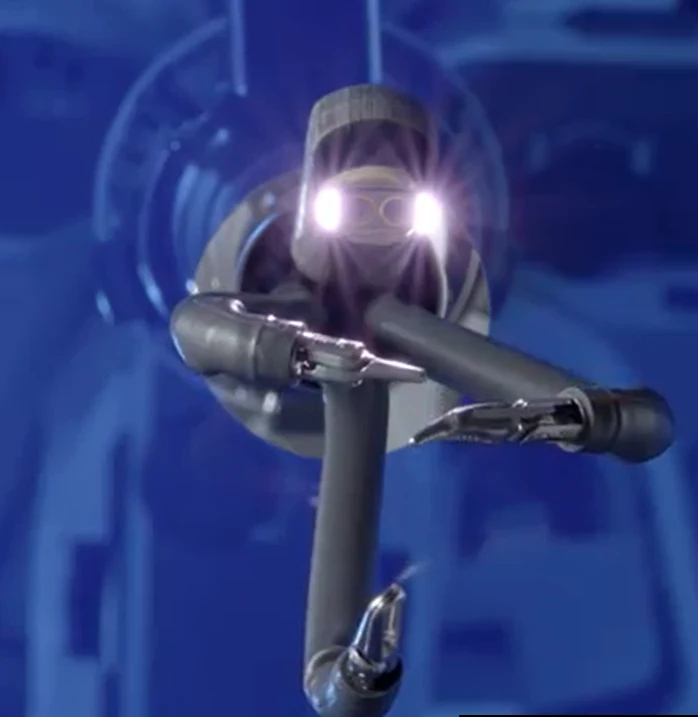
Single incision, today. Surgeons in Ferrara, Italy, described removing the gallbladder through one incision in 1997.¹³ The whole operation is done through a single incision in the navel. Robotic systems built for a single incision are newer (Figure 3). A 2026 analysis found only four studies comparing them with the standard robotic operation, and no randomized trials.¹⁴
What the studies show about one incision
The best evidence compares single-incision laparoscopic surgery with the standard four-incision laparoscopic operation. A 2019 analysis combined 48 randomized trials and 5,794 patients.¹⁵
- Hernias at the incision were more common after single-incision surgery, about two and a half times as often.
- The operation took about 15 minutes longer.
- Bile duct injury, bile leaks, wound infections, and pain after surgery were the same.
Another analysis of 37 trials found that patients rated the appearance of their scar and their body image better after single-incision surgery.¹⁶ A third analysis looked at that result more closely. When patients knew which operation they had, the cosmetic benefit was clear. When they did not know, the difference was small and not statistically significant.¹⁷
The newer single-incision robotic systems have not been tested in randomized trials. In a 2026 analysis of four observational studies and 833 patients, the single-port robotic system and the standard four-incision robotic system had similar safety.¹⁴ A large Korean study compared single-port robotic surgery with standard laparoscopic surgery in 340 matched pairs and found no difference in pain or in hernias that caused symptoms.¹⁸ Another Korean study found less pain and less need for pain medicine with the single-port robot than with single-incision laparoscopic surgery.¹⁹ Both Korean studies come from the same university system.
My practice. I perform gallbladder surgery robotically through four small incisions. I do not offer single-incision surgery.
This is Part 5 of the gallbladder series.
References
1. Jones MW, Santos G, Patel PJ. Acalculous Cholecystitis. StatPearls [Internet]. Treasure Island (FL): StatPearls Publishing; updated June 15, 2025. https://www.ncbi.nlm.nih.gov/books/NBK459182/
2. Munir MM, Khan S, Huerta S. Acalculous cholecystitis in the critically ill: evolving insights into diagnosis and management. Curr Opin Crit Care. 2026;32(2):162-172. https://pubmed.ncbi.nlm.nih.gov/41634928/
3. Favela JG, Argo MB, Huerta S. Aetiology, diagnosis and management for ischaemic cholecystitis: current perspectives. eGastroenterology. 2023;1(2):e100004. https://pubmed.ncbi.nlm.nih.gov/39943995/
4. Nam C, Lee JS, Kim JS, et al. Clinical perspectives on post-cholecystectomy syndrome: a narrative review. Ann Med. 2025;57(1):2496408. https://pubmed.ncbi.nlm.nih.gov/40304725/
5. Zhou H, Xuan F, Liu M. Incidence risk and risk factors for postcholecystectomy syndrome: a systematic review and meta-analysis. Medicine (Baltimore). 2026;105(7):e47687. https://pubmed.ncbi.nlm.nih.gov/41686575/
6. Zackria R, Lopez RA. Postcholecystectomy Syndrome. StatPearls [Internet]. Treasure Island (FL): StatPearls Publishing; updated August 28, 2023. https://www.ncbi.nlm.nih.gov/books/NBK539902/
7. Ra J, Rao S, Ramdass PVAK. Cholecystectomy and irritable bowel syndrome: a systematic review and meta-analysis of 3,511,681 patients. J Clin Med. 2026;15(14):5392. https://pubmed.ncbi.nlm.nih.gov/42513306/
8. Hardy KJ. Carl Langenbuch and the Lazarus Hospital: events and circumstances surrounding the first cholecystectomy. Aust N Z J Surg. 1993;63(1):56-64. https://pubmed.ncbi.nlm.nih.gov/8466463/
9. Reynolds W. The first laparoscopic cholecystectomy. JSLS. 2001;5(1):89-94. https://pubmed.ncbi.nlm.nih.gov/11304004/
10. Vecchio R, MacFayden BV, Palazzo F. History of laparoscopic surgery. Panminerva Med. 2000;42(1):87-90. https://pubmed.ncbi.nlm.nih.gov/11019611/
11. Himpens J, Leman G, Cadiere GB. Telesurgical laparoscopic cholecystectomy. Surg Endosc. 1998;12(8):1091. https://pubmed.ncbi.nlm.nih.gov/9685550/
12. Aguayo E, Dobaria V, Nakhla M, et al. National trends and outcomes of inpatient robotic-assisted versus laparoscopic cholecystectomy. Surgery. 2020;168(4):625-630. https://pubmed.ncbi.nlm.nih.gov/32762874/
13. Navarra G, Pozza E, Occhionorelli S, et al. One-wound laparoscopic cholecystectomy. Br J Surg. 1997;84(5):695. https://pubmed.ncbi.nlm.nih.gov/9171771/
14. Amin F, Ishfaq A, Ullah F, et al. Comparative outcomes of da Vinci SP versus da Vinci Xi platforms in robotic cholecystectomy: a systematic review and meta-analysis. J Robot Surg. 2026;20(1). https://pubmed.ncbi.nlm.nih.gov/42138767/
15. Lyu Y, Cheng Y, Wang B, et al. Single-incision versus conventional multiport laparoscopic cholecystectomy: a current meta-analysis of randomized controlled trials. Surg Endosc. 2020;34(10):4315-4329. https://pubmed.ncbi.nlm.nih.gov/31620914/
16. Haueter R, Schütz T, Raptis DA, et al. Meta-analysis of single-port versus conventional laparoscopic cholecystectomy comparing body image and cosmesis. Br J Surg. 2017;104(9):1141-1159. https://pubmed.ncbi.nlm.nih.gov/28569406/
17. Milas M, Deveđija S, Trkulja V. Single incision versus standard multiport laparoscopic cholecystectomy: up-dated systematic review and meta-analysis of randomized trials. Surgeon. 2014;12(5):271-289. https://pubmed.ncbi.nlm.nih.gov/24529791/
18. Choi YJ, Shin YL, Jeon SM, et al. Safety and feasibility of robotic single-port (SP) cholecystectomy compared to conventional laparoscopic cholecystectomy: a propensity score matching analysis. Surg Endosc. 2026;40(7):5626-5633. https://pubmed.ncbi.nlm.nih.gov/42301445/
19. Kim SM, Kim SJ, Song TJ, Han H. Single-port robotic cholecystectomy using the da Vinci SP system versus single-port laparoscopic cholecystectomy: comparative clinical outcomes. Surg Endosc. 2026;40(4):3158-3165. https://pubmed.ncbi.nlm.nih.gov/41606139/
Dr. Rodriguez served as a speaker and educator for Intuitive Surgical through June 2025. He has no current financial relationship with the company.