Two weeks ago I described the operation. Last week I described how it is kept safe. Before surgery, the question patients ask most often is what they will be able to eat afterward.
For nearly every patient, the answer is that the diet does not need to change. The reason has to do with how your body uses bile acid.
Your body reuses most of its bile acid
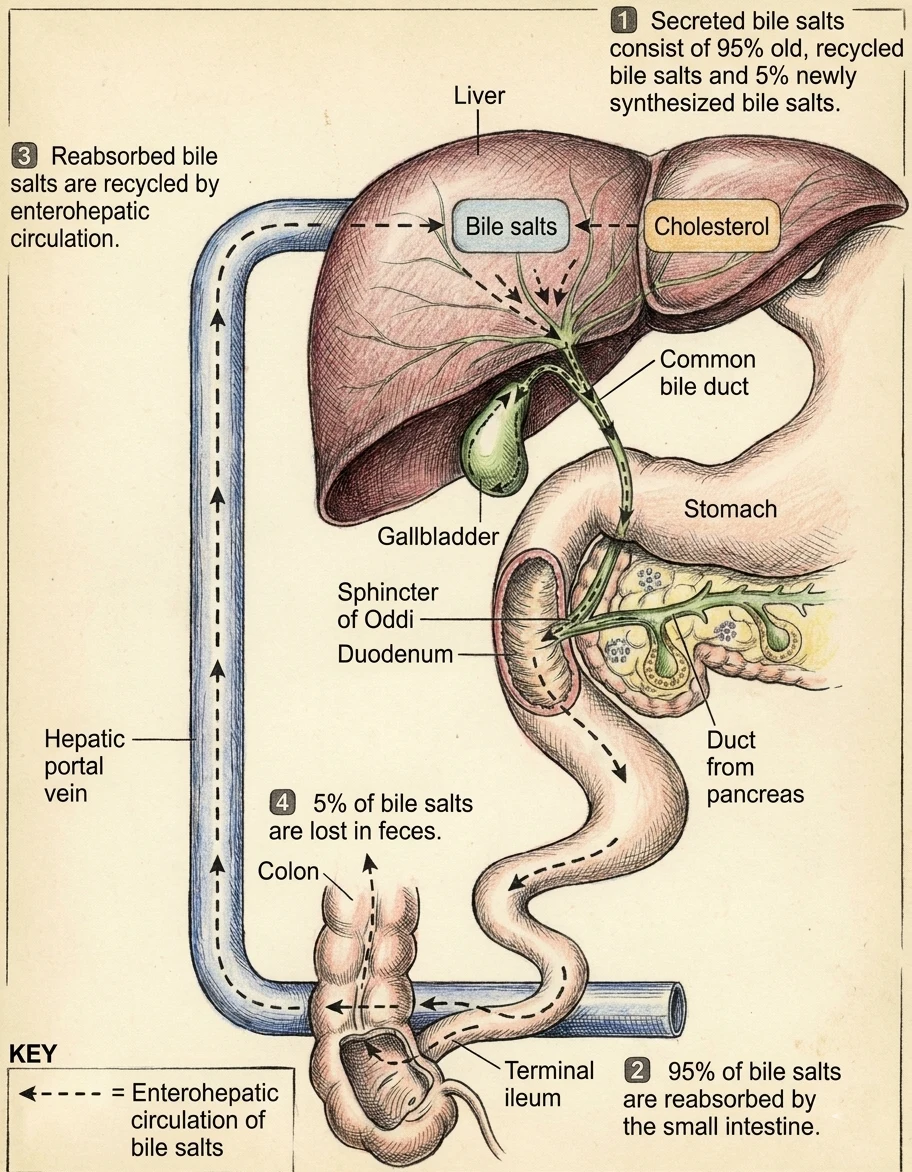
Bile acids are the part of bile that breaks down fat. Your liver makes them from cholesterol and releases them into the small intestine, where they break fat into droplets small enough to absorb.
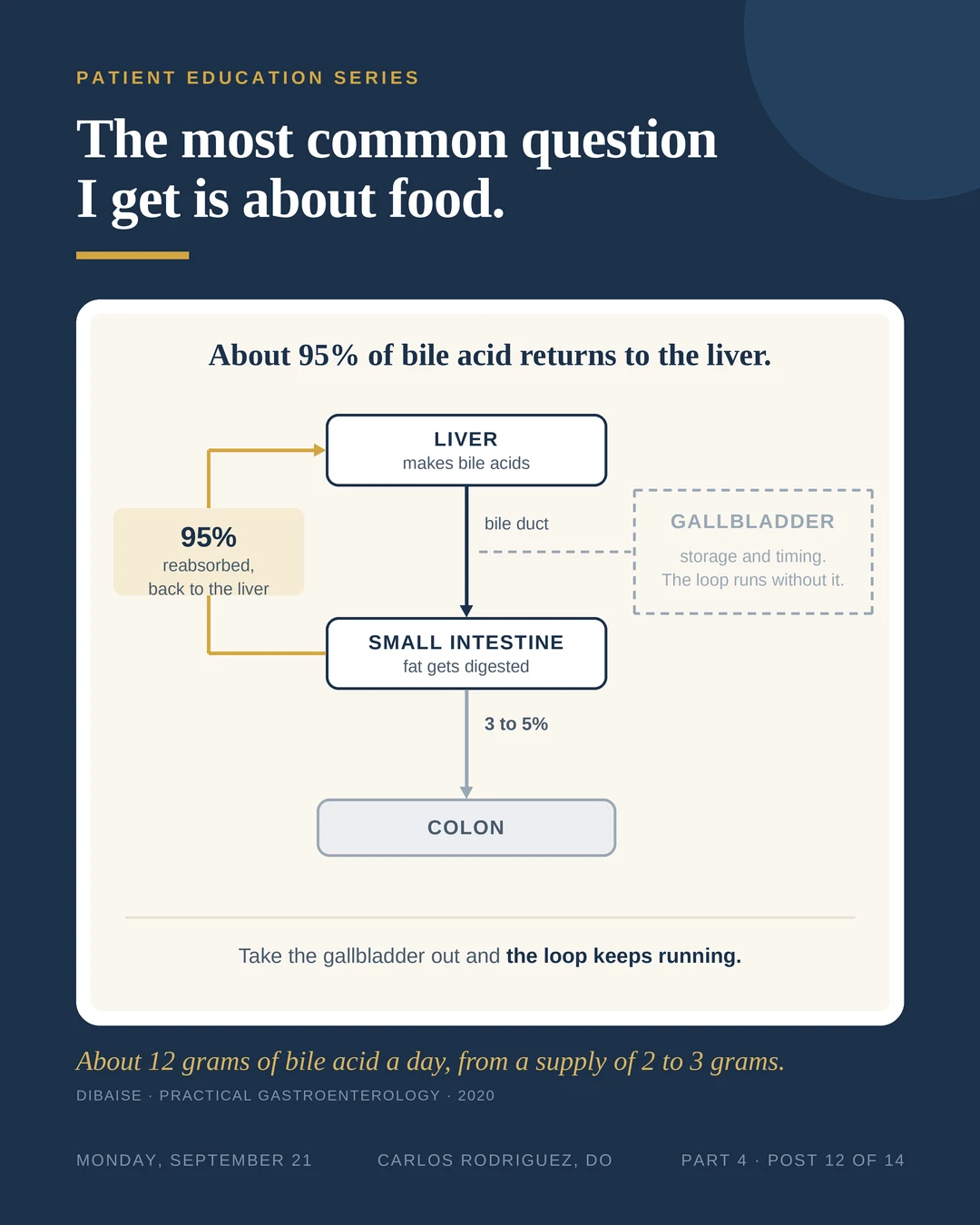
Bile acids are not used up in this process. In the last section of the small intestine, called the ileum, most of them are absorbed back into the bloodstream and carried to the liver, which releases them again. Your body's supply of bile acid makes this round trip, liver to intestine and back, four to six times a day.¹
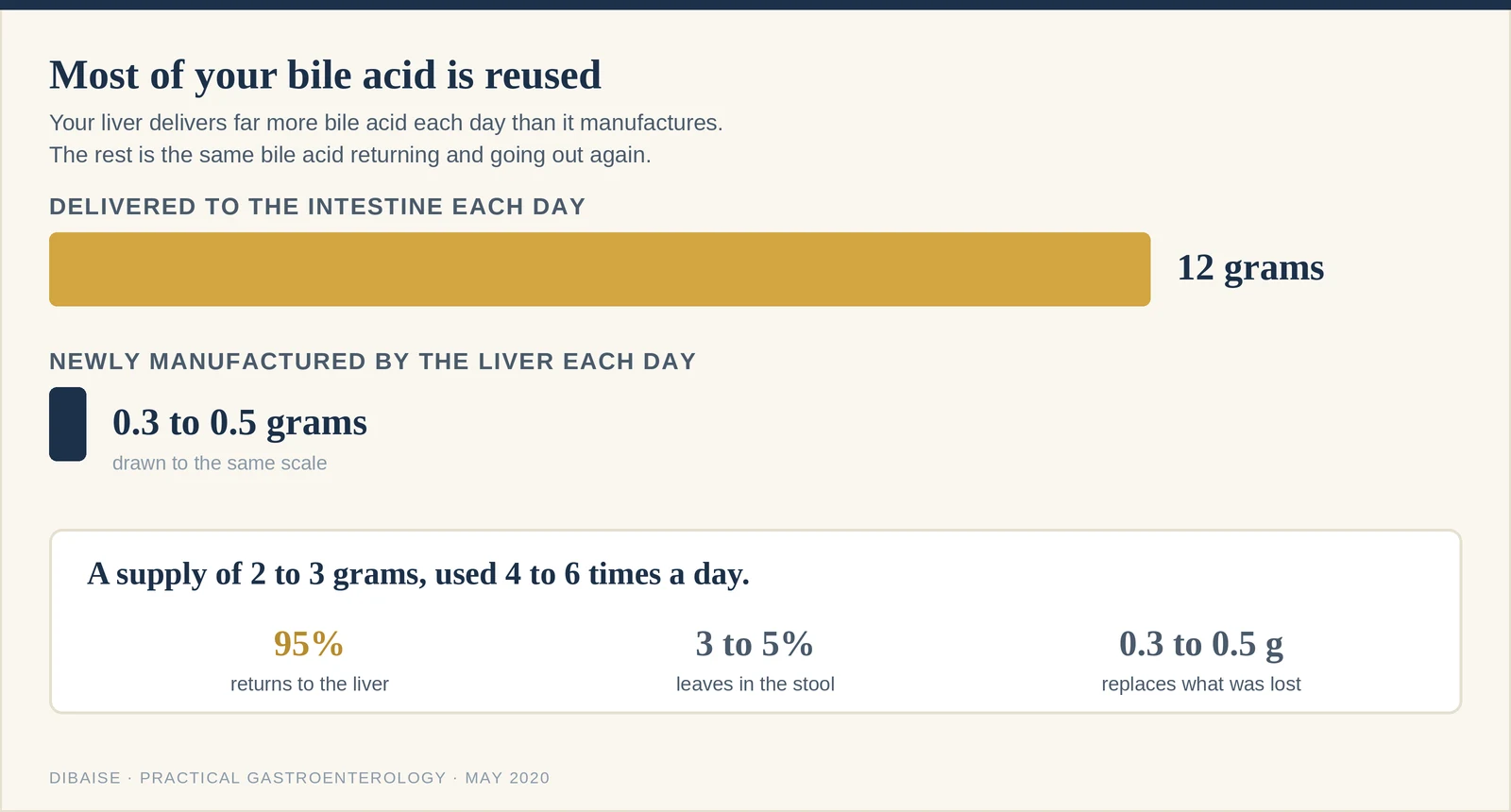
The numbers show how much of this bile acid is reused. Your liver delivers about 12 grams of bile acid into the intestine each day, but it makes only about 0.3 to 0.5 grams of new bile acid a day. The rest is bile acid that has already made the trip before. Your total supply at any time is only 2 to 3 grams.¹
About 95 percent of the bile acid returns to the liver. The 3 to 5 percent that does not return passes into the colon and leaves in the stool. The small amount of new bile acid the liver makes each day replaces that loss.¹
Doctors call this circuit the enterohepatic circulation. Entero means intestine. Hepatic means liver.
Where the gallbladder fits
The gallbladder is a storage reservoir. It sits on a short side branch off the main bile duct.
Between meals, bile flows into the gallbladder, which removes water and concentrates it. When you eat a meal that contains fat, the gallbladder squeezes and sends that concentrated bile into the intestine.²
The gallbladder controls when bile reaches the intestine and how concentrated it is. It does not make bile. The recycling of bile acid continues without it.
What changes when the gallbladder is removed
Without the gallbladder, bile flows from the liver into the intestine steadily, day and night, in a weaker concentration, whether or not you have eaten.
Your liver still makes bile acid, and your intestine still reabsorbs most of it. The main change is the timing of delivery. It affects your diet and your bowel habits.
Diet after surgery
Bile still reaches your intestine, so fat is still digested. There is no permanent low-fat diet after this operation.
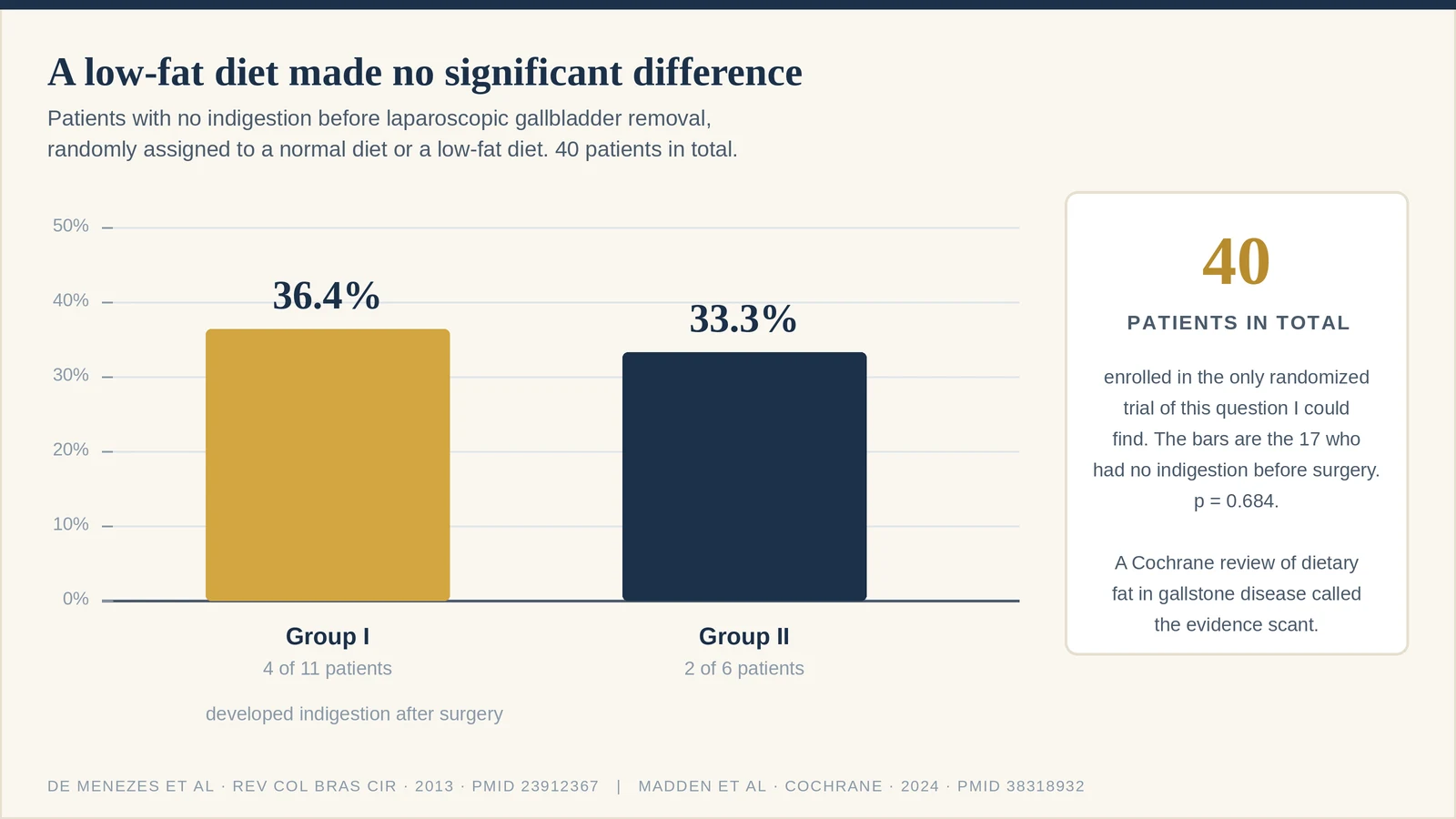
The evidence on diet after gallbladder removal is limited. I could only find one randomized trial that tested a low-fat diet after this operation. It enrolled 40 patients and assigned them to a normal diet or a low-fat diet. The study measured symptoms of indigestion after surgery.³
Seventeen of the 40 patients had no indigestion before surgery. Among them, new indigestion appeared in 4 of 11 patients in Group I and 2 of 6 patients in Group II, 36.4 and 33.3 percent. The difference was not significant. One group was assigned a normal diet and the other a low-fat diet. The study abstract does not say which group received which diet. The remaining patients already had indigestion before surgery and were excluded from this portion of the study. The authors concluded that the low-fat diet had no significant effect.³ Forty patients is a small trial.
A Cochrane review looked at a related question, changing dietary fat in people with gallstone disease. The reviewers found five trials, and only one, from 1986, reported a usable result. They noted that a low-fat diet has traditionally been advised and concluded that the evidence behind it is scant.⁴
I tell my patients to resume their normal pre-operative diet and to reintroduce fatty meals gradually. The gradual approach is for comfort while the body adjusts to the new timing. The evidence does not show that it is required.
Diarrhea after surgery, and why it happens
Some patients develop diarrhea after gallbladder removal. The change in bile delivery is the reason.
Before surgery, most bile reached the intestine when a meal was there to use it. After surgery, bile arrives continuously, including when no food is present. More bile acid than before reaches the colon.
In the colon, bile acids cause the lining to release water and salt into the stool.⁵ The result is loose, urgent stools.
A review combined 21 studies and 3,476 patients. It found that 462 of them, 13.3 percent, developed diarrhea after their gallbladder was removed.⁶ Different studies proposed age, sex and weight as predictors, but the studies did not agree, so there is no reliable way to tell in advance who will develop it.
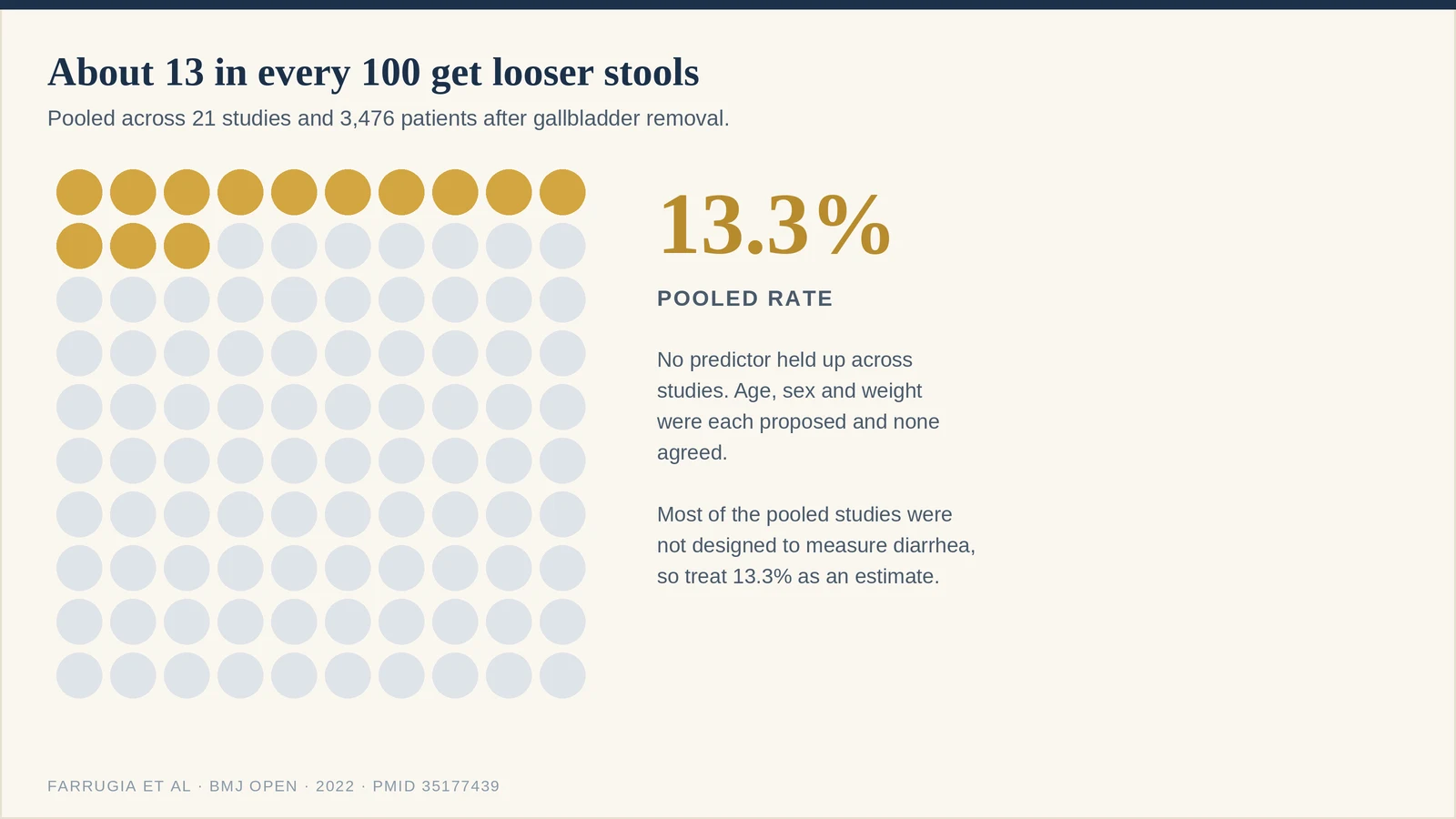
Most of the studies in that review were not designed to measure diarrhea, and they assessed symptoms in different ways, so 13.3 percent is an estimate rather than a precise figure.⁶
I discuss this with every patient at the preoperative appointment.
Why the diarrhea usually stops
In my experience, the diarrhea stops on its own in most patients, usually within two weeks.
The usual explanation is that the intestine adjusts to the new timing. As the ileum reabsorbs more of the bile acid that now arrives between meals, less of it reaches the colon, and the stools return to normal.
I could not find a study that measured how long this takes. One study followed 83 patients for six months after gallbladder removal. More than half had some change in bowel habit after surgery, and in 23 percent of cases the change was still present at six months.⁷
When the diarrhea does not stop
In a small group of patients, the diarrhea continues. One explanation would be that the ileum cannot absorb enough of the bile acid. The research points to a different cause.
Bile acid diarrhea is divided into three types by cause. The first comes from disease or surgical removal of the ileum. The second has no identified cause. The third, which includes diarrhea after gallbladder removal, comes from conditions that do not damage the ileum.⁸ By that classification, the ileum in these patients is working normally.
Researchers have measured a feedback loop that controls how much bile acid the liver makes. Two terms are needed to follow it.
FGF19, short for fibroblast growth factor 19, is a hormone. When the ileum absorbs bile acid, its lining releases FGF19 into the bloodstream. FGF19 travels to the liver and slows bile acid production. The more bile acid the ileum absorbs, the more FGF19 it releases, and the less new bile acid the liver makes.⁹
C4, short for 7-alpha-hydroxy-4-cholesten-3-one, is a blood test for bile acid production. The liver makes C4 on the way from cholesterol to bile acid, so a high C4 level means the liver is making more bile acid.⁹
In 2009, Walters and colleagues measured both in patients with bile acid diarrhea that had no other cause. Compared with people without diarrhea, FGF19 was low, a median of 120 compared with 231 pg/mL, and C4 was high, 51 compared with 18 ng/mL. The lower the FGF19, the higher the C4. FGF19 was also low in patients whose diarrhea began after gallbladder removal. The abstract reports only the FGF19 result for that group.⁹
The authors proposed that when FGF19 is low, the liver does not slow its production. It makes more bile acid than the ileum can normally reabsorb, and the extra reaches the colon.⁹ In that case, the problem is the amount of bile acid, not the ileum.
If the feedback is weak, why was there no diarrhea before surgery? The change from meal-timed delivery to continuous delivery is part of the answer.
Another study suggests that the gallbladder also makes FGF19. The gene for FGF19 was active in the gallbladder lining at about 250 times the level found in the lower small intestine, and gallbladder bile contained about 23 times the FGF19 concentration found in blood. In gallbladder cells grown in the laboratory, adding a bile acid increased FGF19 release, and more bile acid produced more FGF19. When the same group measured gallstone patients before and after surgery, C4 showed that bile acid production at least doubled after the gallbladder was removed, and the daily pattern of FGF19 in the blood changed, with a lower midday peak.¹⁰
The 250-fold figure measures how active the gene is in the tissue. It does not measure how much of the FGF19 in the blood comes from the gallbladder, and the study did not measure that.¹⁰
This suggests that removing the gallbladder may remove one source of FGF19, so the liver makes more bile acid. Why most patients handle the larger amount and a few do not has not been studied. One possibility is that the patients who develop lasting diarrhea have the least extra capacity to reabsorb it. That is my interpretation, not a finding.
That study measured FGF19 and bile acid production, not diarrhea. Bile acid diarrhea with no identified cause is also common on its own. It has been reported in about a third of people diagnosed with diarrhea-predominant irritable bowel syndrome.⁸ Some patients with lasting diarrhea after gallbladder removal may have had that condition before the operation.
Treatment
If the diarrhea has not stopped after two weeks, I prescribe a bile acid sequestrant such as cholestyramine, a medicine that binds bile acid in the intestine so it cannot irritate the colon. Between 70 and 96 percent of people with chronic diarrhea from this cause respond to a short course.⁸ The test used to diagnose bile acid diarrhea is called SeHCAT, short for 23-seleno-25-homotaurocholic acid.⁸ It is a nuclear medicine test, not a medicine. The patient swallows a capsule containing a radiolabeled bile acid, and a scan a week later measures how much the body kept. The test is unavailable in many countries,¹¹ and a trial of cholestyramine is an accepted alternative to testing.⁸
Whether changing the diet improves these symptoms has not been formally studied.¹¹
What I tell patients
There is no great data supporting dietary changes after gallbladder surgery. Resume your normal diet and reintroduce fatty meals gradually. If early post-operative diarrhea does not subside on its own, usually within two weeks, let us know and we will prescribe a bile acid binder.
This is Part 4 of the gallbladder series. Next week we will discuss special situations in gallbladder surgery: acalculous cholecystitis, post-cholecystectomy syndrome, and single-port cholecystectomy.
References
1. DiBaise JK. Does Your Patient Have Bile Acid Malabsorption? Practical Gastroenterology. May 2020;Series #198. https://med.virginia.edu/ginutrition/wp-content/uploads/sites/199/2020/05/Bile-Acid-Malabsorption-May-2020.pdf
2. Di Ciaula A, Garruti G, Lunardi Baccetto R, Molina-Molina E, Bonfrate L, Wang DQ, Portincasa P. Bile Acid Physiology. Ann Hepatol. 2017;16(Suppl 1):s4-s14. https://pubmed.ncbi.nlm.nih.gov/29080336/
3. de Menezes HL, Fireman PA, Wanderley VE, de Mendonca AMMC, Bispo RKA, Reis MR. Randomized study for assessment of hypolipidic diet in digestive symptoms immediately following laparoscopic cholecystectomy. Rev Col Bras Cir. 2013;40(3):203-207. https://pubmed.ncbi.nlm.nih.gov/23912367/
4. Madden AM, Smeeton NC, Culkin A, Trivedi D. Modified dietary fat intake for treatment of gallstone disease in people of any age. Cochrane Database Syst Rev. 2024;2(2):CD012608. https://pubmed.ncbi.nlm.nih.gov/38318932/
5. Huang RL, Huang WK, Xiao XY, Ma LF, Gu HZR, Yang GP. Diagnosis and treatment of post-cholecystectomy diarrhoea. World J Gastrointest Surg. 2023;15(11):2398-2405. https://pubmed.ncbi.nlm.nih.gov/38111762/
6. Farrugia A, Attard JA, Khan S, Williams N, Arasaradnam R. Postcholecystectomy diarrhoea rate and predictive factors: a systematic review of the literature. BMJ Open. 2022;12(2):e046172. https://pubmed.ncbi.nlm.nih.gov/35177439/
7. Ribas Blasco Y, Perez Munante M, Gomez-Fernandez L, Jovell-Fernandez E, Oms Bernad LM. Low-fat diet after cholecystectomy: should it be systematically recommended? Cir Esp. 2019;98(1):36-42. https://pubmed.ncbi.nlm.nih.gov/31623819/
8. Barkun AN, Love J, Gould M, Pluta H, Steinhart H. Bile acid malabsorption in chronic diarrhea: pathophysiology and treatment. Can J Gastroenterol. 2013;27(11):653-659. https://pubmed.ncbi.nlm.nih.gov/24199211/
9. Walters JRF, Tasleem AM, Omer OS, Brydon WG, Dew T, le Roux CW. A new mechanism for bile acid diarrhea: defective feedback inhibition of bile acid biosynthesis. Clin Gastroenterol Hepatol. 2009;7(11):1189-1194. https://pubmed.ncbi.nlm.nih.gov/19426836/
10. Barrera F, Azocar L, Molina H, Schalper KA, Ocares M, Liberona J, Villarroel L, Pimentel F, Perez-Ayuso RM, Nervi F, Groen AK, Miquel JF. Effect of cholecystectomy on bile acid synthesis and circulating levels of fibroblast growth factor 19. Ann Hepatol. 2015;14(5):710-721. https://pubmed.ncbi.nlm.nih.gov/26256900/
11. Walters JRF, Sikafi R. Managing bile acid diarrhea: aspects of contention. Expert Rev Gastroenterol Hepatol. 2024;18(9):521-528. https://pubmed.ncbi.nlm.nih.gov/39264409/