A direct hernia pushes through the floor of the inguinal canal. An indirect hernia comes through the internal ring, a few centimeters away. For your operation, the difference does not matter, because I repair both places at the same time.
Last week, I showed the two weak areas in the inguinal canal. This week, we look at the two kinds of inguinal hernia side by side, and what the difference means for your operation.
Part 1 is for patients. Part 2 is for medical students and residents.
Part 1: Two types of hernias in the inguinal canal
Two openings
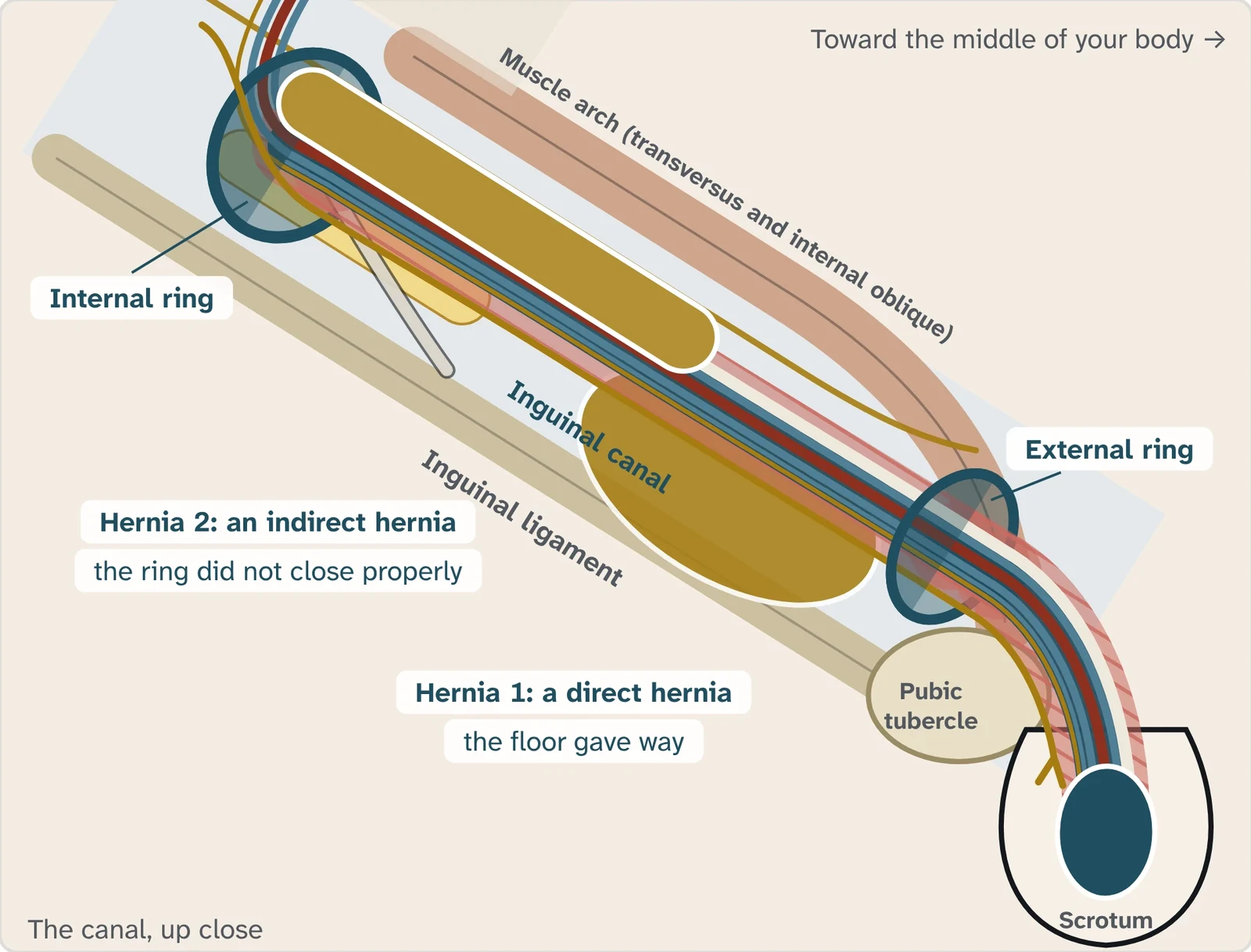
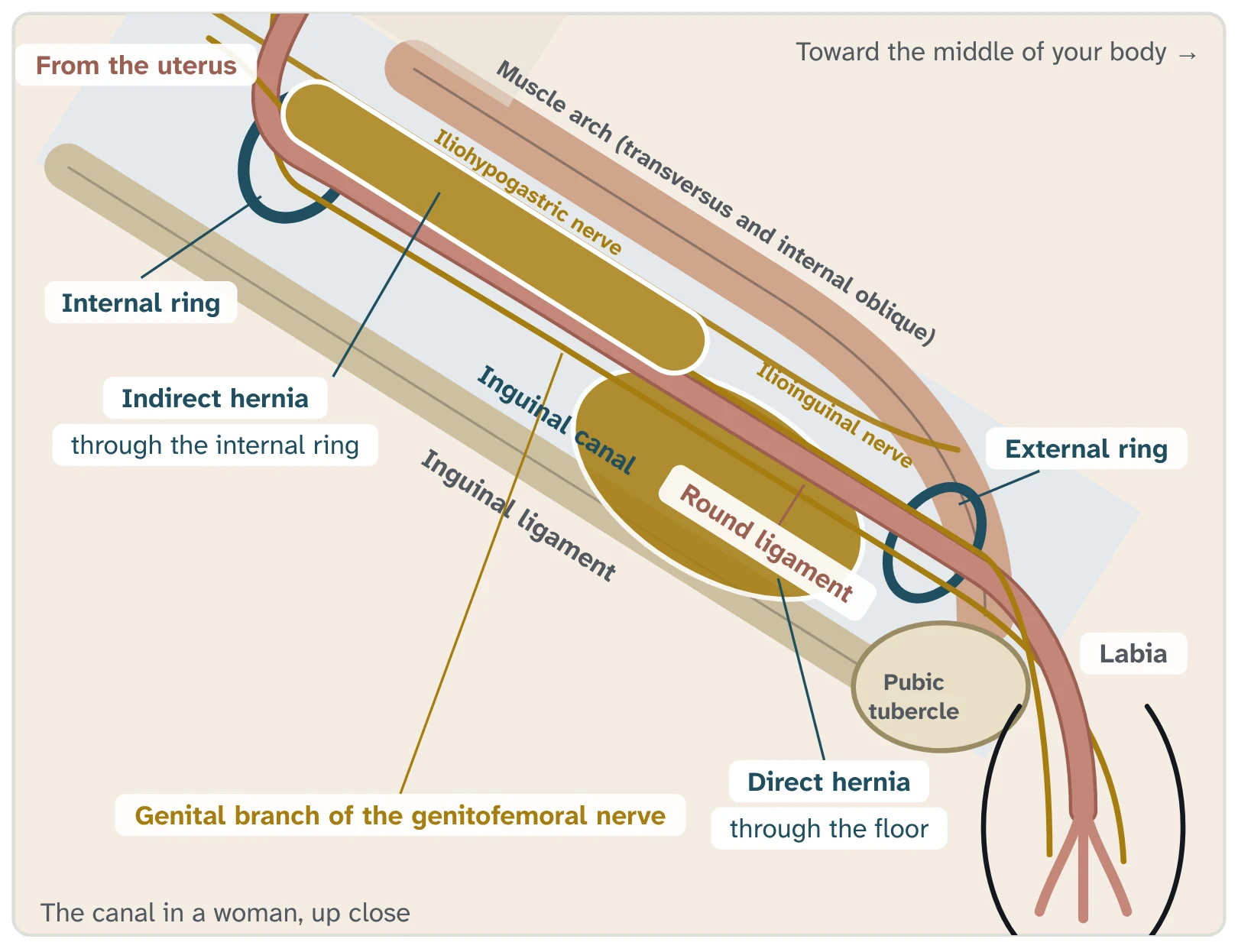
The inguinal canal is a short tunnel through the lower abdominal wall. It has an inside opening (the internal ring), and an external opening (the external ring). In a man, the spermatic cord runs through the canal (Figure 1). In a woman, the round ligament does (Figure 2).
An inguinal hernia comes through the wall of the canal in one of two places:¹,²
- An indirect hernia comes through the internal ring and follows the canal. It uses the path the testicle took before birth.
- A direct hernia pushes straight through the floor of the canal, a little closer to the middle of the body. The floor likely weakened over time and gave way.
Which kind is more common?
Indirect hernias are the more common kind.² A Danish study followed more than 1.5 million working men and counted their first hernia repairs. Of 40,395 repairs, about 57 in 100 were indirect, 39 in 100 were direct and 4 in 100 were both kinds at once or were not recorded.³
What I see from the inside
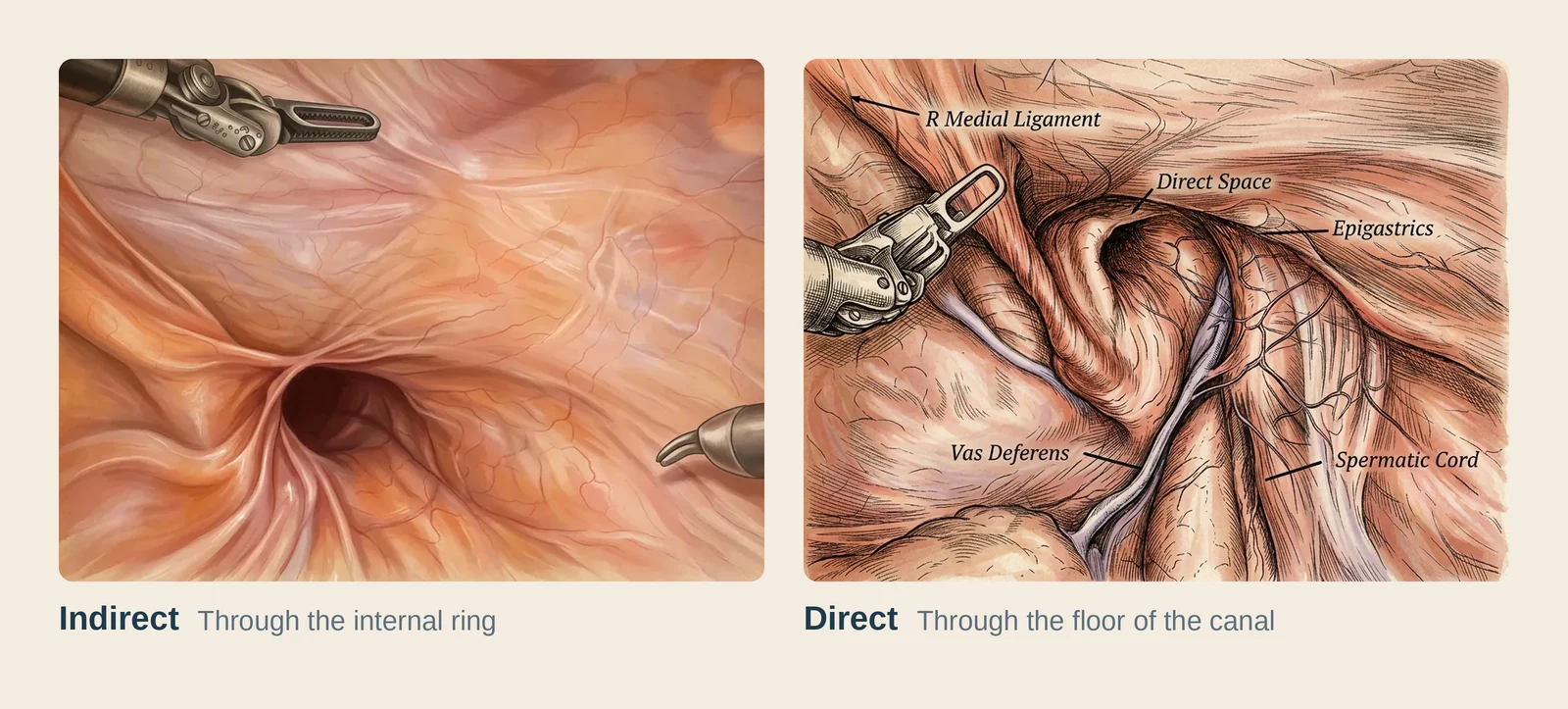
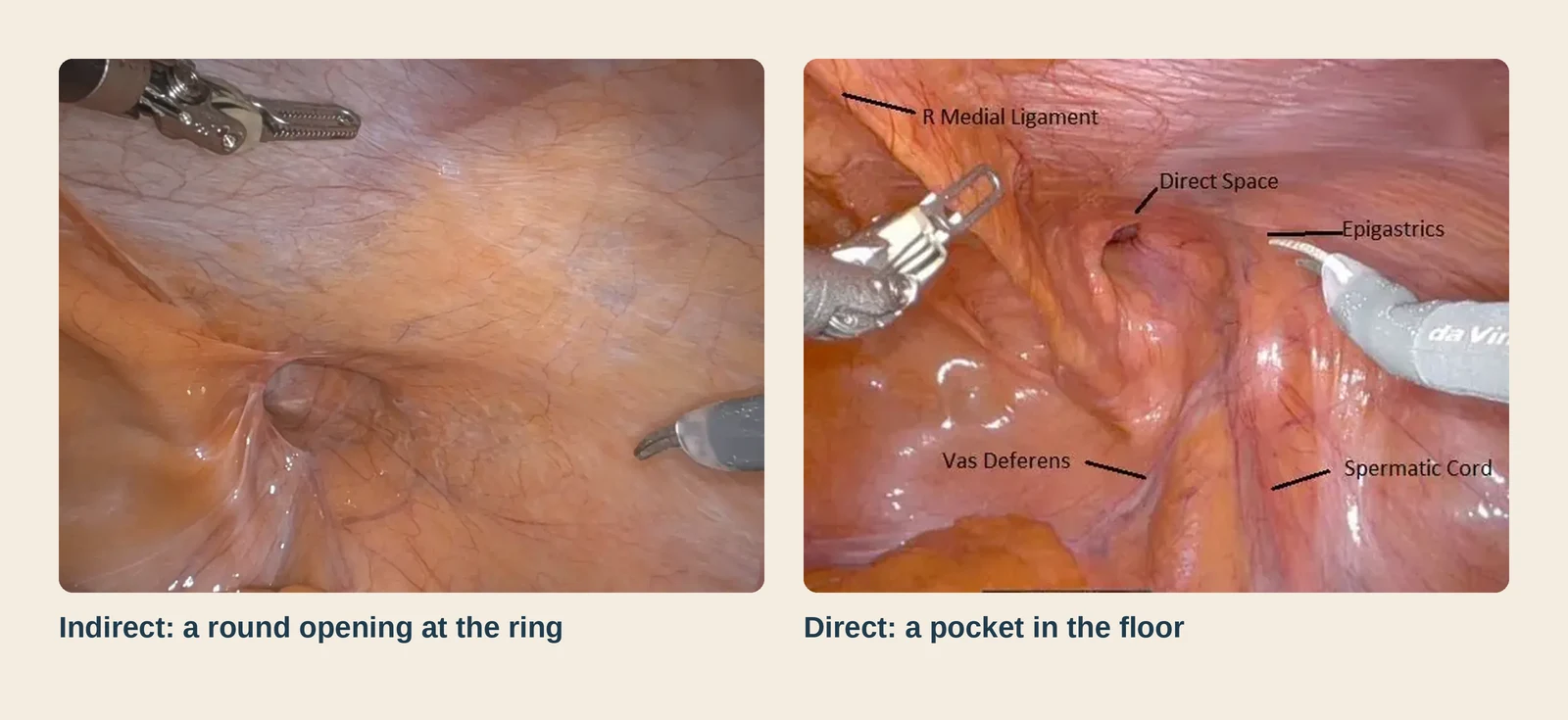
During a robotic repair, the camera looks at the inguinal region from inside the abdomen. The first landmark I find is a pair of blood vessels that run up the inside of the abdominal wall, the inferior epigastric artery and vein. An indirect hernia comes out lateral to the vessels, where a direct hernia comes out medial to the vessels.¹
Can a doctor tell which kind on exam?
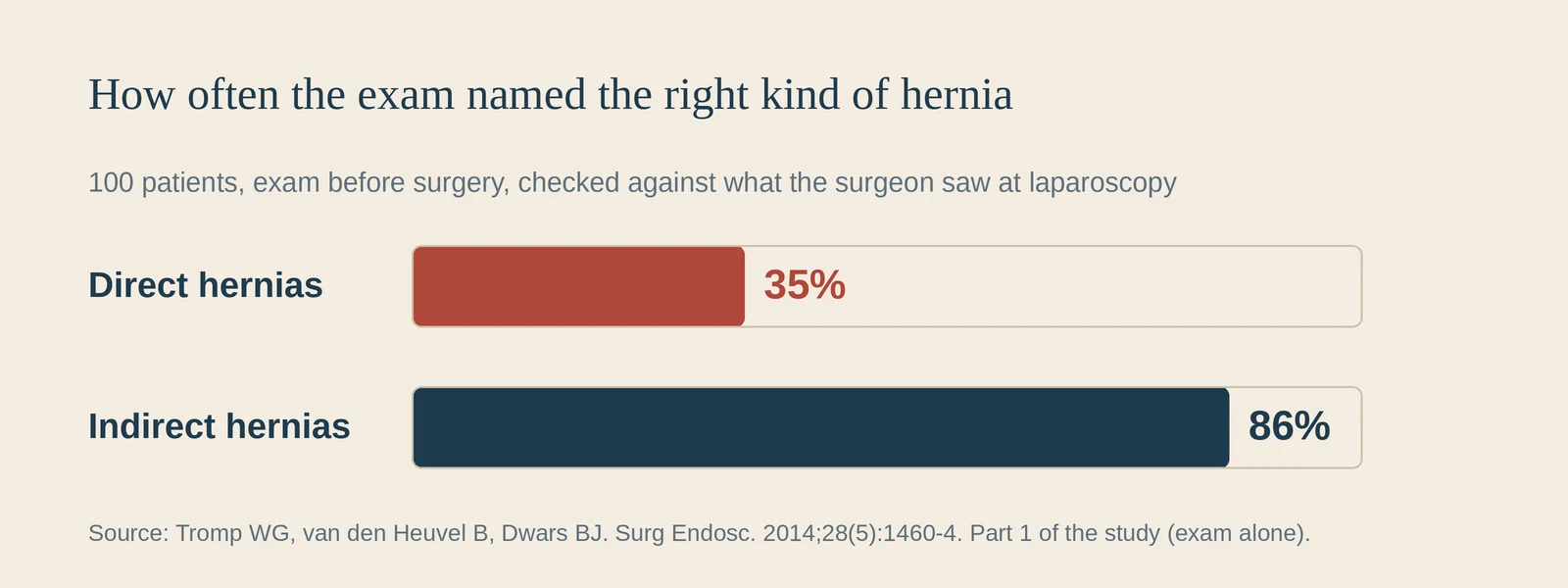
Not reliably. On Thursday I asked how often an exam picked the right kind for a direct hernia. The answer is C: about 1 in 3.
Surgeons in Amsterdam examined 100 patients before a laparoscopic hernia repair. They used a standard exam where the doctor presses over the internal ring while the patient strains, then decided which kind each hernia was. They checked each answer during the operation. The exam was right for 35% of the direct hernias and 86% of the indirect hernias (Figure 5).⁴
Other studies have done better. In a German study of 50 men with small hernias, the exam picked up 75% of the direct hernias.⁵ An ultrasound raised that to 90% in the German study, though it also called some hernias direct that were not.⁵ In the Amsterdam study, a small handheld device that finds the epigastric vessels by sound raised the exam's accuracy to 79% for direct hernias and 93% for indirect hernias.⁴
Why it does not change your operation
It does not matter which kind of hernia you have. I am able to visualize and repair both places at the same time.
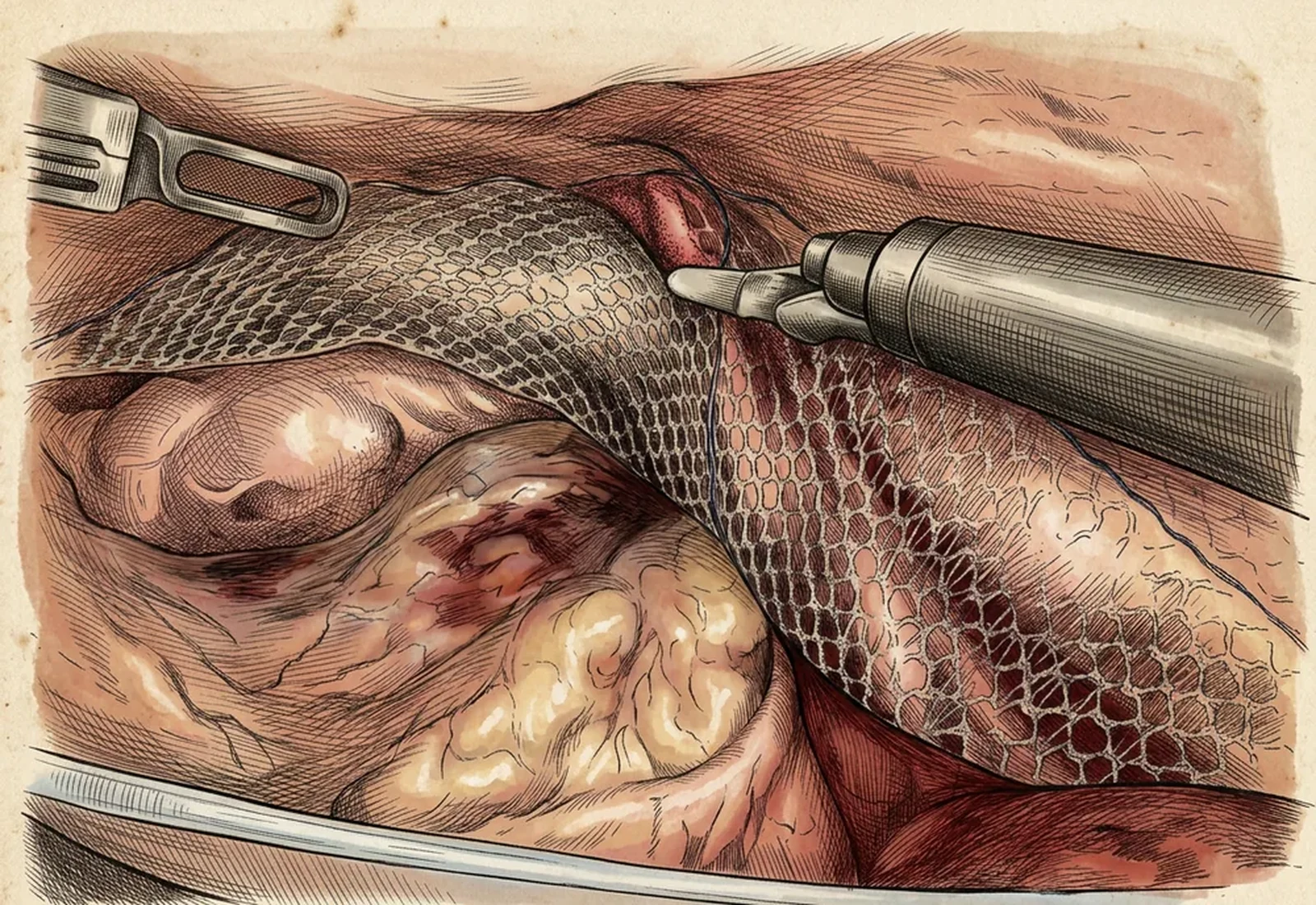
In a robotic repair, I look at every opening in the area from the inside: the internal ring, the floor of the canal, and the femoral opening just below them (we will cover femoral hernias in a later post). I am able to identify and reduce all hernias I encounter. One piece of mesh covers the entire area to minimize the risk of recurrence (Figure 6).⁶
In an open repair, I expose the entire inguinal canal. I inspect both the direct and indirect spaces (they are only separated by a few centimeters). I reduce either hernia (or both). The mesh I place covers the entirety of the inguinal canal, with tails extending beyond (and wrapping around) the internal ring.
International hernia guidelines describe the standard system for naming the kind of hernia as one that surgeons use during the operation. It was not built for naming the hernia beforehand.⁶,⁷
What this means for you
If your doctor feels a hernia, you may hear the words indirect or direct. Knowing which kind you have before surgery is not needed to plan the repair. I find out during the operation, and the repair covers both places either way.
Next week: two hernias that sit just below the inguinal region, femoral and obturator hernias.
Part 2: Resident Pearls
Resident Pearls
1. The inferior epigastric vessels separate indirect from direct hernias. The internal ring lies lateral to the inferior epigastric vessels. An indirect hernia exits through the internal ring, lateral to the vessels. A direct hernia protrudes through the floor of the canal, medial to them.¹ Öberg describes lateral hernias as arising from the internal ring, presumably through a patent processus vaginalis, and medial hernias as herniating through a presumably weakened transversalis fascia in Hesselbach's triangle.²
2. Physical examination is a poor predictor of hernia type. Tromp studied 200 consecutive patients in two parts, with laparoscopic findings as the reference. In part 1 (n = 100), the inguinal occlusion test correctly identified 35% of direct and 86% of indirect hernias. In part 2 (n = 100), adding a handheld Doppler to locate the epigastric vessels raised this to 79% and 93%.⁴ Korenkov examined 50 men with small hernias: exam sensitivity for direct hernia was 75% with a specificity of 100%, and color duplex sonography had a sensitivity of 90% and a specificity of 86%. Both combined hernias found at operation were missed by both methods.⁵ Lilly and Arregui reported that ultrasound identified the type correctly in 85% of 65 explored sides.⁸
3. The EHS classification is an operative classification. Miserez and the European Hernia Society proposed it for intraoperative description of hernia type and for comparing results across studies.⁷ HerniaSurge suggests its use for research, tailored treatment and audit, and notes that it was not developed to classify hernia types preoperatively.⁶
4. A posterior repair covers the whole myopectineal orifice. HerniaSurge states that a laparoscopic preperitoneal repair offers a thorough view of the entire myopectineal orifice and coverage of both inguinal and femoral defects. In the chapter on women, it adds that this approach removes the need for a correct preoperative diagnosis.⁶
5. Direct inguinal hernias have a higher recurrence rate. Öberg reports a higher risk of recurrence after repair of direct hernias.²
6. Cumulative lifting and standing raise the risk of an indirect hernia, not a direct one. Vad's cohort of 1,545,987 Danish men recorded 22,926 indirect, 15,877 direct and 1,592 combined (pantaloon) or unspecified first-time inguinal hernia repairs. Cumulative lifting and standing raised the risk of an indirect inguinal hernia, with an odds ratio of up to about 1.4. The risk of developing a direct inguinal hernia was in general unrelated to these exposures.³ Öberg notes that direct inguinal hernias lack a preformed defect. An indirect hernia can form through one, a patent processus vaginalis, which correlates with the higher risk of an indirect hernia under repeated rises in abdominal pressure.²
7. Connective tissue change is greater in direct hernias. Öberg concludes that connective tissue alteration is present in both types and appears more profound in direct hernias, with less collagen and more disorganized elastic fibers reported in the abdominal fascia of patients with direct hernias.²
8. The contralateral side. HerniaSurge recommends inspecting the contralateral side during TAPP. Clinically occult contralateral hernias are found in 13% to 22% of patients explored this way. Repairing one requires the patient's informed consent, obtained before surgery.⁶
References
1. Tuma F, Lopez RA, Varacallo MA. Anatomy, Abdomen and Pelvis: Inguinal Region (Inguinal Canal). In: StatPearls. Treasure Island (FL): StatPearls Publishing; updated July 24, 2023. https://www.ncbi.nlm.nih.gov/books/NBK470204/
2. Öberg S, Andresen K, Rosenberg J. Etiology of inguinal hernias: a comprehensive review. Front Surg. 2017;4:52. https://pubmed.ncbi.nlm.nih.gov/29018803/
3. Vad MV, Frost P, Bay-Nielsen M, Svendsen SW. Impact of occupational mechanical exposures on risk of lateral and medial inguinal hernia requiring surgical repair. Occup Environ Med. 2012;69(11):802-9. https://pubmed.ncbi.nlm.nih.gov/22935954/
4. Tromp WG, van den Heuvel B, Dwars BJ. A new accurate method of physical examination for differentiation of inguinal hernia types. Surg Endosc. 2014;28(5):1460-4. https://pubmed.ncbi.nlm.nih.gov/24399521/
5. Korenkov M, Paul A, Troidl H. Color duplex sonography: diagnostic tool in the differentiation of inguinal hernias. J Ultrasound Med. 1999;18(8):565-8. https://pubmed.ncbi.nlm.nih.gov/10447083/
6. HerniaSurge Group. International guidelines for groin hernia management. Hernia. 2018;22(1):1-165. https://pubmed.ncbi.nlm.nih.gov/29330835/
7. Miserez M, Alexandre JH, Campanelli G, et al. The European hernia society groin hernia classification: simple and easy to remember. Hernia. 2007;11(2):113-6. https://pubmed.ncbi.nlm.nih.gov/17353992/
8. Lilly MC, Arregui ME. Ultrasound of the inguinal floor for evaluation of hernias. Surg Endosc. 2002;16(4):659-62. https://pubmed.ncbi.nlm.nih.gov/11972209/
Dr. Rodriguez served as a speaker and educator for Intuitive Surgical through June 2025. He has no current financial relationship with the company.