Last week, we looked at the inguinal region from the inside, in men and in women. This week is about why that area gives way, and why lifting something heavy one time is rarely the cause.
Part 1 is for patients. Part 2 is for medical students and residents.
Part 1: Why a hernia forms
Could lifting something heavy one time cause a hernia?
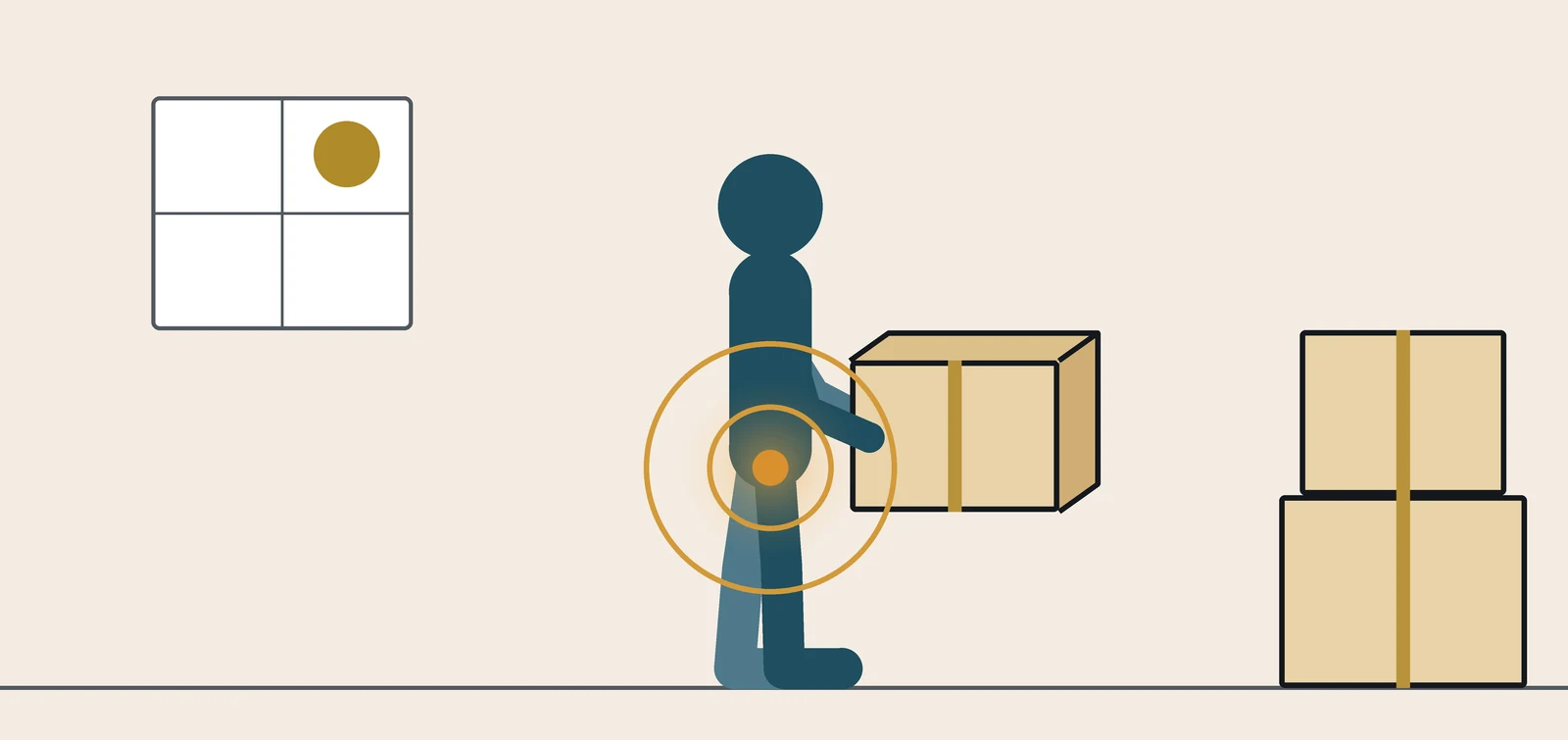
Rarely. About 1 in 4 people with an inguinal hernia blame it on lifting something heavy or one hard strain.¹ Moving a couch, lifting a bag of mulch, a long day at work. The bulge showed up soon after, so the lift gets the blame (Figure 1).
The research does not support that. A review of five studies looked at 983 inguinal hernias. Patients blamed 26% of them on a single strenuous event. Two of those studies checked the patients against a strict set of medical criteria, and only 2 of 54 patients met all of them.¹
Those criteria come from surgeons in Cardiff, Wales, who wrote them in 1996 to help decide work injury claims.² For a hernia to be blamed on one event, all four of these have to be true:¹
- The event was reported. It was written down at the time, for example in an accident report at work.
- It hurt right away. There was severe pain at the moment of the lift or strain.
- There was no hernia before. The person had no history of an inguinal hernia.
- A doctor found it soon after. A doctor diagnosed the hernia within 30 days of the event, and preferably within 3 days.
A hernia caused by one event should hurt when it happens and be found soon after. A hernia that formed over months or years usually does not fit that pattern, even if the bulge was first noticed after lifting something heavy.
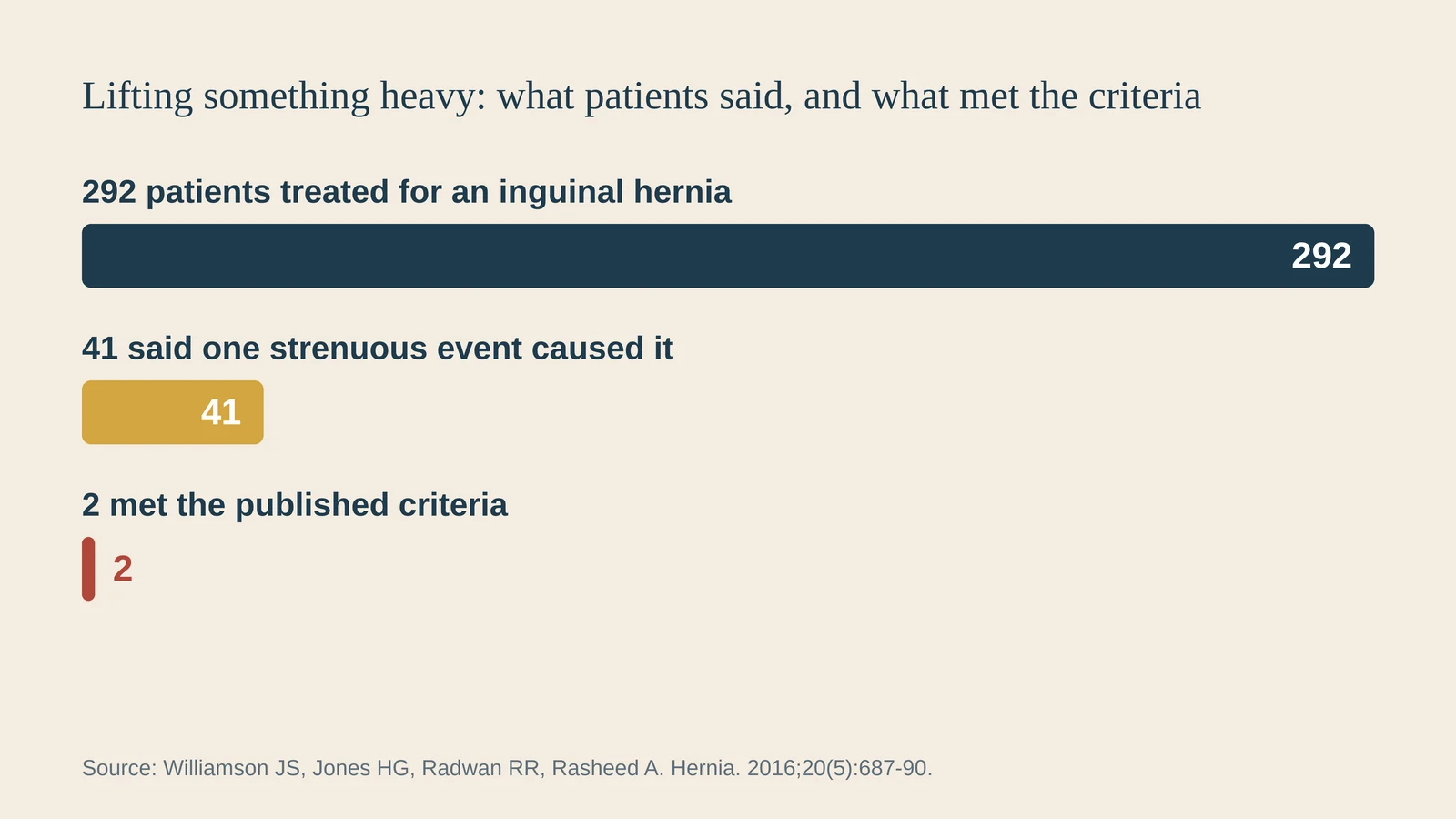
A hospital group in Wales surveyed patients treated for an inguinal hernia over one year, and 292 answered. Of those, 41 said one strenuous event started it. Only 2 met the published criteria, less than 1% of all the patients in the study (Figure 2).³ That was the question I asked on Thursday. The answer is C: 2 of the 41.
So why does it seem like lifting caused it? The hernia was forming before that day. The opening or the weak spot was already there. Lifting something heavy raises the pressure inside the abdomen and pushes tissue into that opening. That may be the first time you feel it or see the bulge. A 2008 review of hernias and work reached the same conclusion. Its authors wrote that a weakness present from birth, or one that develops over time, made the hernia "almost inevitable".⁴
What I see in the operating room
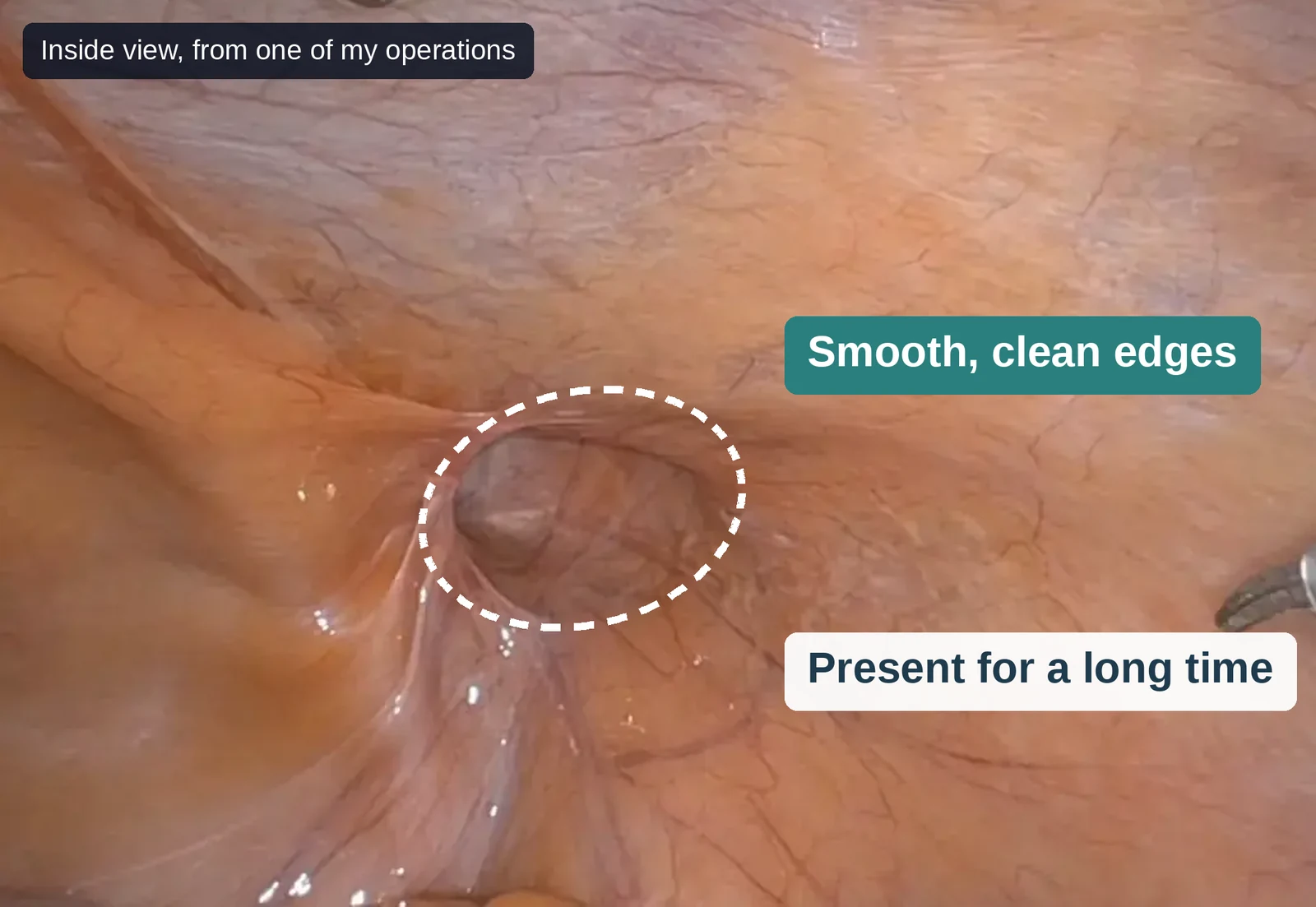
When tissue is torn suddenly, it swells, it bruises and it bleeds. Torn muscle bleeds. If lifting something heavy had torn open the inguinal region, I would expect to find swelling, bruising and blood when I operate.
That is not what I find. I see a hole with smooth, clean edges, in tissue that looks like it has been irritated for a long time (Figure 3). In my career, I have seen only one hernia that looked like a fresh tear from a single event.
What keeps the inguinal region closed
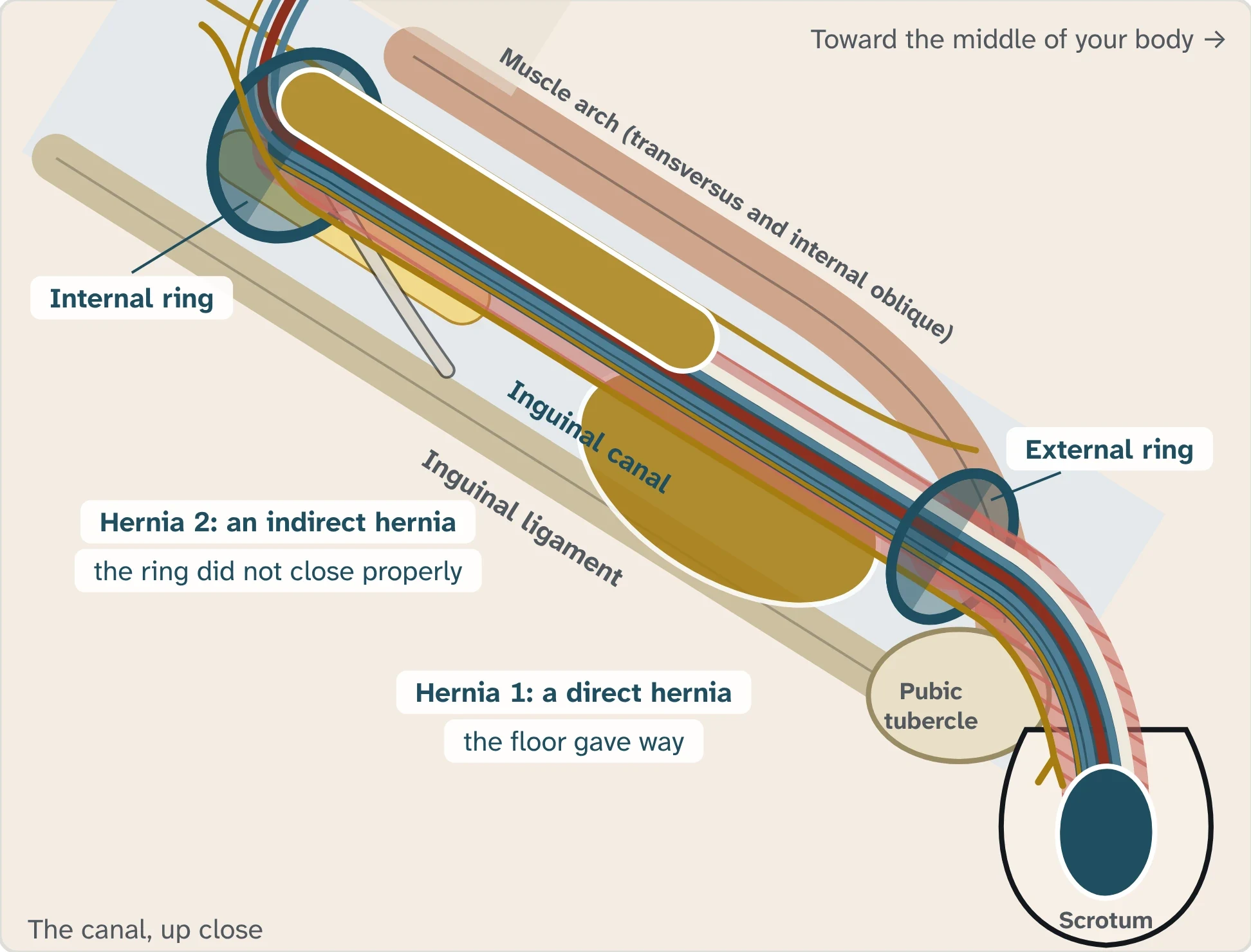
The inguinal canal is a short tunnel through the lower abdominal wall (Figure 4). In a man, the spermatic cord runs through it. In a woman, the round ligament does. A tunnel through a muscle wall is a natural weak point, and the body protects it in three ways:⁵
- The tunnel runs at an angle. The inside opening, the internal ring, does not line up with the outside opening, the external ring.
- The internal ring can tighten. The muscle around the internal ring can contract and make the opening smaller.
- The back wall holds. The back wall of the canal is a sheet of tough tissue called the transversalis fascia. Surgeons call it the floor of the canal. Like other connective tissue, it gets its strength from collagen, the protein that makes tissue strong.
Two places it gives way
A hernia forms where one of those protections fails. Figure 4 shows the two places.
An indirect hernia comes through the internal ring. When the testicle moves down before birth, a thin pouch of the lining of the abdomen goes with it through the ring. The pouch is supposed to close. When it stays open, a hernia has a path already made for it.⁵ Last week I showed you a study from the Netherlands. About 1 in 8 adults had an open pouch, and over the next five years they were four times more likely to need a hernia repair.⁶ Not everyone with an open pouch gets a hernia. In that study, most people with an open pouch had not needed a repair after five years.⁶
A direct hernia pushes through the floor of the canal. There is no pouch. The floor weakens over time and gives way. The tissue of people with direct hernias shows more changes in its collagen than the tissue of people with indirect hernias.⁵
Next week, I will show both kinds side by side.
Why men get them more often
A study from England estimated that more than 1 in 4 men will have an inguinal hernia repair at some point in life. For women, it is about 3 in 100.⁷ A study in the United States followed more than 13,000 adults for about 18 years. In that time, 13.9% of the men were diagnosed with an inguinal hernia, compared with 2.1% of the women.⁸
The reason goes back to the trip the testicle takes before birth, which I showed in IH 1, How the Inguinal Region Forms. A baby boy's testicles form inside the abdomen, high in the back, near the kidneys. Before birth, each testicle moves down, passes through the inguinal canal and reaches the scrotum. The thin pouch of lining described above goes with it.
When that trip is over, the internal ring in a man has to stay open wide enough for the whole spermatic cord: the tube that carries sperm, the blood vessels of the testicle and small nerves. In a woman, only the thin round ligament passes through the ring. A larger opening makes it easier for a hernia to form.⁵ An open pouch is also more common in males than in females.⁵
What raises the risk
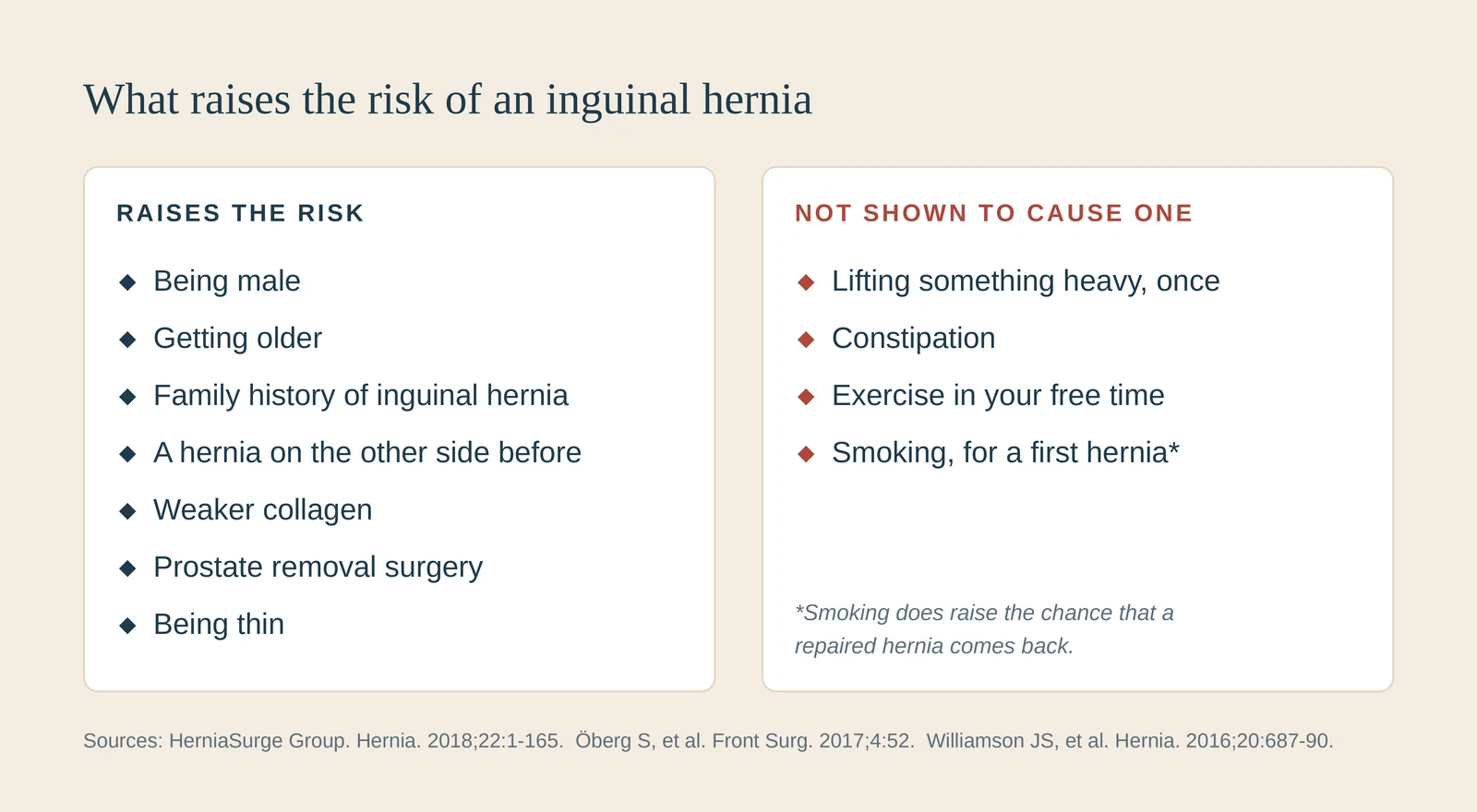
International hernia guidelines list these risk factors for an inguinal hernia:⁹
- Being male
- Getting older
- A family history of inguinal hernia
- A hernia on the other side in the past
- Collagen that is weaker than normal
- Prostate removal surgery
- Being thin
Figure 5 puts them next to the things that have not been shown to cause a hernia.
Family history. A review of 11 studies covering more than 37,000 people found that a family history of inguinal hernia raised the risk of getting one.¹⁰ Hernias run in families, though no one has found a clear pattern of inheritance.¹⁰
Age. In the US study, men aged 40 to 59 were 2.2 times as likely to develop an inguinal hernia as younger men. Men aged 60 to 74 were 2.8 times as likely.⁸ Collagen in the abdominal wall decreases with age.⁵
A hernia on the other side. If you have had an inguinal hernia on one side, your chance of getting one on the other side later is higher. A review reported that about 11 out of every 100 people with an inguinal hernia have the other side repaired within 10 years.⁵ That also means about 89 out of 100 do not.
Collagen. Two main types of collagen give this tissue its strength. Type 1 is a thick, strong fiber. Type 3 is a thin one. People with inguinal hernias tend to have less of the strong type compared with the thin type.⁵ The same change shows up in their skin, away from the hernia. That suggests it is part of how a person's tissue is built, not only a result of the hernia.⁵
Being thin. Heavier men get fewer hernias in this area. A Swedish study followed 7,483 middle-aged men for up to 34 years. Men with obesity had a 43% lower risk of an inguinal or femoral hernia than men of normal weight.¹¹ Part of that may be that a hernia is easier to see and feel in a thin person.¹¹ Extra weight does seem to raise the chance that a hernia comes back after it is repaired.⁵
Years of heavy work
Lifting something heavy one time is rarely the cause. Years of heavy work may play a part. A Danish study followed more than 1.5 million working men. Men with the most years of heavy lifting and long hours on their feet had up to about 1.4 times the odds of needing an indirect hernia repair.¹² Heavy work did not raise the risk of a direct hernia repair.¹² The likely explanation is years of pressure on a pouch that never closed.⁵
Exercise in your free time, and the total weight lifted per day, did not raise the risk of needing a repair for either kind.⁵
What has not been shown to cause a hernia
- Lifting something heavy one time, or one strain, as above.¹,²,³,⁴
- Constipation does not appear to be a risk factor.⁵
- Smoking raises the chance that a repaired hernia comes back. Whether it causes a first hernia is not clear.⁵
What this means for you
If you have an inguinal hernia, you did not cause it by lifting something heavy one time. It was forming before that day. Most of the risk factors on the list, like being male, your age and your family history, are things no one controls.⁹ A hernia also will not heal on its own.
Next week, I will show the two kinds of inguinal hernia, indirect and direct, side by side.
Part 2: Resident Pearls
Resident Pearls
1. Smith's criteria. Smith, Crosby and Lewis proposed them in 1996 after reviewing 129 consecutive patients with 145 inguinal hernias at the University Hospital of Wales. Only 7% of patients attributed the hernia to a single muscular strain, and the authors offered the criteria to help assess cause in industrial injury claims.² As summarized by Patterson, all four must be met: the event was officially reported, there was severe pain at the time of the event, there was no prior history of inguinal hernia, and the diagnosis was made by a doctor within 30 days, preferably within 3.¹ Patterson's systematic review found five eligible studies, all case series; only two applied Smith's criteria, and 2 of 54 patients met all four.¹ Williamson found 2 of 41 patients met published criteria, under 1% of all patients treated for inguinal hernia at one center over one year.³ Hendry's review concluded that immediate pain followed by a new diagnosis supports a link to the activity, but that an underlying congenital or acquired weakness likely made the hernia almost inevitable.⁴ When a patient asks you to tie a hernia to a work event, document the date and nature of the event, whether it was reported, pain at the time, any prior hernia history, and the date of first examination. The criteria depend on those four facts.
2. What an acute tear looks like. Acute tissue injury brings edema, hematoma and ecchymosis, and torn muscle bleeds. At operation, I find well-circumscribed defects with the appearance of chronic inflammation, not fresh hemorrhage or edema. I have seen one hernia in my career that looked like an acute traumatic injury. This is my operative experience, not a study. It agrees with how rarely Smith's criteria are met.¹,³
3. Three things protect the inguinal region. Öberg ties the integrity of the abdominal wall to the orientation of the inguinal canal, the transversalis fascia, and the sphincter-like function of the internal ring.⁵
4. Lateral and medial hernias have different causes. In Vad's cohort of 1,545,987 Danish men, cumulative lifting and standing raised the risk of lateral (indirect) repair, with odds ratios up to about 1.4. Standing-years remained the most robust exposure after adjustment for lifting. Medial (direct) repair was in general unrelated to these exposures, and the authors estimated a preventive potential of about 15%.¹² Cumulative exposure did not predict lateral re-operation.⁵
5. A patent processus vaginalis raises the risk of an indirect hernia, but most adults who have one do not develop a hernia. Asymptomatic patency is reported in 6% to 19% of adults.⁵ Van Veen inspected both internal rings in 599 consecutive adults, most of them women, during transperitoneal laparoscopy done for other reasons; 337 were available at a mean follow-up of 5.5 years. A patent processus was found in 12%. Hernia repair was needed in 12% of the patent group and 3% of the closed group, about four times the risk.⁶ Since 88% of the patent group had not needed a repair, patency alone does not explain an indirect hernia.⁵,⁶ The right testis descends later than the left, and in children born at term both a patent processus and an inguinal hernia are more common on the right.⁵
6. Medial hernias show the larger connective tissue change. Hernia patients have a lower type I to type III collagen ratio in abdominal wall tissue and in skin, and higher MMP-1, -2 and -9 in the transversalis fascia than controls. Lysyl oxidase is lower in medial hernias than in lateral hernias and controls.⁵ The skin findings point to a systemic change rather than a local response to the hernia.⁵
7. Higher BMI is linked to a lower risk of inguinal and femoral hernia. In NHANES I, overweight men had a hazard ratio of 0.79 for inguinal hernia and obese men 0.51.⁸ Rosemar found a 4% lower relative risk of inguinal or femoral hernia for each one-unit increase in BMI and a 43% lower risk with obesity. Heavy smokers also had a 26% lower risk in that cohort.¹¹ Rosemar suggests a hernia may be easier to detect in a lean man, but a true protective effect cannot be excluded.¹¹ High BMI seems to raise the risk of recurrence after repair.⁵
8. Women have their own risk profile. In NHANES I, inguinal hernia in women was associated with older age, rural residence, greater height, chronic cough and umbilical hernia.⁸ In men, hiatal hernia carried a hazard ratio of 1.8.⁸
9. Inguinal hernias are heritable. A family history raises the risk of a primary hernia and is linked to earlier recurrence.¹⁰ A nationwide study found familial clustering most prominent for daughters of mothers who had inguinal or femoral hernia surgery, and four susceptibility loci that seem to be tied to connective tissue homeostasis have been reported.⁵
10. Prostate. HerniaSurge lists prostatectomy as a risk factor.⁹ For prostatic hypertrophy, Öberg describes only a weak association.⁵
11. The contralateral side. About 11% of patients with a primary inguinal hernia have a contralateral repair within 10 years.⁵ Öberg argues against routine bilateral repair given the 10% to 12% risk of chronic pain.⁵ HerniaSurge recommends inspecting the contralateral side during TAPP after consent.⁹
References
1. Patterson T, Currie P, Spence R, McNally S, Spence G. A systematic review of the association between a single strenuous event and the development of an inguinal hernia: a medicolegal grey area. Surgeon. 2018;16(5):309-314. https://pubmed.ncbi.nlm.nih.gov/29534851/
2. Smith GD, Crosby DL, Lewis PA. Inguinal hernia and a single strenuous event. Ann R Coll Surg Engl. 1996;78(4):367-8. https://pubmed.ncbi.nlm.nih.gov/8712653/
3. Williamson JS, Jones HG, Radwan RR, Rasheed A. Inguinal hernias associated with a single strenuous event. Hernia. 2016;20(5):687-90. https://pubmed.ncbi.nlm.nih.gov/27178542/
4. Hendry PO, Paterson-Brown S, de Beaux A. Work related aspects of inguinal hernia: a literature review. Surgeon. 2008;6(6):361-5. https://pubmed.ncbi.nlm.nih.gov/19110825/
5. Öberg S, Andresen K, Rosenberg J. Etiology of inguinal hernias: a comprehensive review. Front Surg. 2017;4:52. https://pubmed.ncbi.nlm.nih.gov/29018803/
6. van Veen RN, van Wessem KJP, Halm JA, Simons MP, Plaisier PW, Jeekel J, Lange JF. Patent processus vaginalis in the adult as a risk factor for the occurrence of indirect inguinal hernia. Surg Endosc. 2007;21(2):202-5. https://pubmed.ncbi.nlm.nih.gov/17122977/
7. Primatesta P, Goldacre MJ. Inguinal hernia repair: incidence of elective and emergency surgery, readmission and mortality. Int J Epidemiol. 1996;25(4):835-9. https://pubmed.ncbi.nlm.nih.gov/8921464/
8. Ruhl CE, Everhart JE. Risk factors for inguinal hernia among adults in the US population. Am J Epidemiol. 2007;165(10):1154-61. https://pubmed.ncbi.nlm.nih.gov/17374852/
9. HerniaSurge Group. International guidelines for groin hernia management. Hernia. 2018;22(1):1-165. https://pubmed.ncbi.nlm.nih.gov/29330835/
10. Burcharth J, Pommergaard HC, Rosenberg J. The inheritance of groin hernia: a systematic review. Hernia. 2013;17(2):183-9. https://pubmed.ncbi.nlm.nih.gov/23423330/
11. Rosemar A, Angerås U, Rosengren A. Body mass index and groin hernia: a 34-year follow-up study in Swedish men. Ann Surg. 2008;247(6):1064-8. https://pubmed.ncbi.nlm.nih.gov/18520236/
12. Vad MV, Frost P, Bay-Nielsen M, Svendsen SW. Impact of occupational mechanical exposures on risk of lateral and medial inguinal hernia requiring surgical repair. Occup Environ Med. 2012;69(11):802-9. https://pubmed.ncbi.nlm.nih.gov/22935954/