An inguinal hernia does not go away on its own, but not every hernia needs surgery right away. For most men whose hernia causes no pain or only mild discomfort, waiting is a safe choice¹,². If your hernia no longer goes back in, call your doctor. If it no longer goes back in and hurts, or it turns red, call your doctor and go to the emergency department.
On Thursday, I asked how many men assigned to wait in a Dutch trial needed emergency surgery over 12 years. The answer is B, 4 in 100. Of 258 men, 10 had a hernia that suddenly became stuck and painful³.
Last week, we looked at inguinal hernias in women. This week covers the decision that comes after the diagnosis: when it is safe to wait, what usually happens over time, and the warning signs that mean you need care right away.
Part 1 is for patients. Part 2 is for medical students and residents.
Part 1: Wait or repair
Does an inguinal hernia go away on its own?
No. A hernia is an opening in the layers of muscle and tissue of the lower abdominal wall. In adults, that opening does not close by itself. No medicine or exercise closes it. You need surgery to fix it.
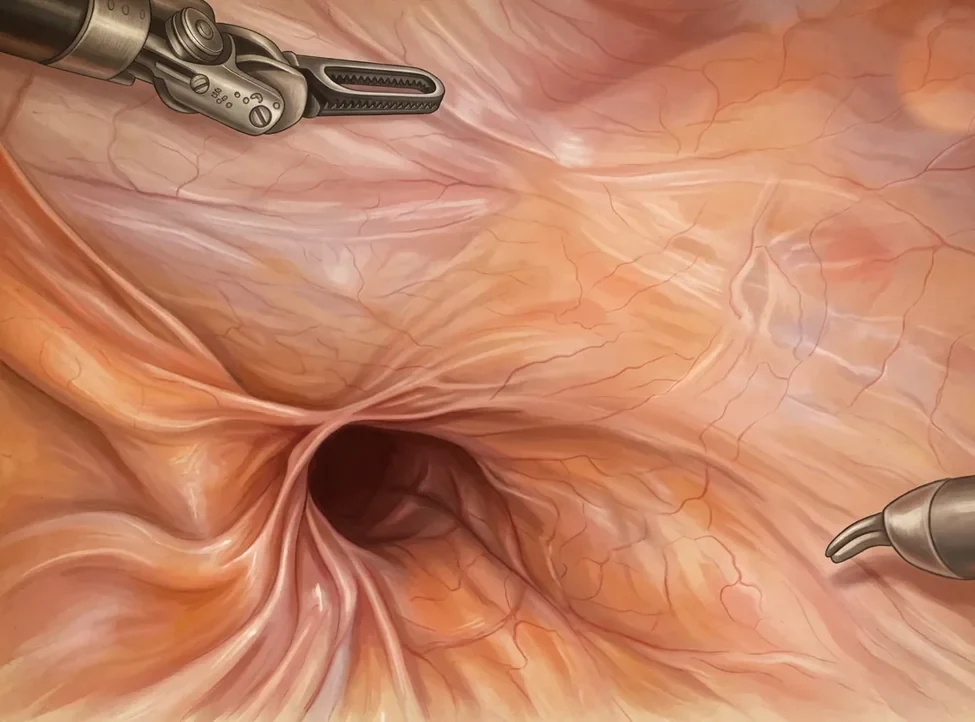
The real question is timing. Some hernias should be repaired soon. Others can be watched.
When is it safe to wait on an inguinal hernia?
Two large trials compared waiting with surgery in men whose hernias caused little or no pain. The men were picked at random to wait or to have surgery.
In the United States and Canada, 720 men were followed for up to four and a half years. Of the 364 men assigned to wait, 2 had a hernia that suddenly became stuck and painful. That works out to about 2 in every 1,000 men for each year of waiting. After two years, few men in either group had pain that limited their daily activities: about 5 in 100 of the men who waited and about 2 in 100 of the men who had surgery. The difference was small enough that it could have been chance². For these men, waiting was safe in the first two years, and emergencies were rare.
Why would anyone still have pain after surgery? Surgery fixes the hernia, but it does not always take away every ache. About 1 in 10 people have some lasting pain after a hernia repair, and it usually gets better over time. Pain bad enough to affect daily life or work happens in fewer than 6 in 100¹.
A Dutch trial followed 496 men age 50 and older for 12 years. In the men assigned to wait, 4 in every 100 had a hernia that suddenly became stuck and painful and needed emergency surgery over those 12 years³.
The international hernia guidelines say men with no symptoms or mild symptoms can be watched, because the risk of an emergency is low¹. Here, symptoms means pain or discomfort from the hernia.
In my practice, having a hernia is a reason to repair it. If you want it fixed, I will fix it. If you would rather not have surgery, we talk about your risk now and over the long term, and I tell you what to watch for. If you wait and later change your mind, I will fix it.
What happens if you wait on an inguinal hernia?
Most men who choose to wait and watch their hernia will eventually have surgery. The most common reason is that the hernia starts to hurt or becomes uncomfortable.
In the United States trial, 68 of every 100 men who started out watching were estimated to have surgery within 11 years. In men older than 65, it was 79 of every 100⁴. In the Dutch trial, 64 of every 100 had surgery within 12 years³. When the long-term results of three trials were combined, about 29 of every 100 men had surgery within 1 year, 52 within 5 years, and 71 within 10 years (Figure 2)⁵.
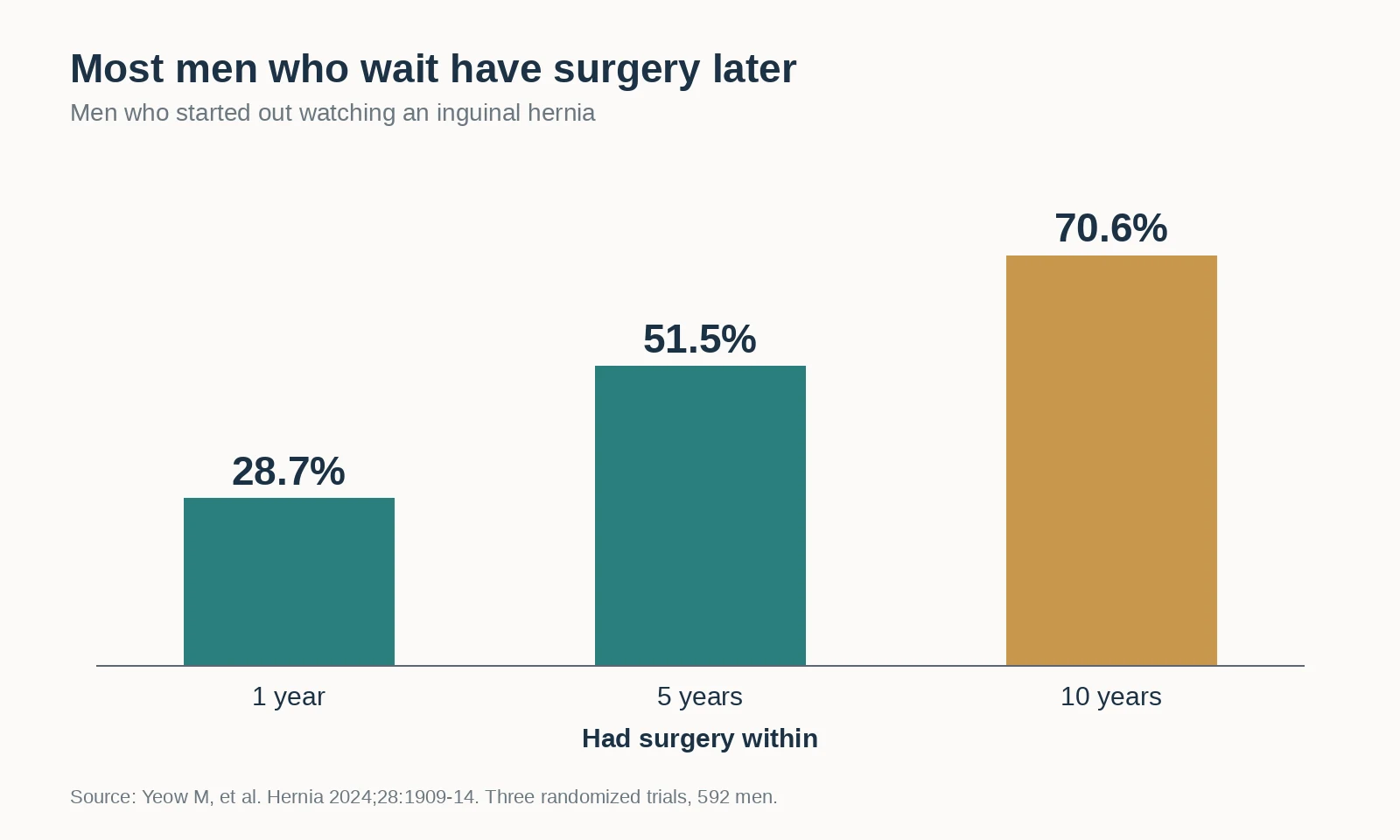
Waiting did not make the later operation riskier. In the United States trial, problems after surgery were about the same in men who had surgery right away and in men who waited first².
The Dutch trial asked each man a question: if you got another hernia, would you choose the same plan again? Of the men assigned to wait, 38 in 100 said no. They would choose surgery instead. Of the men who had surgery right away, 18 in 100 said no. They would choose to wait instead³.
Most men who wait will have surgery at some point. Waiting lets you choose when.
Should women wait on an inguinal hernia?
I recommend that women have their inguinal hernias repaired. The international guidelines also advise a timely repair for women and argue against waiting¹. One reason is the femoral hernia. In a woman, a femoral hernia can look like an inguinal hernia, and femoral hernias get stuck far more often. In Sweden, 17 of every 100 of these hernia operations in women were emergencies, compared with 5 of every 100 in men⁶.
When is an inguinal hernia an emergency?
Most inguinal hernias go back in when you lie down or press on them gently. The international hernia guidelines were updated in 2023. They now sort a hernia that will not go back in into three groups⁷:
- It has not gone back in for a long time, and nothing has changed. Doctors call this a chronically irreducible hernia. It is not an emergency. Many of my patients first come to see me for this. Call your doctor and make an appointment.
- It suddenly stopped going back in, and it hurts. Doctors call this an acutely irreducible hernia. This is an emergency. Call your doctor and go to the emergency department. A doctor there may be able to gently push it back in. If that works, you still need the hernia repaired, as a planned operation. If it does not work, you need surgery right away.
- The trapped tissue is losing its blood supply. Doctors call this a strangulated hernia. A doctor can only confirm it with a scan or during surgery, so when a doctor suspects it, you go to surgery right away. The hernia is usually very painful, hard or tender, and the skin over it may turn red, purple or dark.
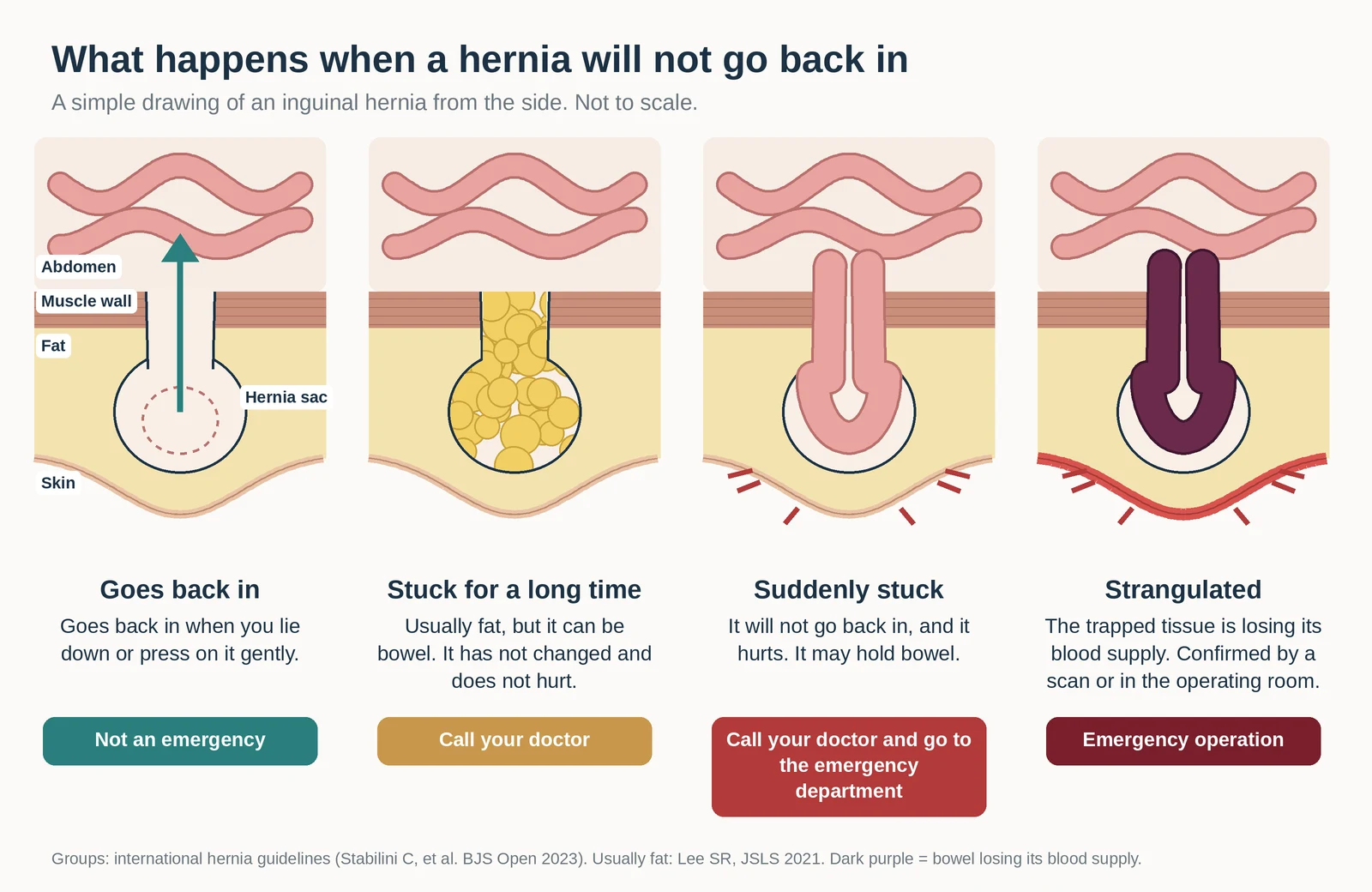
The guidelines dropped the old word "incarcerated" because it did not describe the problem of a hernia that suddenly gets stuck⁷.
Do not wait to see if a painful, stuck hernia gets better. The guidelines state that the chance the bowel is damaged and part of it must be removed doubles for every day after the pain starts⁷.
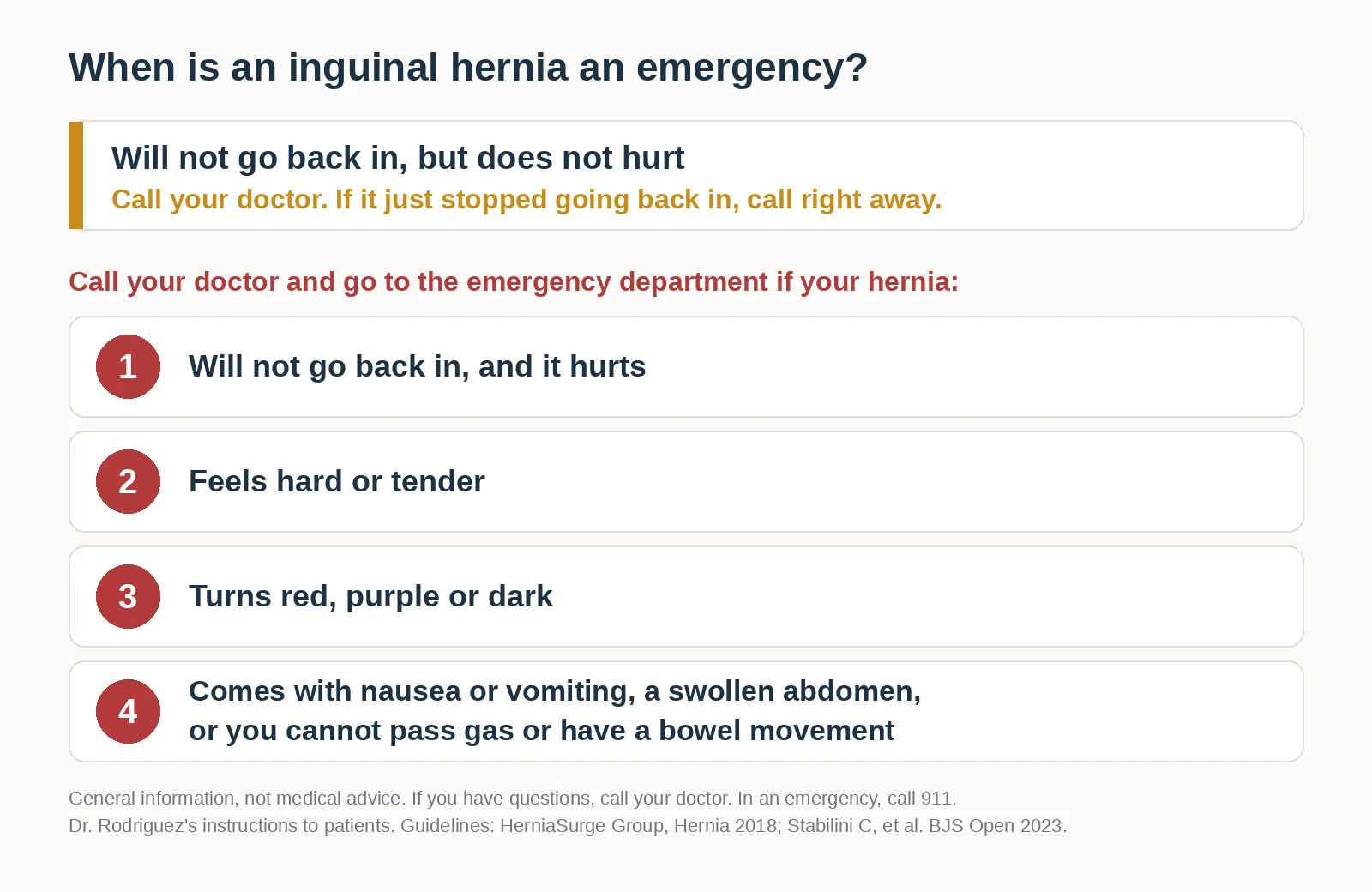
If a hernia that normally goes back in easily suddenly does not, call your doctor right away, even if it does not hurt¹.
Call your doctor if your hernia:
- has not gone back in for a long time, but does not hurt and has not changed
- has just stopped going back in, but does not hurt (call right away)
Call your doctor and go to the emergency department if your hernia:
- will not go back in and hurts
- feels hard or tender
- turns red, purple or dark
- comes with nausea or vomiting, a swollen abdomen, or you cannot pass gas or have a bowel movement
For a man whose hernia causes few symptoms, an emergency is uncommon, as the trials above show²,³. The risk appears highest soon after a hernia first appears. In an older British hospital study, the chance that an inguinal hernia had become strangulated was about 3 in 100 at 3 months after it was first noticed, and about 5 in 100 at 2 years⁸. A new bulge should be checked by a doctor soon.
Why is a planned hernia repair safer than an emergency repair?
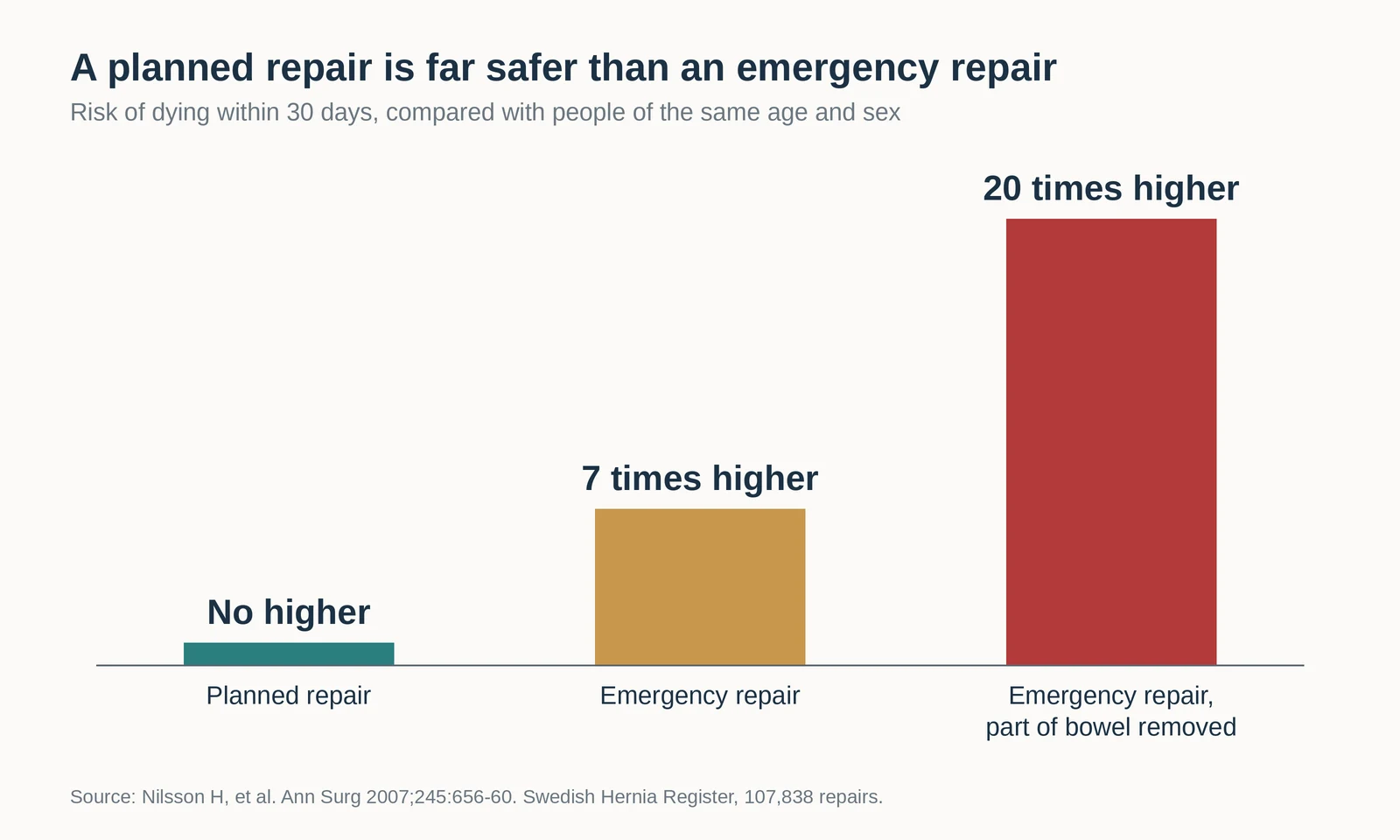
A planned repair is a routine operation. An emergency repair is not. In Sweden, the mortality rate after a planned hernia repair was no higher than in the general population, even in older patients. After an emergency repair, the mortality rate was 7 times higher, and 20 times higher when part of the bowel had to be removed⁶. A review of emergency repairs in older patients found complications in 21 to 29 of every 100⁹.
What should you do if you have an inguinal hernia?
If you notice a new bulge, see your doctor.
If your hernia causes little or no pain and you would rather not have surgery, waiting is a reasonable choice. Talk it over with your surgeon, and keep your follow-up visits.
If your hernia no longer goes back in, call your doctor. If it no longer goes back in and hurts, turns red or dark, or you start vomiting, call your doctor and go to the emergency department.
Next week: when pain in the inguinal region is not a hernia.
Part 2: Resident Pearls
Resident Pearls
1. Watchful waiting is safe for men with minimally symptomatic inguinal hernias. Fitzgibbons randomized 720 men at 5 North American centers to watchful waiting (364) or open tension-free repair (356), with follow-up of 2 to 4.5 years. At 2 years, pain limiting activities was 5.1% vs. 2.2% (P = .06) and change in the SF-36 physical component score did not differ. 23% of the watchful waiting group crossed over to repair, most often for increased pain. Acute incarceration occurred at 1.8 per 1,000 patient-years. Postoperative complications were similar in men repaired as assigned and in men who crossed over².
2. About two-thirds of men in watchful waiting cross over to repair within 10 to 12 years. In the long-term follow-up of the Fitzgibbons trial (254 men, maximum 11.5 years), the estimated cumulative crossover rate was 68%: 79% in men older than 65 and 62% in younger men. Pain was the reason in 54.1%. Three patients required an emergency operation, with no deaths⁴. In the Dutch trial of men aged 50 and older (Van den Dop, median follow-up 12 years), crossover was 64.2%: 71.7% if mildly symptomatic and 60.4% if asymptomatic. Half had crossed over by 2.0 years when mildly symptomatic and by 6.0 years when asymptomatic. Incarceration, defined as an acutely painful groin with a hernia that would not reduce, occurred in 3.9% of the watchful waiting group (10 patients, 6 within 2 years and 3 after year 9); all were scheduled for emergency surgery. Regret was higher with watchful waiting (37.7% vs. 18.0%)³.
3. Pooled crossover is 29% at 1 year, 52% at 5 years and 71% at 10 years. Yeow's individual participant data meta-analysis reconstructed long-term follow-up from three randomized trials, 592 men. Cumulative crossover was 28.7% at 1 year, 51.5% at 5 years and 70.6% at 10 years. Reasons for crossover were increased pain in 57.6% and incarceration in 4.4%⁵.
4. The Glasgow trial authors recommend repair for medically fit men with a painless hernia. O'Dwyer randomized 160 men aged 55 and older with an asymptomatic hernia to observation or operation. Pain at 12 months did not differ, but the observation group had 3 serious hernia-related adverse events and the operation group had none¹⁰. At a median 7.5 years, the estimated conversion rate to surgery was 72%, and the authors concluded that surgical repair is recommended for medically fit patients¹¹. The North American and Glasgow groups read similar crossover data and reached different conclusions.
5. HerniaSurge supports watchful waiting in men and argues against it in women. HerniaSurge states that men with asymptomatic or minimally symptomatic inguinal hernias may be managed with watchful waiting because the risk of hernia-related emergencies is low. It lists female sex, femoral hernia and a prior hospitalization for the hernia as risk factors for incarceration or strangulation. In women it recommends timely repair and argues strongly against watchful waiting, except during pregnancy, when watchful waiting is recommended¹.
6. Emergency inguinal or femoral hernia repair raises mortality 7-fold, and 20-fold with bowel resection. In 107,838 repairs in the Swedish Hernia Register, mortality after elective repair did not exceed that of the background population, even at high age. It was 7 times higher after emergency operation and 20 times higher when bowel resection was performed. 17.0% of operations in women were emergencies, compared with 5.1% in men⁶. A systematic review of emergency inguinal and femoral hernia repair in the elderly reported complication rates of 21.2% to 28.9% and mortality of 1.2% to 6%⁹.
7. Strangulation risk in an inguinal hernia is highest in the first 3 months after it appears. Gallegos calculated a cumulative probability of strangulation of 2.8% at 3 months and 4.5% at 2 years for 439 inguinal hernias, and recommended urgent referral for patients with a short history. This was a hospital series and does not reflect the lower rates in the randomized trials of minimally symptomatic men⁸.
8. Delay in repairing an acutely irreducible inguinal hernia increases morbidity and mortality. HerniaSurge 2023 calls an acutely irreducible groin hernia a potentially life-threatening emergency whose outcome depends on time to treatment and bowel viability. Its text states that the likelihood of strangulation and the need for bowel resection doubles for every 24 h from the onset of symptoms; that sentence carries no citation of its own. Manual reduction is suggested in acutely irreducible hernias without suspicion of bowel ischemia (weak); after successful reduction, observe until sedation wears off, and elective mesh repair is recommended. Emergency surgery is recommended immediately when strangulation is suspected or reduction fails (strong, upgraded). Citing a systematic review by East, the guideline reports that reduction succeeds in up to 70%. Biochemical markers of ischemia should not be used alone (weak). The evidence for all of these is low or very low⁷. Pawlak's algorithm uses taxis under conscious sedation within 24 hours of onset and without signs of strangulation, with repair during the same admission or up to several weeks later¹².
9. Most patients in a watchful waiting protocol stop coming to follow-up. Valinoti followed 400 patients in a watchful waiting protocol in Buenos Aires from 2013 to 2026, with visits every 6 months in the first year and yearly after. 60.0% stopped attending. Younger patients dropped out most: 92.9% of those under 30. The most common reasons were having no symptoms and not knowing the follow-up schedule¹³.
10. An irreducible hernia is not always an emergency. HerniaSurge 2018 defined incarceration only as inability to reduce the hernia¹. The 2023 update recommends abandoning the term (strong, upgraded) and replaces it with acutely irreducible (previously reducible, cannot be reduced after the acute onset of symptoms), chronically irreducible (long-standing, no sudden new symptoms) and strangulated (confirmed only by preoperative imaging or at operation)⁷. Sources published before 2023, including the trials in Pearls 1 to 3 and the 2018 guideline in Pearl 5, use "incarceration"; their own term is kept when quoting their results. Lee reviewed 154 incarcerated inguinal hernias repaired by TAPP. In the 134 that had been irreducible for 3 months or more, only 3% had preoperative pain and omentum was the content in 98%. In the 20 acute cases (under 3 months), 85% had pain and intestine was the content in 85%. This is a single-surgeon retrospective series¹⁴. Pain, tenderness, skin changes or obstructive symptoms point to strangulation and an emergency; a painless, long-standing irreducible hernia can be scheduled.
References
1. HerniaSurge Group. International guidelines for groin hernia management. Hernia. 2018;22(1):1-165. https://pubmed.ncbi.nlm.nih.gov/29330835/
2. Fitzgibbons RJ Jr, Giobbie-Hurder A, Gibbs JO, et al. Watchful waiting vs repair of inguinal hernia in minimally symptomatic men: a randomized clinical trial. JAMA. 2006;295(3):285-92. https://pubmed.ncbi.nlm.nih.gov/16418463/
3. Van den Dop LM, Van Egmond S, Heijne J, et al. Twelve-year outcomes of watchful waiting versus surgery of mildly symptomatic or asymptomatic inguinal hernia in men aged 50 years and older: a randomised controlled trial. EClinicalMedicine. 2023;64:102207. https://pubmed.ncbi.nlm.nih.gov/37936657/
4. Fitzgibbons RJ Jr, Ramanan B, Arya S, et al. Long-term results of a randomized controlled trial of a nonoperative strategy (watchful waiting) for men with minimally symptomatic inguinal hernias. Ann Surg. 2013;258(3):508-15. https://pubmed.ncbi.nlm.nih.gov/24022443/
5. Yeow M, Aiolfi A, Lomanto D, Fatt SLK, Wijerathne S. Watchful waiting to surgery in men with mildly symptomatic or asymptomatic inguinal hernia: an individual participant data meta-analysis of long-term follow-up of randomized controlled trials. Hernia. 2024;28(5):1909-1914. https://pubmed.ncbi.nlm.nih.gov/39046678/
6. Nilsson H, Stylianidis G, Haapamäki M, Nilsson E, Nordin P. Mortality after groin hernia surgery. Ann Surg. 2007;245(4):656-60. https://pubmed.ncbi.nlm.nih.gov/17414617/
7. Stabilini C, van Veenendaal N, Aasvang E, et al. Update of the international HerniaSurge guidelines for groin hernia management. BJS Open. 2023;7(5):zrad080. https://pubmed.ncbi.nlm.nih.gov/37862616/
8. Gallegos NC, Dawson J, Jarvis M, Hobsley M. Risk of strangulation in groin hernias. Br J Surg. 1991;78(10):1171-3. https://pubmed.ncbi.nlm.nih.gov/1958976/
9. Piltcher-da-Silva R, Sasaki VL, Bettini LFC, Soares PSM, Valandro IG, Cavazzola LT. Outcomes of emergency inguinal and femoral hernia repair in the elderly: a systematic review. J Abdom Wall Surg. 2023;2:11246. https://pubmed.ncbi.nlm.nih.gov/38312429/
10. O'Dwyer PJ, Norrie J, Alani A, Walker A, Duffy F, Horgan P. Observation or operation for patients with an asymptomatic inguinal hernia: a randomized clinical trial. Ann Surg. 2006;244(2):167-73. https://pubmed.ncbi.nlm.nih.gov/16858177/
11. Chung L, Norrie J, O'Dwyer PJ. Long-term follow-up of patients with a painless inguinal hernia from a randomized clinical trial. Br J Surg. 2011;98(4):596-9. https://pubmed.ncbi.nlm.nih.gov/21656724/
12. Pawlak M, East B, de Beaux AC. Algorithm for management of an incarcerated inguinal hernia in the emergency settings with manual reduction. Taxis, the technique and its safety. Hernia. 2021;25(5):1253-1258. https://pubmed.ncbi.nlm.nih.gov/34036484/
13. Valinoti AC, Aramburu S, Principe J, Giacone JA, Sadava EE. Long-term follow-up in asymptomatic or oligosymptomatic inguinal hernias: watchful or watchless waiting? Surg Endosc. 2026. https://pubmed.ncbi.nlm.nih.gov/42902005/
14. Lee SR. Feasibility of laparoscopic transabdominal preperitoneal hernioplasty for incarcerated inguinal hernia. JSLS. 2021;25(3). https://pubmed.ncbi.nlm.nih.gov/34671177/
Dr. Rodriguez served as a speaker and educator for Intuitive Surgical through June 2025. He has no current financial relationship with the company.