Yes, women get inguinal hernias. They are much less common than in men. About 3 in 100 women will have one repaired in their lifetime, compared with 27 in 100 men¹. Women make up about 8 of every 100 inguinal and femoral hernia repairs². In a woman, the hernia is often harder to find, so the diagnosis takes longer.
On Thursday, I asked how many women in a 2025 study had symptoms for more than a year before surgery. The answer is C, 4 in 10. In that study of 80 women, 40% had symptoms for more than a year³.
Part 1 is for patients. Part 2 is for medical students and residents.
Part 1: Inguinal hernias in women
What it can feel like
Most women do not come in because of a bulge. They come in because of pain. In the 2025 study, about 3 in 4 women had pain at the crease at the top of the thigh that was hard to pin down. Only about half had noticed a bulge, and for most of them it came and went³. The pain is often worse when standing, lifting or coughing, and better when lying down³.
Where it forms
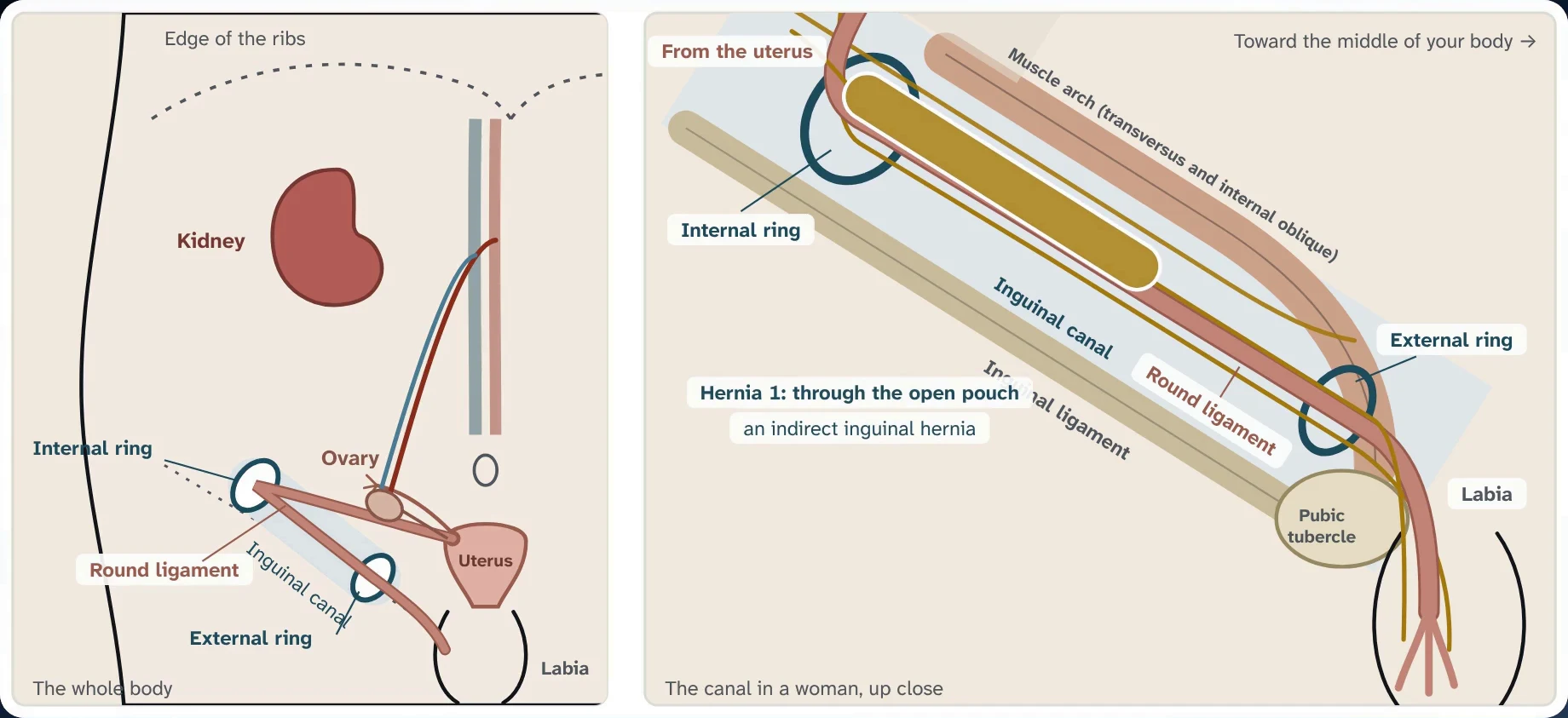
Figure 1 shows the inguinal canal in a woman. It is a short tunnel through the muscles of the lower abdominal wall, just above the crease at the top of the thigh. In a woman, the round ligament runs through it, from the uterus to the labia.
The most common hernia in women comes through the internal ring, the opening where the round ligament enters the canal. That is an indirect inguinal hernia. In the 2025 study, 8 in 10 women had one³. The video below shows how this tunnel forms before birth, and the three places a hernia can form.
Why the diagnosis is often delayed
- Pain comes first, not a bulge. Pain at the crease of the thigh has many possible causes. It often gets blamed first on more common problems, such as hip arthritis, constipation or swollen lymph nodes³.
- Women often see someone else first. Many women see their family doctor or their gynecologist before they see a surgeon³.
- The hernia can be small. It may be hard to feel on exam, especially when it comes and goes³.
- Some women choose to wait. In the 2025 study, about 1 in 3 of the women whose symptoms lasted more than a year had put off surgery because the symptoms did not stop them from doing their daily activities. Others were afraid of mesh or had family matters to take care of first³.
How I find it
I start with an exam. In the 2025 study, a hernia could be felt in about 8 of 10 women³. The exam can miss a small hernia, and the guidelines name small femoral hernias in women as an example⁴.
When I cannot feel a hernia and the story fits, I order a CT scan first. If the CT does not show a hernia and I still think one is there, I order an MRI. In one small study, MRI found hidden inguinal hernias that CT had missed⁵.
Why I do not wait
The main study showing it can be safe to watch a hernia was done in men³. In women, the risk is different. In the Swedish Hernia Register, about 17 of every 100 hernia repairs in women were emergencies, compared with 5 of every 100 in men². An emergency repair is a bigger operation. Sometimes part of the intestine has to be removed.
The international hernia guidelines recommend timely repair for women with a hernia in this area⁴. I recommend repair for women, even when the hernia does not cause symptoms.
What I find during surgery
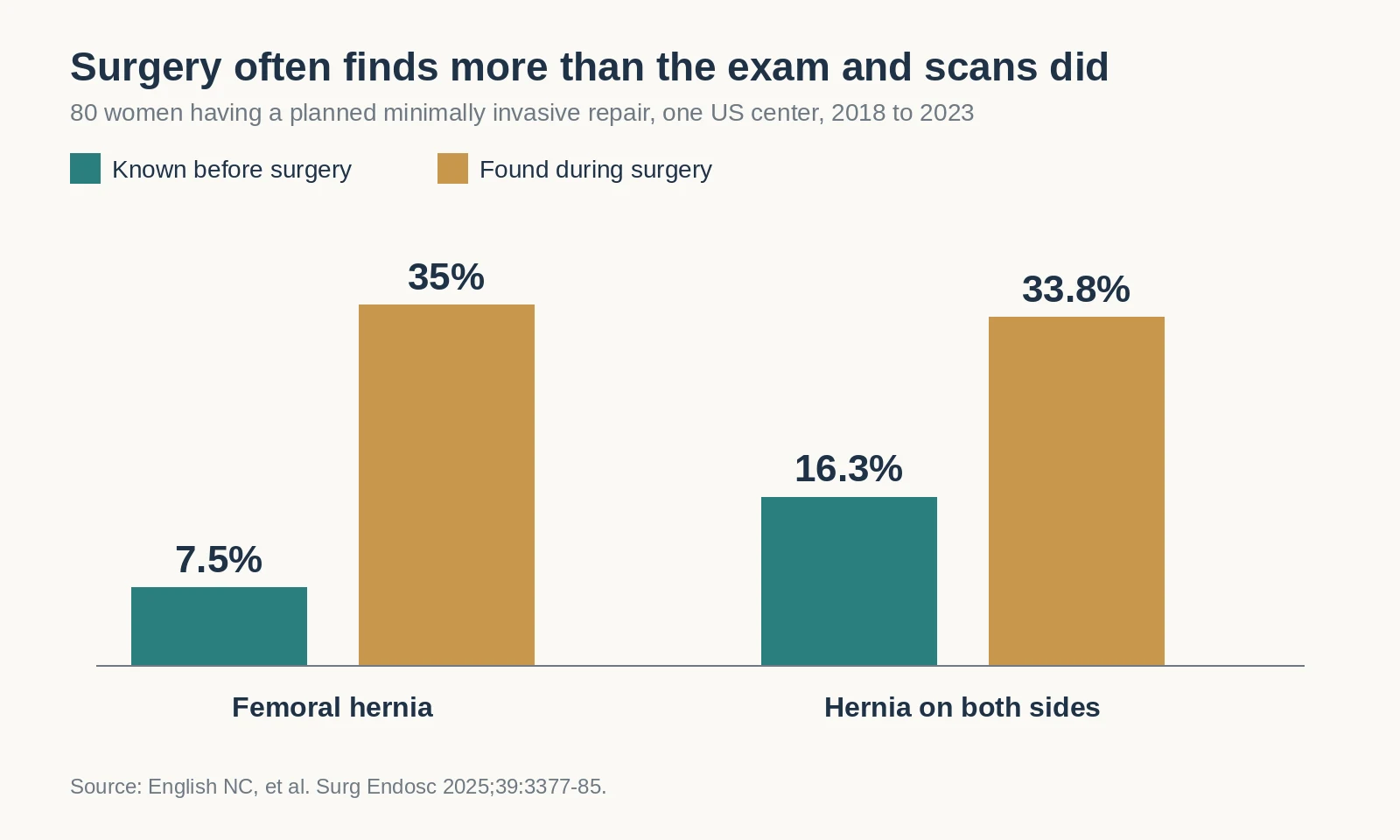
A woman often has more than one hernia, and some of them are not found until surgery. In the 2025 study, the researchers compared two things for each of the 80 women: what her chart showed before surgery, from the exam and any scans, and what the surgeon saw during surgery³.
- Femoral hernia: before surgery, 6 women (7.5%) were known to have one. During surgery, 28 women (35%) had one. At least 22 of those 28 femoral hernias were not known until surgery.
- A hernia on both sides: before surgery, 13 women (16%) were known to have hernias on both sides. During surgery, 27 women (34%) did.
Figure 2 shows these numbers³. Another center found a femoral hernia in 38.5% of women, compared with 12.2% of men⁶. Femoral hernias were the topic of last week's post.
Why I usually repair it from the inside
During a robotic repair, I look from inside the abdomen. On the side of the hernia, I can see the internal ring, the floor of the inguinal canal and the femoral space. One flat piece of mesh covers all three. I can also see the other side. If I am repairing a hernia on your right side, I can look at your left side during the same operation. If I find a hernia there too, I repair it only if we agreed to that before surgery.
After an open repair: an open repair works through an incision over the inguinal canal. The femoral space sits just below the canal. It is not always opened during an open repair, so a small femoral hernia can be missed⁴. A review of 55 studies looked at women whose hernia came back. After an open repair, 4 in 10 of the hernias that came back were femoral hernias. The authors say these may be femoral hernias that were not found at the first operation⁷.
After a minimally invasive repair: from inside, I check the femoral space and cover it with the mesh. In the same review, none of the hernias that came back after a laparoscopic repair were femoral hernias⁷. In one large US health system, no women needed a second operation on the same side after a robotic repair⁸.
The guidelines suggest a minimally invasive repair for women when the surgeon has the experience⁴.
I also offer an open repair. A Lichtenstein repair places mesh over the floor of the inguinal canal. It does not cover the femoral space, so it can miss a femoral hernia⁴. Unlike the Lichtenstein repair, a McVay repair opens the floor of the inguinal canal and directly inspects the femoral canal. Repair of a femoral hernia is inherent to a McVay repair. Which open repair fits you depends on your anatomy, your past surgeries and your preference.
What happens to the round ligament
In Post 1, I said I would explain why I usually divide the round ligament during a robotic repair. In an adult woman, the round ligament does very little. Stronger ligaments deep in the pelvis hold the uterus in place. It runs through the middle of the area the mesh has to cover (Figure 3).
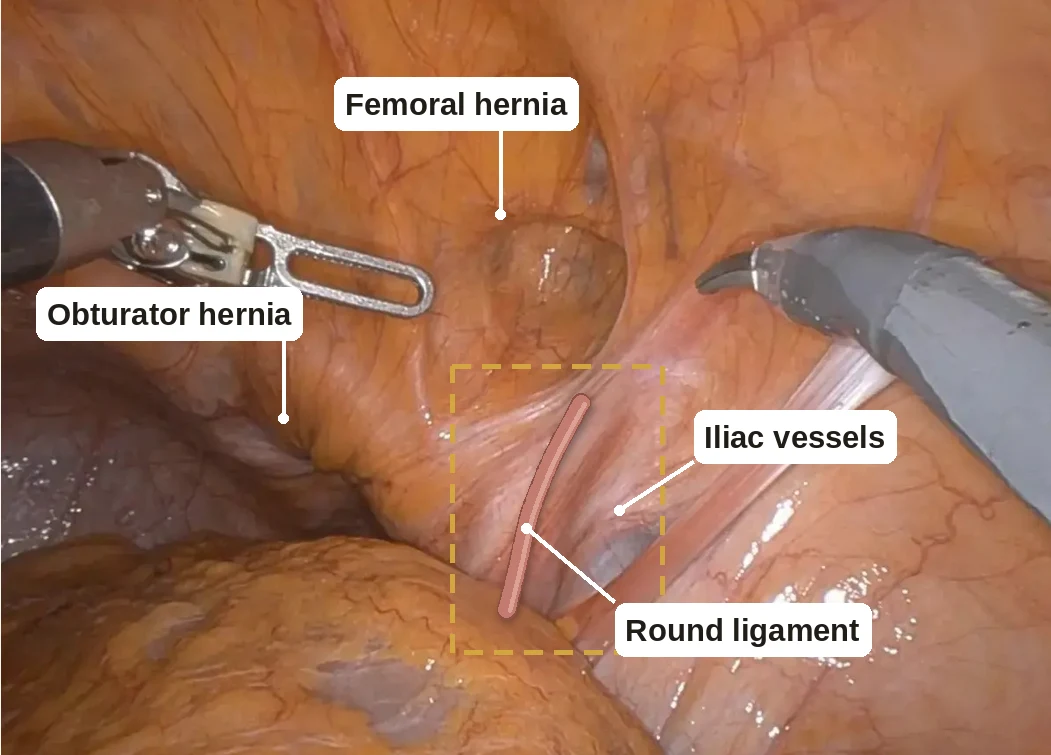
- Robotic repair: I usually divide it so the mesh can lie flat. If you plan to become pregnant in the future, tell me before surgery, and I keep it.
- Open repair: I try to keep it, because two small nerves run right beside it.
Studies of more than 1,000 women found that dividing the round ligament made the operation a few minutes shorter, with no difference in pain, numbness, the hernia coming back, or the uterus dropping⁹,¹⁰. In a US registry of 1,365 women, surgeons divided it in about 2 of every 3 repairs, with no increase in complications¹¹. One study followed about 400 women for three and a half years and found no effect on later pregnancy or childbirth¹². That is not enough women to be certain¹⁰, which is why I keep it when a woman plans a future pregnancy.
What this means for you
If you have pain at the crease at the top of your thigh and no one has found the cause, ask to be examined for a hernia.
If you have a bulge that becomes firm and painful and will not go back in, or you have abdominal pain with vomiting, seek urgent medical care right away.
My inguinal hernia in women page covers the robotic and open repairs in more detail.
Next week: when to repair a hernia, and when a hernia is an emergency.
Part 2: Resident Pearls
Resident Pearls
1. The lifetime risk of inguinal hernia repair is about 27% in men and 3% in women. Primatesta and Goldacre estimated these figures from 30,675 repairs in the Oxford Record Linkage Study area, 1976 to 1986. Women had 9% of the repairs¹.
2. Women have about three times as many emergency hernia operations as men. In the Swedish Hernia Register (6,895 repairs in women and 83,753 in men, 1992 to 2003), 16.9% of operations in women were emergencies, compared with 5.0% in men. Bowel resection was needed in 16.6% of the emergency operations in women and 5.6% in men².
3. Women often have symptoms for more than a year before repair, and the reasons are mixed. In 80 women having planned repair at one US center (2018 to 2023), 40% had symptoms for more than a year. The most common complaints were non-specific pain (73.8%) and an intermittent bulge (48.8%). A defect was palpable in 81.3%. Of those with symptoms for more than a year, 34.4% had declined or delayed surgery because symptoms did not limit daily activities; provider-driven delays included malnutrition, multiple prior repairs, infection, ascites and prior misdiagnosis. Area Deprivation Index did not differ by symptom duration³.
4. Occult femoral and contralateral defects are common in women. In the same cohort, 97.5% of repairs were minimally invasive. Femoral defects were documented in 7.5% before surgery and found in 35% intraoperatively; bilateral defects in 16.3% before and 33.8% during surgery. Indirect hernias were the most common (81.3%)³. In a second cohort of 494 primary repairs, women had more femoral (38.5% vs 12.2%) and fewer direct hernias (12.9% vs 32.9%) than men⁶.
5. MRI is the most sensitive imaging test for an occult inguinal hernia. In 59 sides with a suggestive but non-diagnostic exam, sensitivity was 33% for ultrasound, 54% for CT and 91% for MRI. MRI identified 10 of 11 hernias missed on CT. This was a single-surgeon series of 36 patients, so the numbers are small⁵.
6. HerniaSurge recommends timely repair in women and suggests a laparo-endoscopic approach. The 2018 guideline recommends timely repair in women with an inguinal or femoral hernia and suggests laparo-endoscopic repair, if expertise is available, to decrease chronic pain and avoid missing a femoral hernia (weak recommendation). It notes that physical exam can miss small hernias, naming femoral hernias in women. The 2023 update did not revise the chapter on women⁴.
7. Recurrence in women is lower after laparoscopic repair, and recurrences after open repair are often femoral. A systematic review of 55 studies and 43,870 women found crude recurrence of 1.2% after laparoscopic and 4.9% after open repair in randomized and prospective studies. After open repair, 40.9% of recurrent hernias were femoral, compared with 0% after laparoscopic repair⁷. In 131,626 mesh repairs at Kaiser Permanente, women had a higher reoperation risk than men after open repair (HR 1.98) and a lower risk after laparoscopic repair (HR 0.70); no reoperations were observed in women after robotic repair⁸.
8. Women are less likely to receive minimally invasive repair. In 23,723 planned repairs in a Michigan statewide collaborative, 37.4% of women and 45.1% of men had a minimally invasive repair (adjusted OR 0.88). Women reported regret more often (12.9% vs 8.5%)¹³.
9. Not everyone agrees that every woman needs a minimally invasive repair. In the ACHQC registry, femoral hernias were found in 27% of 1,357 women having minimally invasive repair, compared with 12% of 316 having Lichtenstein repair, but most were smaller than 1.5 cm and recurrence was similar at 1 to 5 years. The authors call the minimally invasive recommendation for women potentially overstated¹⁴.
10. Dividing the round ligament during minimally invasive repair shortens the operation without added complications. Two meta-analyses (6 studies with 1,131 women; 9 studies with 1,104 women) found preservation added about 7 minutes with no difference in chronic pain, paresthesia, recurrence, seroma or uterine prolapse; data on fertility are insufficient⁹,¹⁰. In 1,365 women in the ACHQC registry, the ligament was divided in 63.6% with no difference in complications, reoperation or recurrence, and pain scores at 6 months were lower after division¹¹. In 393 women followed for a median of about 3.5 years, division did not affect later pregnancy, dyspareunia, dysmenorrhea, pelvic pain or prolapse¹².
References
1. Primatesta P, Goldacre MJ. Inguinal hernia repair: incidence of elective and emergency surgery, readmission and mortality. Int J Epidemiol. 1996;25(4):835-9. https://doi.org/10.1093/ije/25.4.835
2. Koch A, Edwards A, Haapaniemi S, Nordin P, Kald A. Prospective evaluation of 6895 groin hernia repairs in women. Br J Surg. 2005;92(12):1553-8. https://doi.org/10.1002/bjs.5156
3. English NC, Hood C, Corey B, Parmar AD. Natural history of groin hernias in women and factors leading to delay in repair: a single-institution study. Surg Endosc. 2025;39(5):3377-3385. https://doi.org/10.1007/s00464-025-11709-1
4. HerniaSurge Group. International guidelines for groin hernia management. Hernia. 2018;22(1):1-165. https://doi.org/10.1007/s10029-017-1668-x
5. Miller J, Cho J, Michael MJ, Saouaf R, Towfigh S. Role of imaging in the diagnosis of occult hernias. JAMA Surg. 2014;149(10):1077-80. https://doi.org/10.1001/jamasurg.2014.484
6. Pivo S, Huynh D, Oh C, Towfigh S. Sex-based differences in inguinal hernia factors. Surg Endosc. 2023;37(11):8841-8845. https://doi.org/10.1007/s00464-023-10367-5
7. Schmidt L, Öberg S, Andresen K, Rosenberg J. Recurrence rates after repair of inguinal hernia in women: a systematic review. JAMA Surg. 2018;153(12):1135-1142. https://doi.org/10.1001/jamasurg.2018.3102
8. Maertens F, Chan PH, Prentice HA, Brill ER, Paxton EW, Mostaedi R. Female sex and ipsilateral reoperation risk following mesh-based inguinal hernia repair: a cohort study including 131,626 repairs in adults from an integrated healthcare system over a 10-year period. Hernia. 2024;28(1):25-31. https://doi.org/10.1007/s10029-023-02878-w
9. Silveira CAB, de Figueiredo SMP, Rasador ACD, et al. Round ligament management during minimally invasive groin hernia repair in women: a systematic review and meta-analysis. Surg Endosc. 2024;38(4):1731-1739. https://doi.org/10.1007/s00464-024-10721-1
10. Zhong W, Zhang L, Zhong JQ, et al. Comparison of outcomes between preservation or division of the uterine round ligament in laparoscopic groin hernia repair in females: a meta-analysis and trial sequential analysis. Hernia. 2024;28(2):343-354. https://doi.org/10.1007/s10029-023-02917-6
11. Renshaw S, Collins C, Gupta A, Poulose B, Haisley KR. Round ligament management in female patients undergoing inguinal hernia repair: should we divide or preserve? J Am Coll Surg. 2022;234(6):1193-1200. https://doi.org/10.1097/XCS.0000000000000207
12. Liu Y, Liu J, Xu Q, et al. Objective follow-up after transection of uterine round ligament during laparoscopic repair of inguinal hernias in women: assessment of safety and long-term outcomes. Surg Endosc. 2022;36(6):3798-3804. https://doi.org/10.1007/s00464-021-08696-4
13. Ehlers AP, Thumma JR, Howard R, et al. Guideline-discordant care among females undergoing groin hernia repair: the importance of sex as a biologic variable. Hernia. 2022;26(3):823-829. https://doi.org/10.1007/s10029-021-02543-0
14. Maskal SM, Ellis RC, Melland-Smith M, et al. Revisiting femoral hernia diagnosis rates by patient sex in inguinal hernia repairs. Am J Surg. 2023;230:21-25. https://doi.org/10.1016/j.amjsurg.2023.10.048
Dr. Rodriguez served as a speaker and educator for Intuitive Surgical through June 2025. He has no current financial relationship with the company.