Last week, we looked at the two kinds of inguinal hernia. This week covers two hernias that sit below the inguinal canal: femoral and obturator hernias. These two hernias are rare, and most of them happen in women.
A femoral hernia is not an inguinal hernia. The international hernia guidelines call both of them groin hernias, because both push through the lower abdominal wall at the groin. An inguinal hernia comes through the inguinal canal. A femoral hernia comes through the femoral canal¹. The inguinal canal sits above the inguinal ligament, the firm band that runs from the front of the hip bone to the pubic bone. A femoral hernia comes out below that ligament². An obturator hernia is not a groin hernia. It forms at a weak spot deep in the pelvis, where tissue pushes into the small tunnel that carries a nerve to the inner thigh. It is grouped with hernias of the pelvic floor³.
Part 1 is for patients. Part 2 is for medical students and residents.
Watch: is a femoral hernia an emergency?
Video. Femoral and obturator hernias, where they come through, and why I repair them soon after they are found.
Part 1: Two hernias below the inguinal canal
Where they come through
In Post 2, I showed the four openings in the lower abdominal wall that I check during every robotic repair. Two of them are the internal ring and the floor of the inguinal canal, where inguinal hernias form. This post is about the other two.
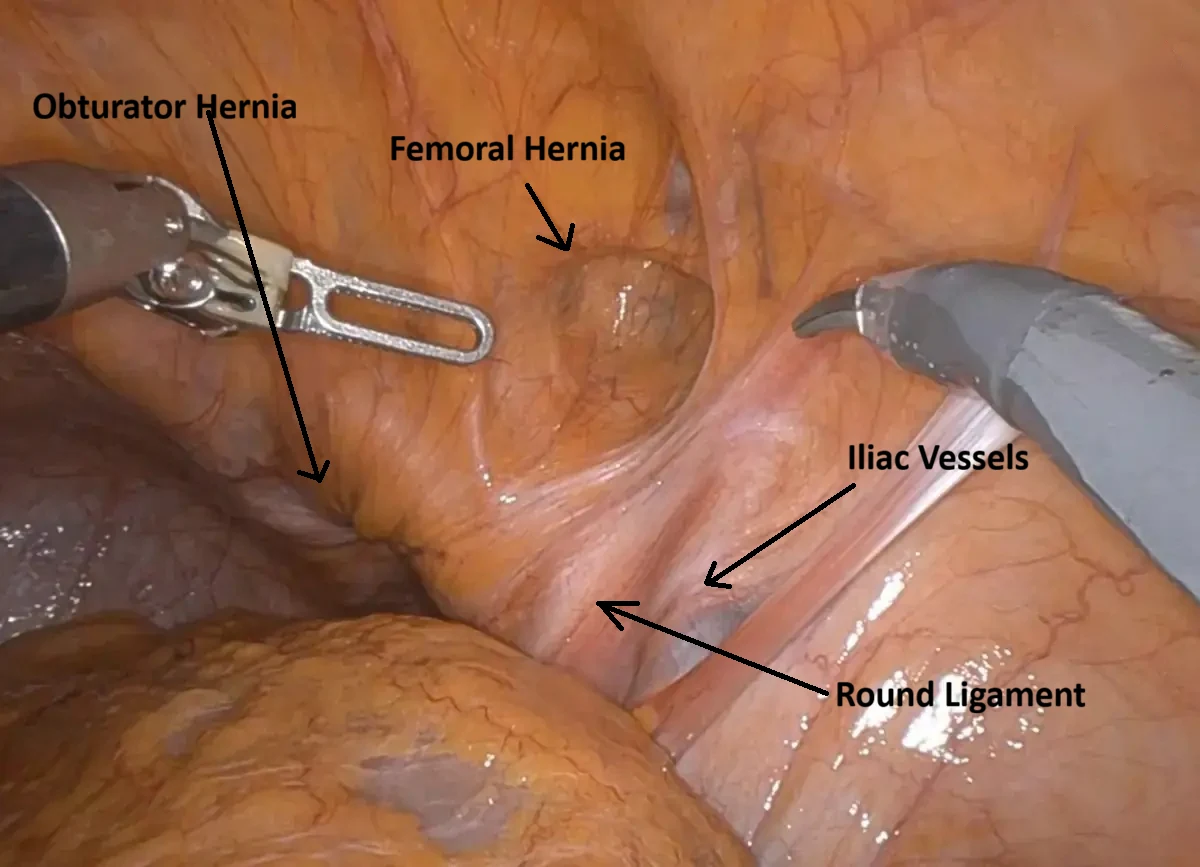
- The femoral opening is a small space just below the inguinal ligament. It sits on the inner side of the large vein that carries blood up from the leg. A femoral hernia pushes through this space and shows up as a bulge in the crease at the top of the thigh.
- The obturator opening is a small tunnel at the front of the pelvis. A nerve and small blood vessels pass through it to the muscles of the inner thigh. When the tissue around this tunnel is weak, fat or bowel can push into it. That is an obturator hernia. It sits deep, under the thigh muscles, so it is rarely felt as a bulge.
Figure 1 shows both in one of my operations.
Who gets them
A Danish study counted every hernia repair in this region over five years: 46,717 repairs. About 3 in 100 were femoral hernias, and 70 in 100 of those were in women. Femoral hernia repairs became more common with every decade of life and peaked between ages 80 and 90⁴. In Sweden, femoral hernias made up 22 of every 100 of these operations in women, compared with 1 in 100 in men⁵.
Obturator hernias are much rarer. In Denmark, they made up less than 1 in 1,000 hernia operations, about one case for every 400,000 people each year. 88 of every 100 patients were women, and the middle age was 77⁶. A 2026 review of 876 patients described the typical patient as an older woman who is underweight³.
Why they are more likely to get stuck
Both openings are small and have firm edges. Bowel that slips through can get stuck and lose its blood supply.
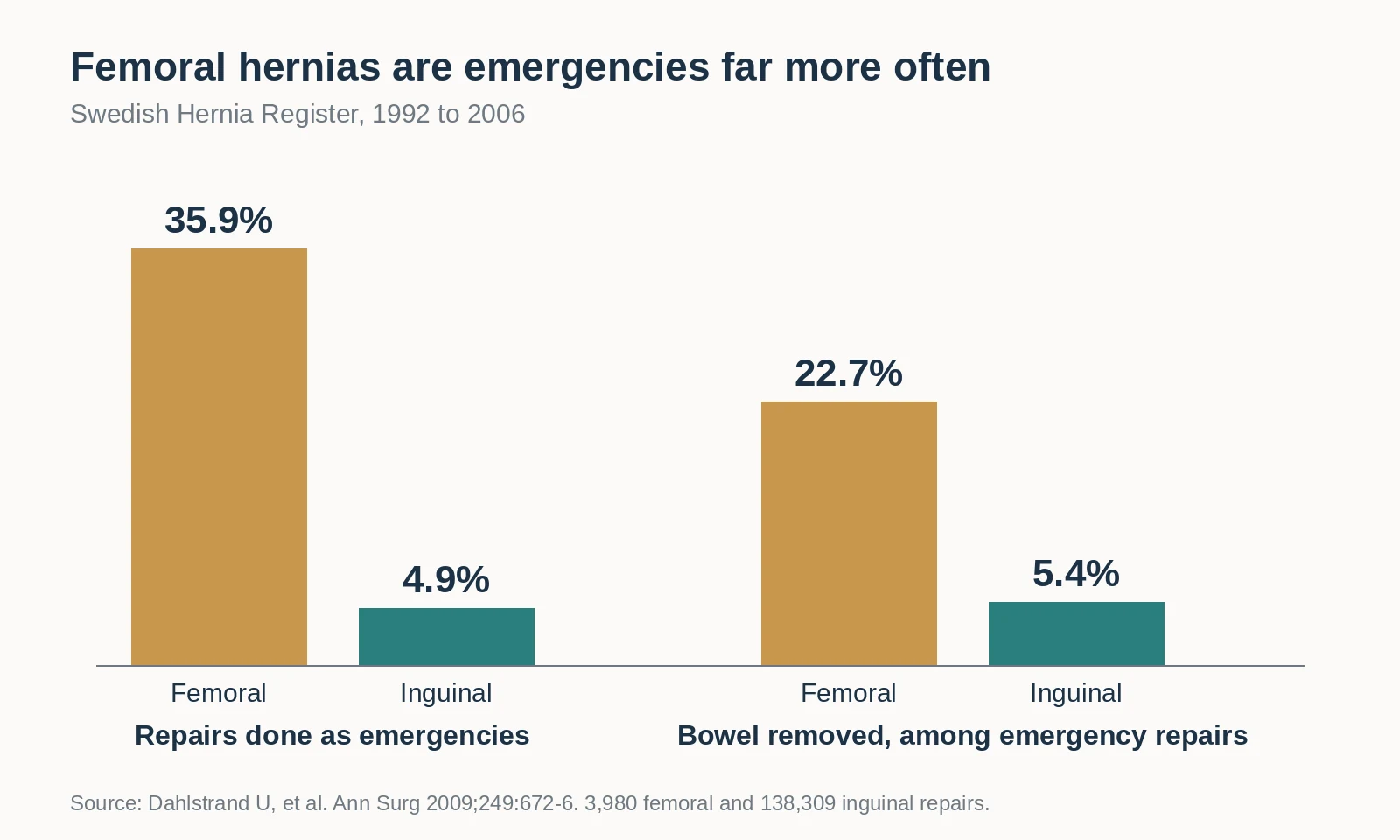
In Sweden, 36 of every 100 femoral hernia repairs were emergency operations, compared with 5 of every 100 inguinal hernia repairs. In those femoral emergencies, nearly 1 in 4 patients needed part of the bowel removed (Figure 2). After an emergency femoral repair, the risk of dying was 10 times that of the general population. After a planned repair, it was no higher than the general population⁷.
In one older British study of 37 femoral hernias, the chance that the hernia had become stuck and lost its blood supply was 22% by 3 months after it was first noticed, and 45% by 21 months⁸. That study was small, but it agrees with the larger ones.
Obturator hernias carry the same pattern. In Denmark, 42 of every 100 obturator hernia repairs were emergencies. Within 30 days, 14 of every 100 patients died after an emergency repair. No patients died after a planned repair⁶.
How they are found
A small femoral hernia can be hard to feel, especially in a patient who carries extra weight¹. When the exam is not clear, an ultrasound tells a femoral hernia from an inguinal hernia correctly in about 95 to 99 of every 100 cases⁹. A CT scan can also tell the two apart. A femoral hernia sits right beside the femoral vein and presses on it. In one study, the CT showed this in all 11 femoral hernias and in only 1 of 92 inguinal hernias¹⁰. When the CT shows a hernia pressing on the femoral vein, it is almost always a femoral hernia.
An obturator hernia is usually found a different way. Many first show up as a blocked bowel: abdominal pain, swelling and vomiting. Some women feel pain along the inside of the thigh toward the knee, because the hernia presses on the nerve that passes through the tunnel. At the Mayo Clinic, 37 of every 100 patients had this thigh pain¹¹. A CT scan finds most obturator hernias³. In a Tokyo hospital, the share of obturator hernias diagnosed before surgery rose from 44 in 100 before CT scans to 80 in 100 after. Fewer patients needed bowel removed, and fewer died¹².
In women, a femoral hernia can be mistaken for an inguinal hernia. I will cover that next week, in the post on hernias in women.
How I repair them
International hernia guidelines recommend repairing a femoral hernia soon after it is found, even when it causes few or no symptoms¹. I do not watch and wait with a femoral hernia.
In a robotic repair, I see all four openings on both sides from inside the abdomen, including the femoral and obturator openings. One piece of mesh covers all of them. A later post in this series covers the mesh. In a Danish study of 3,970 femoral hernia repairs, laparoscopic repair from inside the abdomen led to fewer repeat operations than open repair¹³.
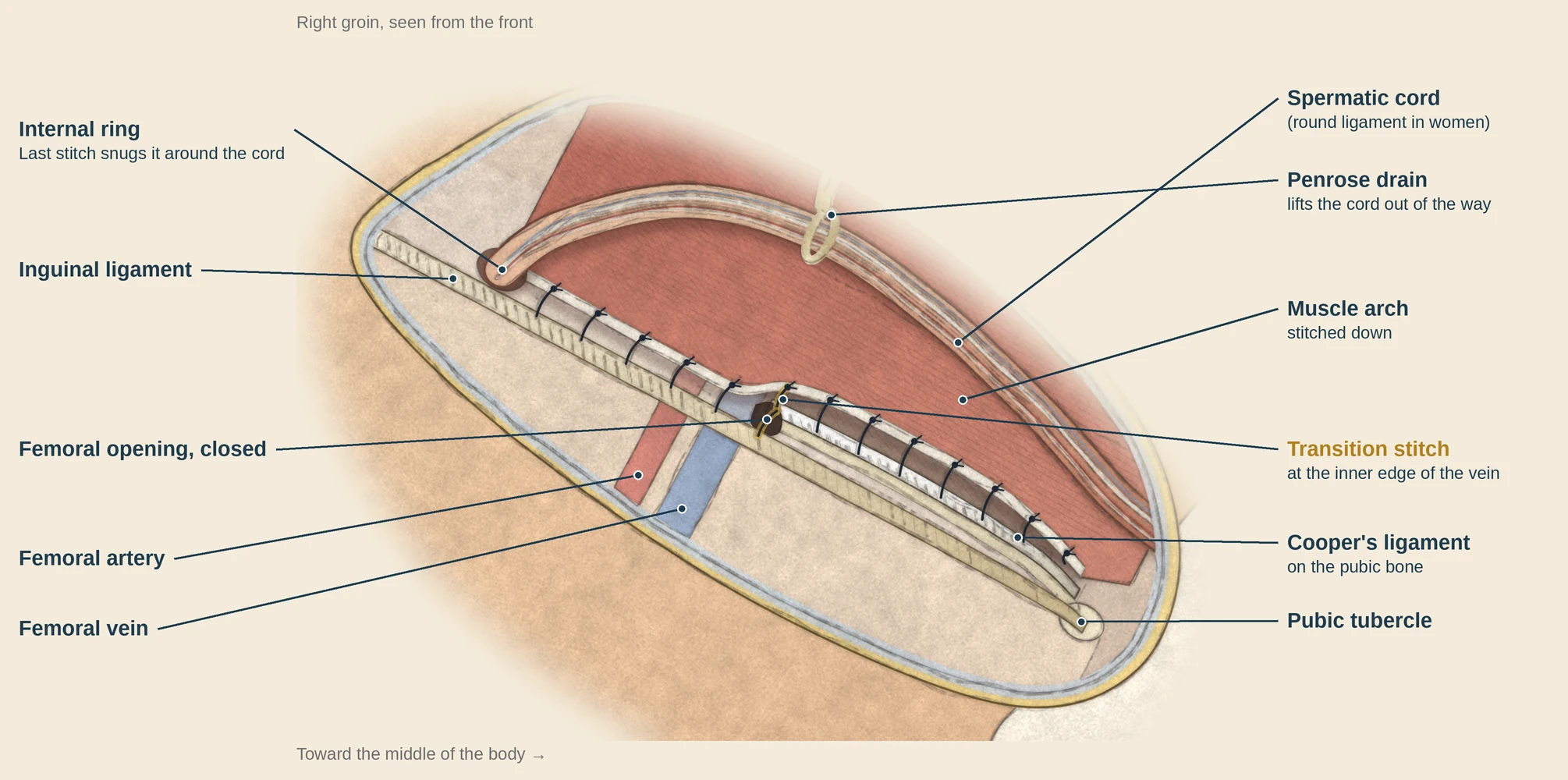
When an open repair is the better choice for a femoral hernia, I use a McVay repair. The McVay repair opens the floor of the inguinal canal, exposing the femoral canal. I stitch the floor of the inguinal canal down to a strong ligament on the pubic bone, called Cooper's ligament¹⁴. Where the stitches reach the femoral vein, a transition stitch moves the repair off Cooper's ligament. This closes the femoral opening without pinching the vein.
A Lichtenstein repair places mesh over the floor of the canal from the front. It does not open the floor of the canal, so the femoral opening cannot be seen, and it is not closed.
Obturator hernias are most often repaired from inside the abdomen. In Denmark, 72 of every 100 were repaired laparoscopically, and mesh was used in 77 of every 100⁶.
What this means for you
If you notice a bulge in the crease at the top of your thigh, call your doctor.
A planned repair is far safer than an emergency one.
If the bulge becomes firm and painful and will not go back in, or you have abdominal pain with vomiting, seek urgent medical care right away.
Next week: inguinal hernias in women.
Part 2: Resident Pearls
Resident Pearls
1. Femoral hernias are about 3% of inguinal and femoral hernia repairs, and 70% occur in women. Burcharth's Danish nationwide cohort recorded 46,717 inguinal and femoral hernia repairs over five years. Femoral hernias were 3% of repairs (29.8% men, 70.2% women). Femoral repair prevalence increased steadily with age and peaked at 80 to 90 years in both sexes⁴. In the Swedish Hernia Register, femoral hernias were 1.1% of inguinal and femoral hernia operations in men and 22.4% in women⁵.
2. More than one-third of femoral hernia repairs are emergencies. Dahlstrand analyzed 3,980 femoral repairs in the Swedish Hernia Register: 35.9% were emergency operations, compared with 4.9% of 138,309 inguinal repairs. Bowel resection was performed in 22.7% of emergency femoral repairs and 5.4% of emergency inguinal repairs. Women underwent emergency femoral surgery more often than men (40.6% vs. 28.1%). Emergency femoral repair carried a 10-fold increase in mortality risk; elective repair did not exceed that of the general population⁷.
3. Strangulation risk in a femoral hernia is highest in the first 3 months. Gallegos calculated a cumulative probability of strangulation of 22% at 3 months and 45% at 21 months for femoral hernias, against 2.8% at 3 months and 4.5% at 2 years for inguinal hernias. The series was 476 hernias, 37 of them femoral, with 12 femoral strangulations⁸.
4. HerniaSurge recommends timely femoral repair and suggests a laparo-endoscopic mesh repair. HerniaSurge lists female sex, femoral hernia and a prior hospitalization for the hernia as risk factors for incarceration and strangulation. It suggests timely mesh repair of femoral hernias by a laparo-endoscopic approach where expertise is available, a weak recommendation. It also suggests laparo-endoscopic repair for women, to lower the risk of chronic pain and avoid missing a femoral hernia¹.
5. Mesh repair of a femoral hernia leads to fewer reoperations than suture repair. In elective femoral repairs in Sweden, laparoscopic repair (hazard ratio 0.31) and open preperitoneal mesh (hazard ratio 0.28) led to fewer reoperations than suture repair⁷. In the Danish Hernia Database, 3,970 primary femoral repairs were analyzed, 39.2% of them emergencies. Laparoscopic repair reduced the risk of reoperation compared with open repair (hazard ratio 0.33, 95% CI 0.09 to 0.95). Reoperation risk was higher in women (hazard ratio 1.95)¹³.
6. A Cooper's ligament (McVay) repair closes the femoral canal. Rutledge performed a Cooper's ligament repair on every adult inguinal and femoral hernia from 1959 to 1984: 1,142 repairs, 97% followed. Recurrence was 0% for 31 primary femoral hernias and 0% for 154 repairs in women¹⁴. Constriction of the femoral vein is a known complication, from a suture through the vein or compression by the repaired tissue; it presents as deep vein thrombosis or pulmonary embolism¹⁵.
7. Ultrasound and CT both separate femoral from inguinal hernias. Kwee's meta-analysis of 16 studies found that ultrasound correctly classified clinically occult hernias as inguinal or femoral in 94.4% to 99.1% of cases, from four studies⁹. On CT, Suzuki found that a sac localized lateral to the pubic tubercle with compression of the femoral vein was present in 11 of 11 femoral hernias and 1 of 92 inguinal hernias¹⁰.
8. Obturator hernias are rare and occur mainly in elderly women. Holm reported 184 obturator hernias in 167 patients from the Danish Hernia Database, 1998 to 2023: 88% women, median age 77. Prevalence was 0.084% of hernia operations, about one per 400,000 inhabitants per year. 42% were emergency repairs, 72% were laparoscopic, and mesh was used in 77%. A concurrent inguinal or femoral hernia was found in 57%. Thirty-day mortality was 14% after emergency repair and 0% after elective repair⁶.
9. The Howship-Romberg sign is present in about one-third of obturator hernias. In the Mayo Clinic series of 30 patients from 1950 to 2008 (median age 82, 29 women), 63% presented with bowel obstruction and 37% had the Howship-Romberg sign. Small-bowel resection was needed in 47%¹¹.
10. CT is the test that diagnoses obturator hernia. Bademkıran's 2026 systematic review of 22 studies and 876 patients reported preoperative CT sensitivity of 93.2% (range 66.7% to 100%). Bowel resection was needed in 31.6% and was associated with higher 30-day mortality (19.6% vs. 3.9%)³. In Kammori's Tokyo series, preoperative diagnosis rose from 43.5% before CT to 80.0% after, with lower rates of bowel resection (52.2% to 25.0%) and mortality (30.4% to 5.0%)¹².
11. Inspect the obturator foramen during a posterior repair. Susmallian explored the obturator foramen during 293 laparoscopic extraperitoneal repairs of bilateral or recurrent inguinal hernias and found an obturator hernia in 20 patients (6.82%)¹⁶.
References
1. HerniaSurge Group. International guidelines for groin hernia management. Hernia. 2018;22(1):1-165. https://pubmed.ncbi.nlm.nih.gov/29330835/
2. Patel PJ, Azmat CE, Goethals A. Femoral Hernia. In: StatPearls [Internet]. Treasure Island (FL): StatPearls Publishing; updated May 3, 2025. https://www.ncbi.nlm.nih.gov/books/NBK535449/
3. Bademkıran E. Obturator hernia in adults: a systematic review of CT diagnosis and surgical management. Hernia. 2026;30(1). https://pubmed.ncbi.nlm.nih.gov/42118363/
4. Burcharth J, Pedersen M, Bisgaard T, Pedersen C, Rosenberg J. Nationwide prevalence of groin hernia repair. PLoS One. 2013;8(1):e54367. https://pubmed.ncbi.nlm.nih.gov/23342139/
5. Nilsson H, Stylianidis G, Haapamäki M, Nilsson E, Nordin P. Mortality after groin hernia surgery. Ann Surg. 2007;245(4):656-60. https://pubmed.ncbi.nlm.nih.gov/17414617/
6. Holm MA, Baker JJ, Andresen K, Fonnes S, Rosenberg J. Epidemiology and surgical management of 184 obturator hernias: a nationwide registry-based cohort study. Hernia. 2023;27(6):1451-1459. https://pubmed.ncbi.nlm.nih.gov/37747656/
7. Dahlstrand U, Wollert S, Nordin P, Sandblom G, Gunnarsson U. Emergency femoral hernia repair: a study based on a national register. Ann Surg. 2009;249(4):672-6. https://pubmed.ncbi.nlm.nih.gov/19300219/
8. Gallegos NC, Dawson J, Jarvis M, Hobsley M. Risk of strangulation in groin hernias. Br J Surg. 1991;78(10):1171-3. https://pubmed.ncbi.nlm.nih.gov/1958976/
9. Kwee RM, Kwee TC. Ultrasonography in diagnosing clinically occult groin hernia: systematic review and meta-analysis. Eur Radiol. 2018;28(11):4550-4560. https://pubmed.ncbi.nlm.nih.gov/29761361/
10. Suzuki S, Furui S, Okinaga K, et al. Differentiation of femoral versus inguinal hernia: CT findings. AJR Am J Roentgenol. 2007;189(2):W78-83. https://pubmed.ncbi.nlm.nih.gov/17646443/
11. Nasir BS, Zendejas B, Ali SM, Groenewald CB, Heller SF, Farley DR. Obturator hernia: the Mayo Clinic experience. Hernia. 2012;16(3):315-9. https://pubmed.ncbi.nlm.nih.gov/22138700/
12. Kammori M, Mafune K, Hirashima T, et al. Forty-three cases of obturator hernia. Am J Surg. 2004;187(4):549-52. https://pubmed.ncbi.nlm.nih.gov/15041510/
13. Andresen K, Bisgaard T, Kehlet H, Wara P, Rosenberg J. Reoperation rates for laparoscopic vs open repair of femoral hernias in Denmark: a nationwide analysis. JAMA Surg. 2014;149(8):853-7. https://pubmed.ncbi.nlm.nih.gov/25007246/
14. Rutledge RH. Cooper's ligament repair: a 25-year experience with a single technique for all groin hernias in adults. Surgery. 1988;103(1):1-10. https://pubmed.ncbi.nlm.nih.gov/3336859/
15. Bjørgul K, Forsell C, Andersen OK. [Constriction of the femoral vein after McVay hernioplasty]. Tidsskr Nor Laegeforen. 1994;114(21):2489-90. https://pubmed.ncbi.nlm.nih.gov/7940451/
16. Susmallian S, Ponomarenko O, Barnea R, Paran H. Obturator hernia as a frequent finding during laparoscopic pelvic exploration: a retrospective observational study. Medicine (Baltimore). 2016;95(27):e4102. https://pubmed.ncbi.nlm.nih.gov/27399109/
Dr. Rodriguez served as a speaker and educator for Intuitive Surgical through June 2025. He has no current financial relationship with the company.