Both start the same way: a gallstone blocks the outlet of your gallbladder. In biliary colic, the stone falls back into the gallbladder, the pressure drops, and the pain goes away. In cholecystitis, the stone remains stuck, the gallbladder wall becomes inflamed, the bile trapped inside can become infected, and the pain does not go away.¹
These are the same pictures I use when I explain this in the exam room.
Part 1 is for patients. Part 2 is for medical students and residents.
Part 1: One stone, two problems
Where your gallbladder sits
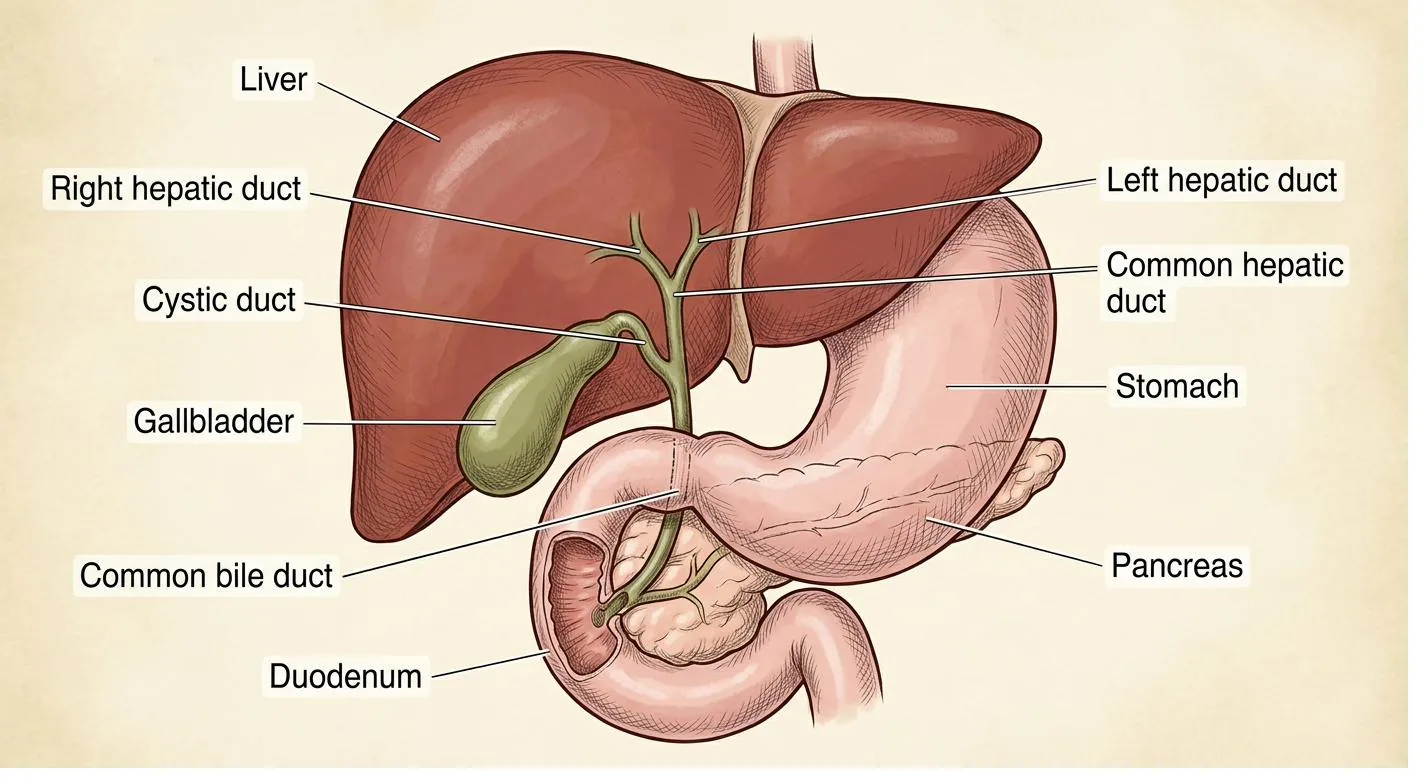
Your gallbladder is about the size of a small pear. It sits under your liver on the upper right side of your abdomen and hangs off the tube that carries bile from your liver to your intestine (Figure 1). After a meal, it squeezes and sends stored bile down that tube.
What is biliary colic?
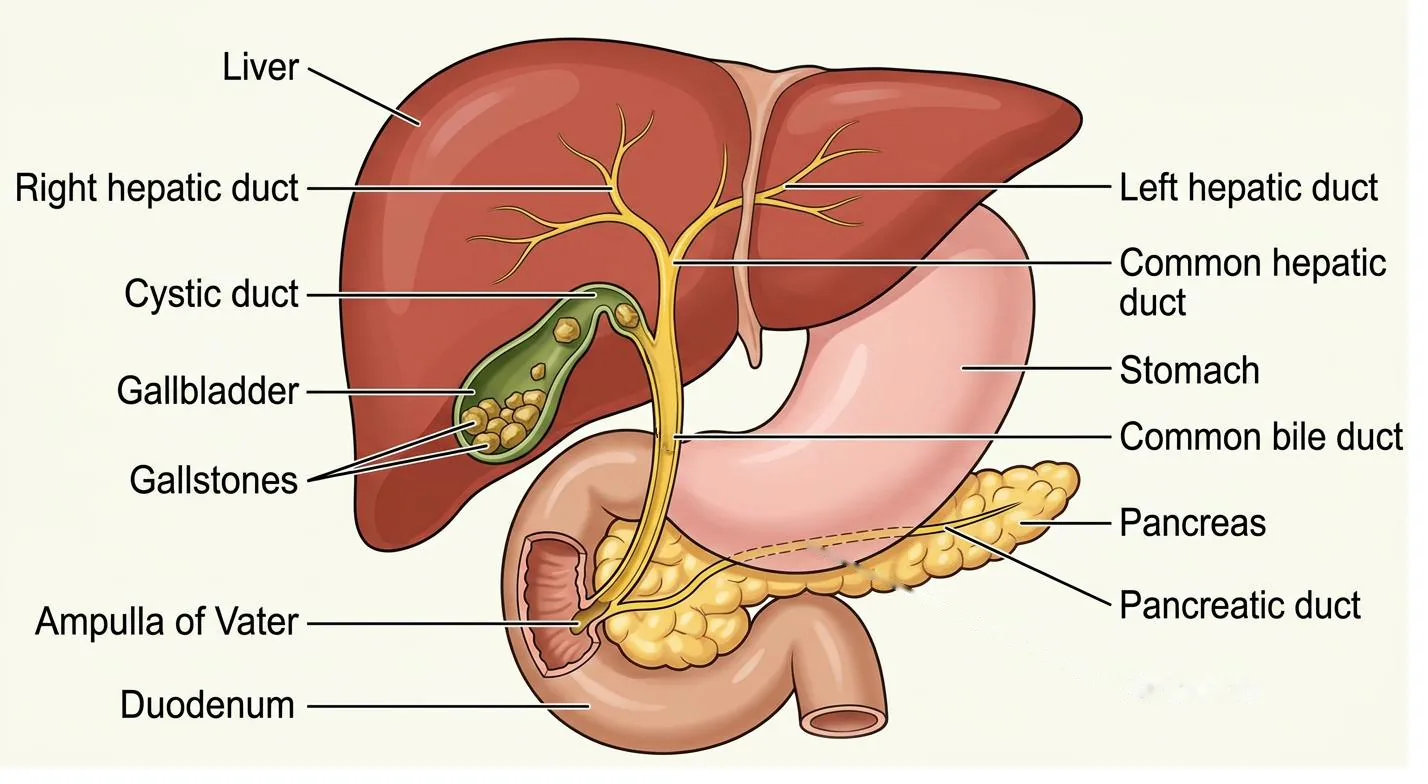
You have gallstones sitting in your gallbladder. When your gallbladder squeezes after a meal and a stone plugs the outlet, pressure builds up behind it. That pressure is the pain (Figure 2).
When the stone falls back into the gallbladder and the outlet opens, the pressure drops and the pain fades. That is why an attack usually lasts a few hours and then goes away. Between attacks, most people feel normal.
Nothing has been damaged yet. That is the key difference between biliary colic and the more serious problems stones can cause.
What is cholecystitis?
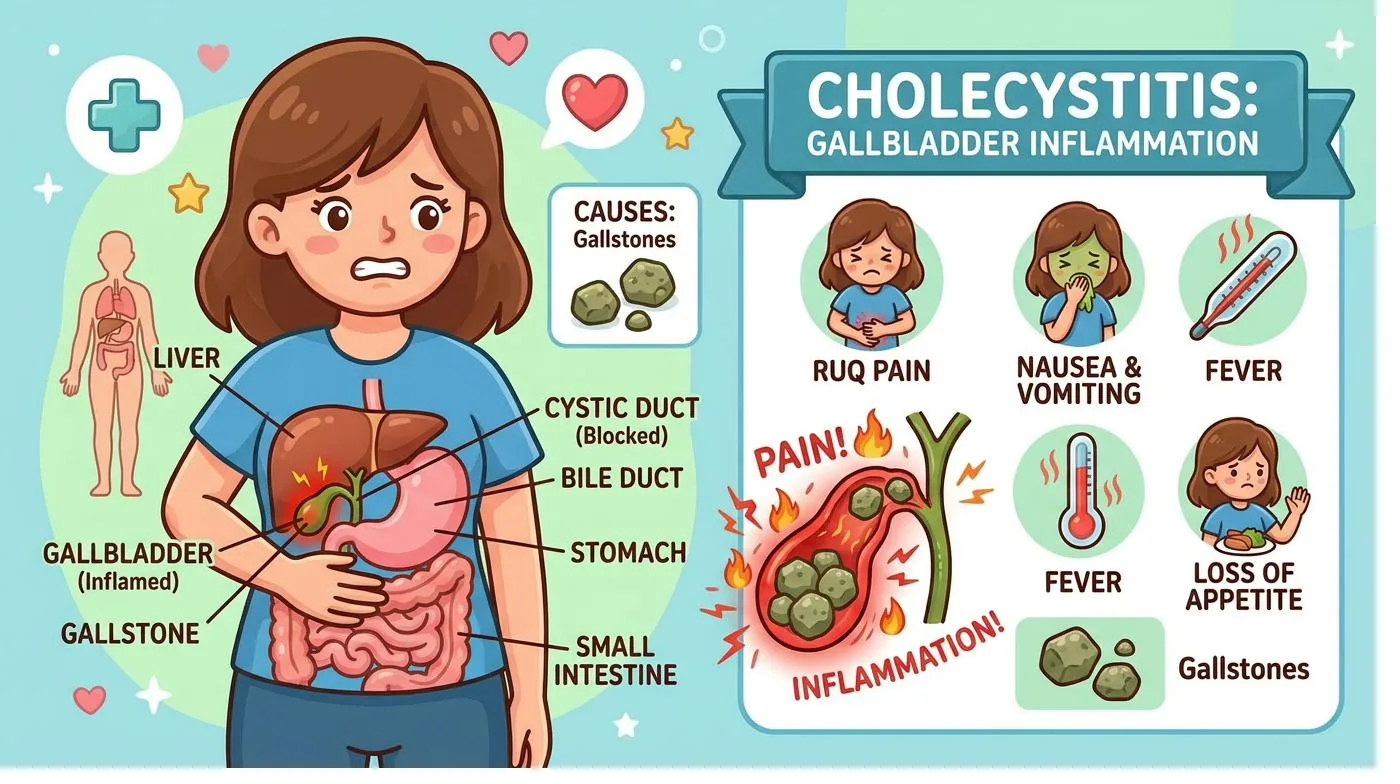
In cholecystitis, a stone wedges itself in the neck of the gallbladder and remains there. The bile trapped behind it has nowhere to go. The gallbladder wall becomes inflamed, and the trapped bile can become infected (Figure 3). That is why the pain does not go away the way an ordinary attack does, and why you may have a fever.
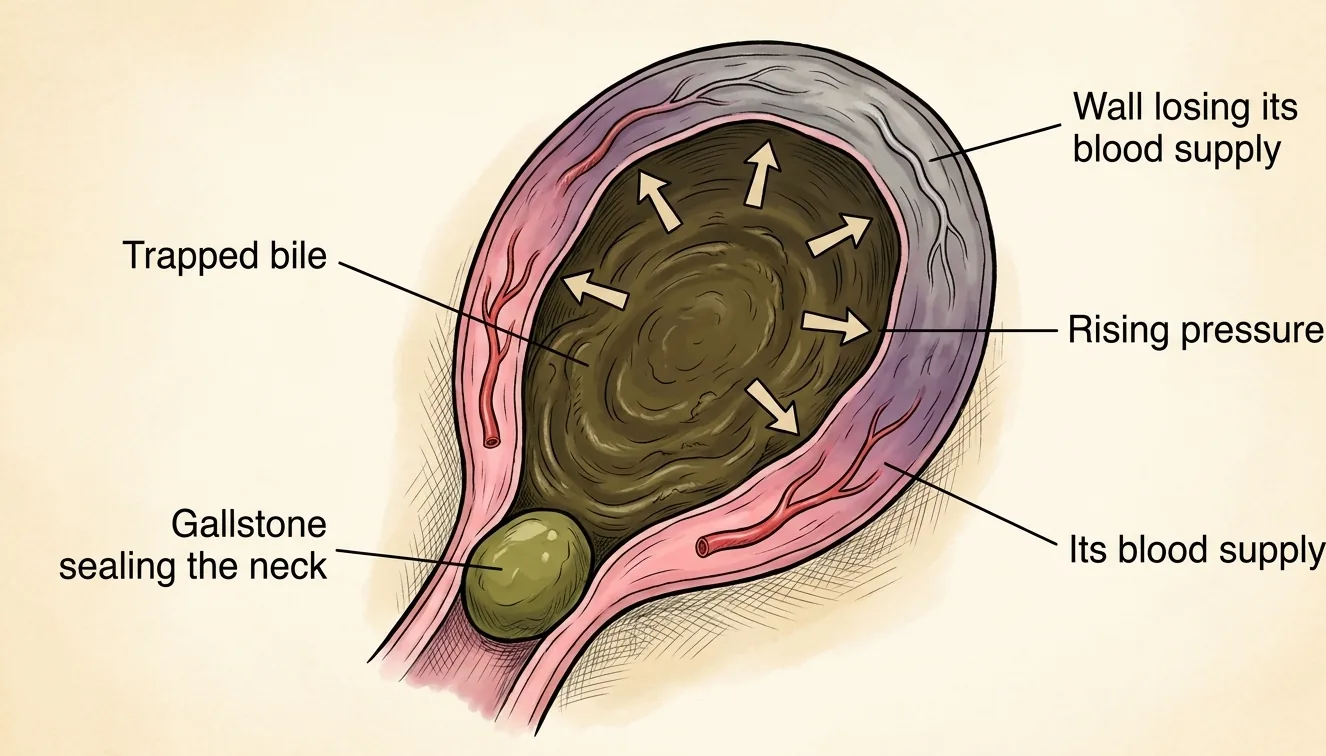
If nothing is done, the pressure inside the blocked gallbladder keeps rising and the wall starts to lose its blood supply (Figure 4). Rarely, an inflamed gallbladder can turn gangrenous. Rupture of a gangrenous gallbladder is very rare.
Side by side
| Biliary colic | Cholecystitis | |
|---|---|---|
| What happens | A stone blocks the outlet for a while, then falls back | A stone remains stuck, and the gallbladder becomes inflamed |
| The pain | Comes on after a meal, then goes away | Does not go away |
| Fever | Usually not | Often |
| Blood work | Usually normal | White blood cell count often high |
| Ultrasound | Stones | Stones, a thick gallbladder wall, fluid around the gallbladder |
| Treatment | Gallbladder out, planned around your life | Gallbladder out promptly, usually during that hospital stay |
How do doctors tell biliary colic from cholecystitis?
Your story, your exam, your blood work and an ultrasound, together.¹
- Your exam. With cholecystitis, the spot under your right ribs is tender when I press on it. When you breathe in while I press, the pain often makes you stop short. Doctors call this a Murphy sign.
- Your blood work. In biliary colic it is usually normal. In cholecystitis, the white blood cell count is often high.
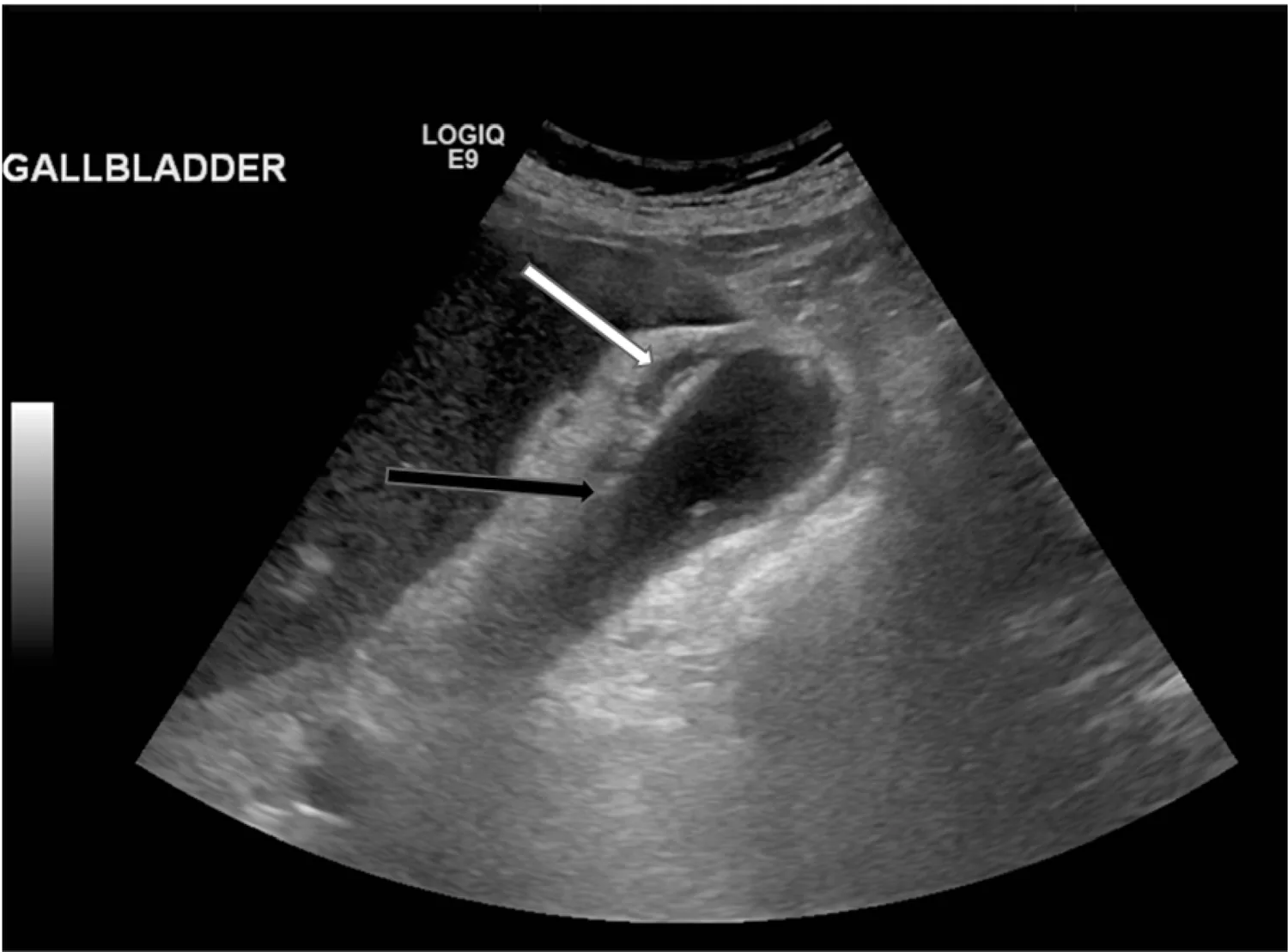
- Your ultrasound. It shows stones in both. Cholecystitis adds a thickened gallbladder wall and fluid around the gallbladder (Figure 5).
- When the ultrasound is unclear, a nuclear medicine scan, called a HIDA scan, that follows a small amount of tracer through your bile ducts can settle the question.²
Can biliary colic turn into cholecystitis?
Yes. Cholecystitis is the most common serious problem gallstones cause, and the risk of a serious problem is a little higher once stones have started causing attacks.³ Once attacks have started, they usually keep coming. The stones do not dissolve and they do not pass on their own.
How are biliary colic and cholecystitis treated?
Biliary colic. This is not an emergency. We plan your operation around your work and your family. If your attacks are rare and mild, waiting is reasonable, but most people who have had a few attacks go on to have more. There is no operation that takes out the stones and leaves the gallbladder; the gallbladder that made these stones would make more.
Cholecystitis. This one does not go on next month's calendar. The usual treatment is antibiotics and removing the gallbladder promptly, usually during the same hospital stay. Surgery done early is safer than surgery done after weeks of waiting.⁴,⁵ For someone who cannot safely have an operation, a small drain can be placed through the skin to empty the gallbladder. It relieves the emergency without fixing the cause.⁶ Occasionally the inflammation is severe enough that the safer plan is to treat it with antibiotics first and remove the gallbladder later, once the inflammation has settled. If that applies to you, we will go over the plan together.
Either way, I remove the gallbladder robotically, through small incisions. Here is how the operation works, step by step.
When should I go to the emergency department for gallbladder pain?
- If the pain does not stop, call your doctor.
- Go to the emergency department for fever or chills, yellow eyes or skin, or if you cannot keep anything down.
What this means for you
If you have gallstones and your pain comes and goes, you most likely have biliary colic. It is worth a visit with a surgeon, but it is not an emergency. If the pain does not go away, or you have a fever, that is no longer biliary colic. Get seen.
For more depth, read Biliary Colic and Asymptomatic Gallstones and Acute Cholecystitis: When the Stone Doesn't Come Free.
Part 2: Resident Pearls
Resident Pearls
1. Same stone, different duration. Biliary colic is transient obstruction of the cystic duct. Cholecystitis is persistent obstruction, with distension, wall inflammation and, in many patients, secondary infection. Gallstones cause cholecystitis in most cases; acute cholecystitis is the most common severe complication of symptomatic gallstones.³
2. TG18 makes the diagnosis a checklist. A: local signs (Murphy sign, right upper quadrant mass, pain or tenderness). B: systemic signs (fever, elevated CRP, elevated WBC). C: imaging findings. Suspected diagnosis is one item in A plus one in B; definite diagnosis adds C. TG18 kept the TG13 criteria and severity grades (I to III) unchanged because validation studies supported them.¹
3. Ultrasound first, cholescintigraphy when in doubt. In a meta-analysis of 57 studies (5,859 patients), cholescintigraphy had a sensitivity of 96% and specificity of 90%, against 81% and 83% for ultrasound. Only one CT study met inclusion criteria.²
4. Operate early. In the ACDC trial (618 patients), laparoscopic cholecystectomy within 24 hours of admission had 11.8% morbidity against 34.4% for antibiotics and delayed surgery at days 7 to 45, with a shorter stay (5.4 vs 10.0 days) and lower cost.⁴ The 2020 WSES guidelines make early laparoscopic cholecystectomy the standard of care whenever possible, including in older and higher-risk patients, and name subtotal cholecystectomy as a safe option in a difficult gallbladder.⁵
5. High risk is not the same as unfit. In CHOCOLATE (142 high-risk patients, APACHE II 7 or more), major complications occurred in 12% after cholecystectomy against 65% after percutaneous drainage, and reintervention in 12% against 66%. One-year mortality did not differ significantly (3% vs 9%).⁶
6. Natural history. Patients with mildly symptomatic stones develop complications at roughly 1% to 3% a year, and 6% to 8% a year come to cholecystectomy for severe symptoms in the early years.³
References
1. Yokoe M, Hata J, Takada T, et al. Tokyo Guidelines 2018: diagnostic criteria and severity grading of acute cholecystitis (with videos). J Hepatobiliary Pancreat Sci. 2018;25(1):41-54. https://pubmed.ncbi.nlm.nih.gov/29032636/
2. Kiewiet JJ, Leeuwenburgh MM, Bipat S, et al. A systematic review and meta-analysis of diagnostic performance of imaging in acute cholecystitis. Radiology. 2012;264(3):708-720. https://pubmed.ncbi.nlm.nih.gov/22798223/
3. Friedman GD. Natural history of asymptomatic and symptomatic gallstones. Am J Surg. 1993;165(4):399-404. https://pubmed.ncbi.nlm.nih.gov/8480871/
4. Gutt CN, Encke J, Köninger J, et al. Acute cholecystitis: early versus delayed cholecystectomy, a multicenter randomized trial (ACDC study, NCT00447304). Ann Surg. 2013;258(3):385-393. https://pubmed.ncbi.nlm.nih.gov/24022431/
5. Pisano M, Allievi N, Gurusamy K, et al. 2020 World Society of Emergency Surgery updated guidelines for the diagnosis and treatment of acute calculus cholecystitis. World J Emerg Surg. 2020;15(1):61. https://pubmed.ncbi.nlm.nih.gov/33153472/
6. Loozen CS, van Santvoort HC, van Duijvendijk P, et al. Laparoscopic cholecystectomy versus percutaneous catheter drainage for acute cholecystitis in high risk patients (CHOCOLATE): multicentre randomised clinical trial. BMJ. 2018;363:k3965. https://pubmed.ncbi.nlm.nih.gov/30297544/
7. Murphy MC, Gibney B, Gillespie C, Hynes J, Bolster F. Gallstones top to toe: what the radiologist needs to know. Insights into Imaging. 2020;11(1):13. https://doi.org/10.1186/s13244-019-0825-4
Dr. Rodriguez served as a speaker and educator for Intuitive Surgical through June 2025. He has no current financial relationship with the company.