Cholangitis is an infection of the bile ducts, the tubes that carry bile from your liver to your intestine. Cholecystitis is inflammation of the gallbladder. Both usually start with a gallstone, but cholangitis means infected bile is trapped behind a blockage, and that can spread into the bloodstream and make you very sick very quickly.
The names sound almost the same, which is why people mix them up. The treatment and the urgency are different.
Part 1 is for patients. Part 2 is for medical students and residents.
Part 1: Two words that sound alike
Follow the stone
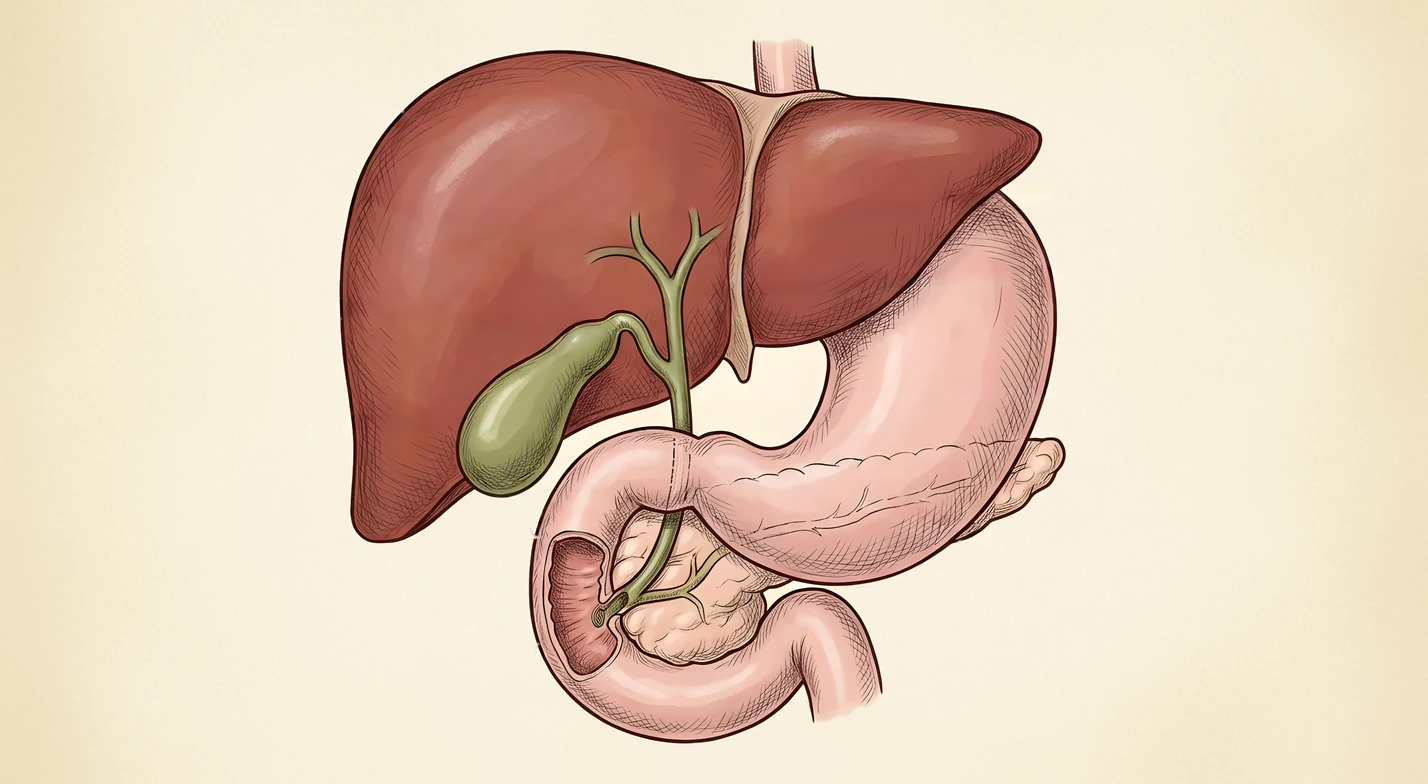
Pick where the stone goes, or press Play all to see the five steps. You will hear me explain each one. Step 3 is cholecystitis. Step 4 is a stone in the duct, and what happens when the bile behind it becomes infected.
Step 1
Stones form
Read the whole script
Bile is mostly water, mixed with cholesterol and bile salts. When there is more cholesterol than the bile salts can hold, or the gallbladder does not empty well, tiny crystals can form. Over time, these tiny crystals grow into stones. Having stones is not by itself a reason to take out the gallbladder. The time to talk about surgery is when those stones start causing trouble.
Stones can cause several problems. The first is what I most commonly see, where a stone gets caught in the neck of the gallbladder, and when the gallbladder squeezes against that stone, you can often feel pain, especially after a fatty meal. If that stone falls back into the gallbladder, the pain goes away. This is called biliary colic.
However, if that stone stays stuck in the neck of the gallbladder, inflammation can occur, and sometimes infection can result. This is called cholecystitis.
Sometimes a stone can leave the gallbladder and get stuck in the common bile duct. This can cause pain and because bile backs up, it can turn your skin and the whites of your eyes yellow. This is called choledocholithiasis, or a stone in the duct. If the bile in the duct becomes infected, this is called cholangitis, and this requires prompt surgical and medical evaluation.
Sometimes this stone travels down to where the bile duct and the pancreatic duct meet. It can block the pancreas from draining and the pancreas becomes inflamed. This is called biliary pancreatitis or gallstone pancreatitis.
What do the words cholangitis and cholecystitis mean?
Both words end in "-itis," which means inflammation.
- Chole-cyst-itis: "cyst" here means the bladder, so this is the gallbladder.
- Chol-ang-itis: "ang" means vessel or duct, so this is the bile duct.
What causes cholecystitis?
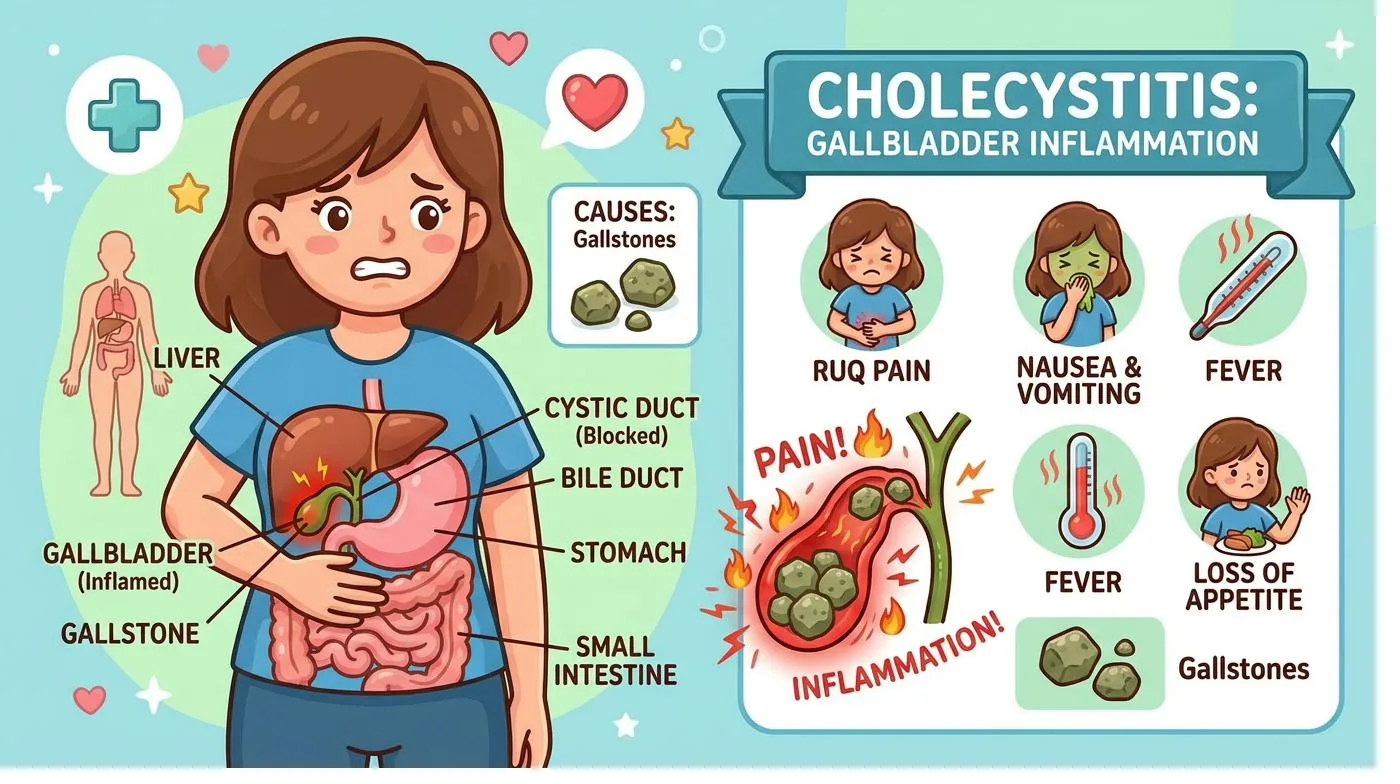
A gallstone plugs the cystic duct, the short outlet of the gallbladder, and stays there. Bile is trapped inside, the gallbladder swells, and its wall becomes inflamed (Figure 1). Gallstones cause about 95% of cases.¹
What causes cholangitis?
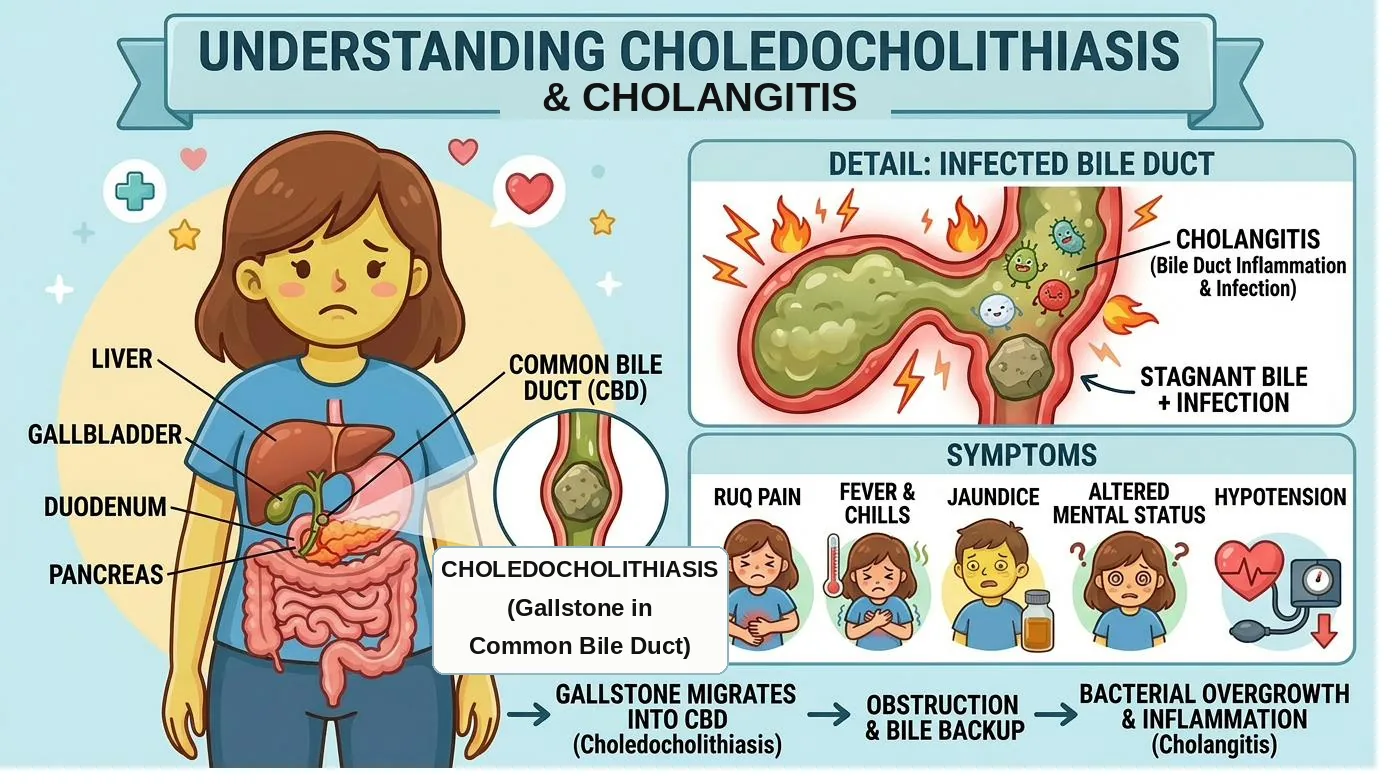
Cholangitis needs a blocked common bile duct (the main bile pipe) and bacteria growing in the bile trapped behind the blockage (Figure 2). The most common cause is a gallstone stuck in the common bile duct, called choledocholithiasis.²
How do the symptoms of cholangitis and cholecystitis differ?
Cholecystitis: steady pain under the right ribs that lasts for hours, often with fever, and tenderness when the area is pressed.¹
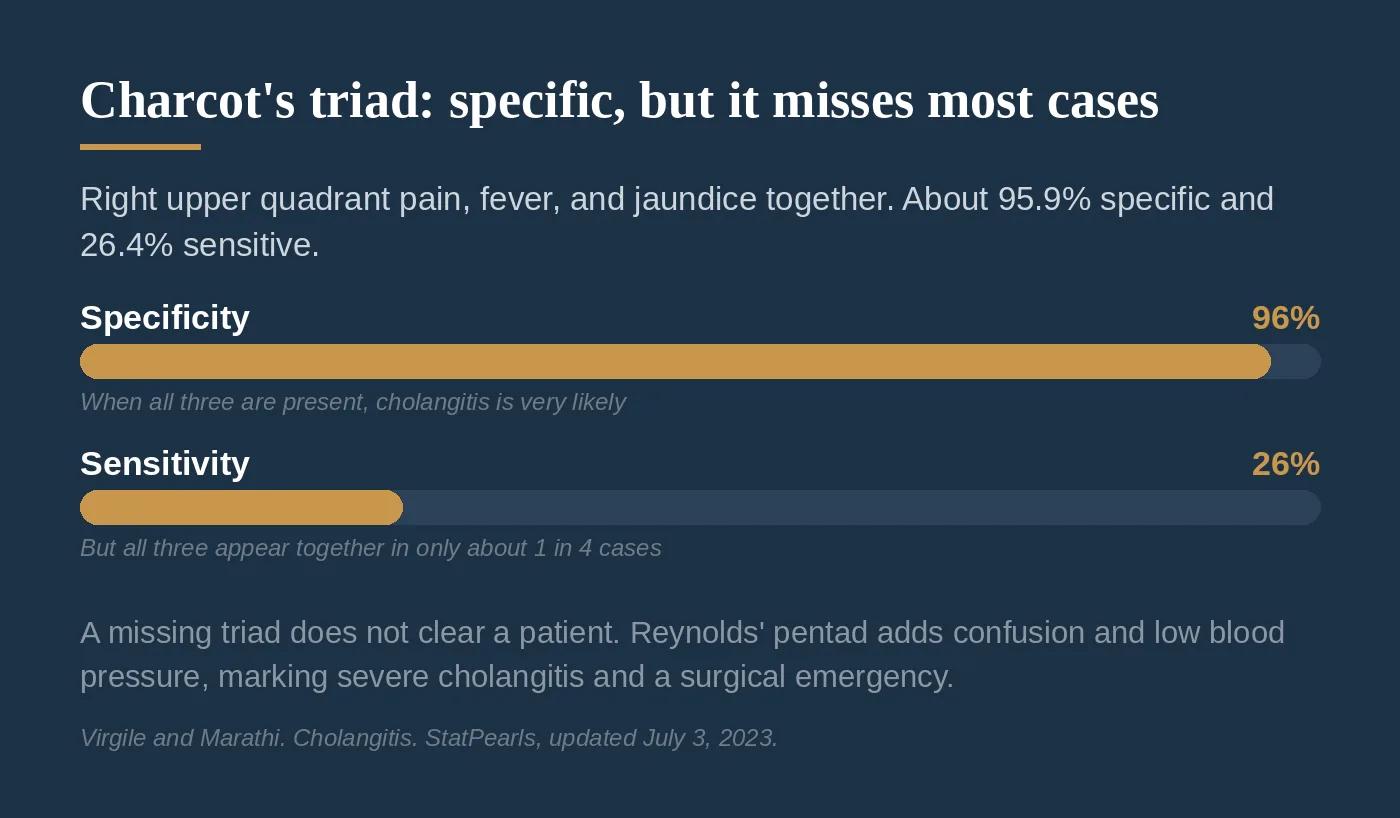
Cholangitis: the classic three signs are fever, pain under the right ribs, and yellow skin or eyes (jaundice). Doctors call this Charcot's triad. Many people do not have all three: about 90% have a fever and 60% to 70% are jaundiced, but only about one in four has the full set (Figure 3).² In the most severe cases, people also become confused or their blood pressure drops.²
How do cholangitis and cholecystitis compare side by side?
| Cholecystitis | Cholangitis | |
|---|---|---|
| Where | Gallbladder | Common bile duct |
| What is happening | Inflamed gallbladder wall | Infected bile trapped behind a blockage |
| Usual cause | Stone in the gallbladder outlet | Stone in the common bile duct |
| Typical signs | Right-sided pain for hours, fever, tenderness | Fever, right-sided pain, yellow skin or eyes |
| Urgency | Needs treatment in the hospital | Can become a bloodstream infection; an emergency |
| Main treatment | Antibiotics, then remove the gallbladder | Antibiotics, then drain the bile duct (usually ERCP) |
Is it a blocked bile duct or an infected bile duct?
Why is cholangitis an emergency?
The infection sits behind a blockage. Bile cannot drain, pressure builds in the duct, and bacteria can move from the bile into the blood. Antibiotics start right away. For mild cases, antibiotics are often enough. For moderate and severe cases, the duct needs to be drained.³
Timing matters. In the large Japanese and Taiwanese data behind the 2018 Tokyo Guidelines, patients with moderate cholangitis who had early or urgent drainage had a significantly lower death rate at 30 days.⁴ With drainage, overall mortality is under 10%.²
How are cholangitis and cholecystitis treated?
Cholangitis: IV antibiotics and fluids first. Then a GI specialist drains the blocked duct with ERCP: a flexible scope passed through the mouth into the small intestine to open the end of the bile duct and remove the stone. ERCP works in 94% to 98% of cases.² Once the patient has recovered from the infection, we treat the cause, which usually means removing the gallbladder.³
Cholecystitis: antibiotics and fluids, then surgery to remove the gallbladder. For most people that happens during the same hospital stay.¹
Your own care: these are the usual treatments. Reading this does not make you my patient or create a doctor-patient relationship. Talk with your own doctor or surgeon about what is right for you.
Can you have cholangitis and cholecystitis at the same time?
Yes. One gallstone problem can lead to another. About 13% of people with cholecystitis also have a stone in the common bile duct,⁵ and a stone in the duct is what sets up cholangitis. I explain that link in Choledocholithiasis vs. Cholecystitis and Choledocholithiasis and Cholangitis.
Who treats cholangitis first, the GI specialist or the surgeon?
When I am called to the emergency department for gallbladder pain, my first question is whether the problem is in the gallbladder or in the duct. The answer decides who goes first. If it is the gallbladder, I take it out. If the duct is infected, the GI specialist drains it first, and I remove the gallbladder once the patient has recovered from the infection.
When should I go to the emergency department for gallbladder pain?
- If the pain comes and goes, call your doctor or surgeon for advice.
- If the pain does not go away, call your doctor or surgeon, and go to the emergency department.
- If you have fever or chills, yellow eyes or skin, or cannot keep anything down, call your doctor or surgeon, and go to the emergency department.
- Call 911 for confusion or feeling faint with any of these.
Check yourself
Three quick questions
Tap an answer to see if you are right.
1. Which one is an infection of the bile duct?
Answer: "Ang" means duct. Cholangitis is infected bile trapped in a blocked bile duct.
2. Fever, pain under the right ribs, and yellow skin together have a name. What is it?
Answer: Charcot's triad. Only about one in four people with cholangitis have all three, so one or two of them is still a reason to get checked.
3. What usually treats a blocked, infected bile duct?
Answer: Antibiotics start right away. Moderate and severe cases need the duct drained, usually with ERCP. The gallbladder comes out after the infection is treated.
Part 2: Resident Pearls
1. Charcot's triad is 95.9% specific but only 26.4% sensitive. Fever with right upper quadrant pain and abnormal liver tests should start the cholangitis workup without waiting for jaundice.²
2. Early or urgent drainage was linked to lower 30-day mortality in Grade II cholangitis. In the TG18 validation data the difference was significant for Grade II, with no difference in Grade I or Grade III.⁴
3. Drainage controls the source in moderate and severe cholangitis. Mild: antibiotics are usually enough. Moderate: early endoscopic or percutaneous drainage. Severe: drainage as soon as the patient is resuscitated.³
4. TG18 places treatment of the underlying cause after the patient's general condition improves. That includes cholecystectomy for gallstone disease.³
References
1. Jones MW, Santos G, Patel PJ. Acute Cholecystitis. In: StatPearls [Internet]. Treasure Island (FL): StatPearls Publishing. Updated July 6, 2025. https://www.ncbi.nlm.nih.gov/books/NBK459171/
2. Virgile J, Marathi R. Cholangitis. In: StatPearls [Internet]. Treasure Island (FL): StatPearls Publishing. Updated July 3, 2023. https://www.ncbi.nlm.nih.gov/books/NBK558946/
3. Miura F, Okamoto K, Takada T, et al. Tokyo Guidelines 2018: initial management of acute biliary infection and flowchart for acute cholangitis. J Hepatobiliary Pancreat Sci. 2018;25(1):31-40. https://pubmed.ncbi.nlm.nih.gov/28941329/
4. Kiriyama S, Kozaka K, Takada T, et al. Tokyo Guidelines 2018: diagnostic criteria and severity grading of acute cholangitis (with videos). J Hepatobiliary Pancreat Sci. 2018;25(1):17-30. https://pubmed.ncbi.nlm.nih.gov/29032610/
5. LaGattuta N, Puri R, St Hill CR. Choledocholithiasis. In: StatPearls [Internet]. Treasure Island (FL): StatPearls Publishing. Updated September 8, 2026. https://www.ncbi.nlm.nih.gov/books/NBK441961/